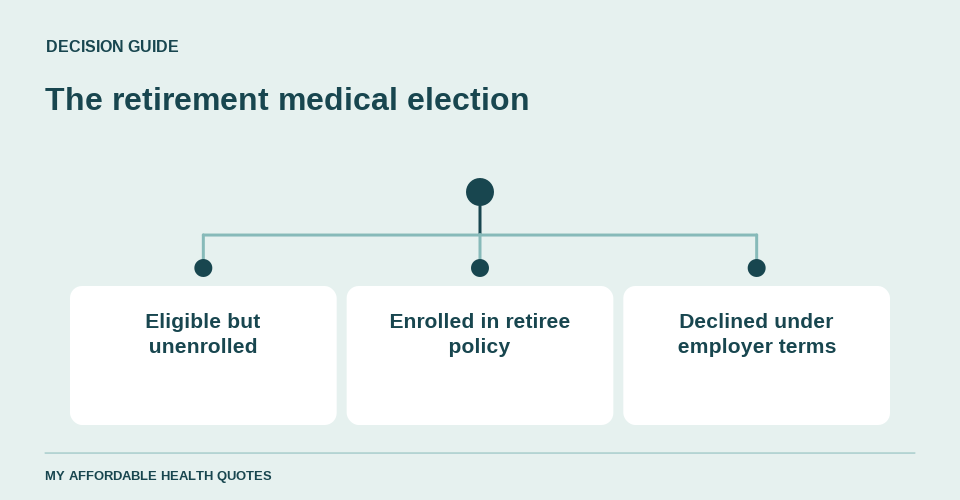
A Wyoming executive in her late fifties has spent months negotiating her exit. Her deferred compensation has a payment schedule. Her pension election has instructions. Buried in a separate packet is a short deadline for choosing an early-retiree medical plan. She and her spouse assume they can accept the retiree plan now and switch to an individual policy later if its network proves disappointing. The right question to ask before signing is whether those decisions can actually be reversed, and what it would take for each spouse to enroll in the alternative.
Identify the benefit behind the retirement language
Ask the former employer for the plan description, election form, rate sheet and written explanation of what happens if the executive declines. Determine whether the offer is an actual group retiree medical plan, temporary continuation of the active employee plan, a cash payment or a reimbursement arrangement. Those can look similar when an exit spreadsheet calls them all a health benefit. This discussion focuses on a group retiree medical plan offered to a person who retires before Medicare eligibility. An allowance used to buy an individual policy deserves a separate review under the rules for that particular arrangement.
Look for language about who is eligible to enroll. Is the offer based on the executive’s age and years of service? Must the person be covered by the active plan on the last day of work? Must an eligible spouse elect coverage at the same time? Some questions have more significance than the quoted premium. A household that declines an arrangement it can never enter later has made a long-term decision, even if the immediate choice is described as next year’s enrollment. Ask the administrator to point to the operative clause rather than relying on a colleague who retired under different terms.
Place the election beside the final employment dates
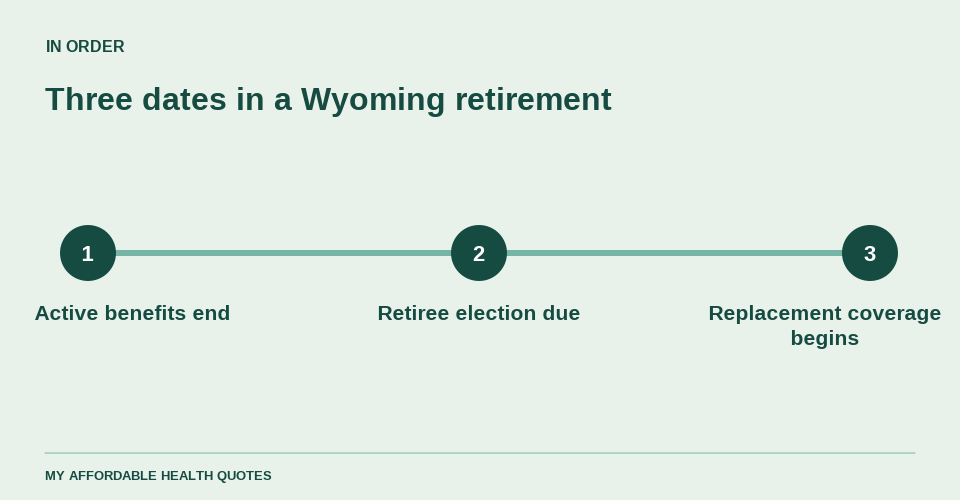
Record the last working day, the last day of active medical benefits and the deadline for the retiree election separately. Ask what the employer treats as receipt: a submitted form, delivery at a particular office or a completed online election with a confirmation number. If the packet contains several benefits, find out whether a pension election automatically affects the medical election. A person may be able to begin receiving a pension without choosing medical coverage, or there may be terms that link the two. The plan administrator can confirm which applies to the particular former employee.
Now ask what date the individual policy would start if selected. HealthCare.gov explains that losing active job-based coverage at early retirement can qualify a person to enroll in a Marketplace plan outside ordinary open enrollment. The facts and dates still need to be established with the Marketplace. Distinguish the qualifying loss of active coverage from a later voluntary decision to drop retiree coverage. The latter decision alone does not create the same opportunity. Do not build the retirement calendar around an assumption that testing the retiree plan for three months automatically creates a second choice whenever the household requests one.
Compare an offer with actual enrollment
HealthCare.gov makes an important distinction for retiree health coverage. A person actually enrolled in retiree coverage cannot get income-based Marketplace premium tax credits for that person for the same period. Someone eligible for retiree coverage who has not enrolled may be considered for Marketplace savings under the applicable rules. Household income and other eligibility requirements still matter. A high final working-year income may produce a different result from a later year. Ask the Marketplace about the actual household rather than treating the existence of the retiree packet as automatic approval or disqualification for assistance.
A deferred compensation payment may affect the household forecast, but it has a different job in this comparison. Bring the payment schedule and relevant tax information to a qualified tax professional to determine what income is expected to count for the year. The account’s total balance, a net bank deposit and the amount reported for tax purposes are different figures. Do not count all three as income or assume every payment belongs to the year the employment contract ended. Use the resulting expected annual income for the Marketplace inquiry and keep the benefits election deadline on its own calendar.
Ask the spouse’s question in the spouse’s name
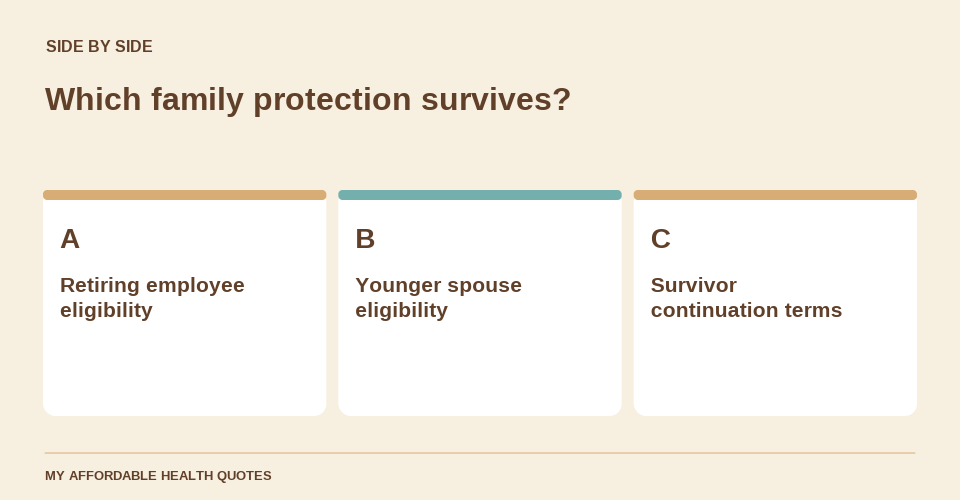
Suppose the executive is sixty and her spouse is fifty-six. They have quite different lengths of time before reaching a common Medicare planning milestone. Ask whether a younger spouse can remain on retiree coverage if the former employee later changes coverage, dies or becomes eligible for Medicare. If eligibility depends on the retiree remaining enrolled, determine what that means for the family’s later options. Ask for the terms for an eligible surviving spouse as well as the terms during the retiree’s life. These are questions about the employer’s written promise, not predictions about what will happen to this family.
A spouse with separate employment should also ask their own benefits office about any available plan and the rules for enrolling now or after a future change. Confirm the exact premium for adding the spouse or employee, any required supporting documentation and when coverage could start. Two adults need not automatically make the same election, but splitting coverage can create separate deductibles and networks. A quote for employee-only retiree coverage plus a private policy for the younger spouse may produce a better or worse household result than insuring both together. Calculate all eligible options on the same basis.
Inspect the network that retirement actually buys
The logo on a retiree card may match the logo on the active plan while the network or pharmacy benefit differs. Verify the primary care practice, any specialty clinic and the pharmacies each person uses. Give the carrier the retiree plan’s precise network description. Check the individual-plan finalists using the Wyoming residence and exact product names. If the household routinely leaves the state for a particular specialist, ask about that planned visit specifically. A statement about emergency care while traveling does little to answer whether the retiree’s established specialist can continue seeing them for routine follow-up.
Ask about ongoing authorizations and accumulated spending. Is retiree coverage a change in status under a continuing plan, or an enrollment in another plan? Do amounts already paid toward the active deductible carry forward? Will the existing approval for a scheduled service be recognized? The same questions apply when transferring to an individual policy. A carrier may reasonably need case details or active enrollment to make a particular decision. Mark those questions as unresolved instead of pricing them as certain savings. If a large service is imminent, ask the treating office what lead time it needs to verify coverage.
Compare the employer contribution, not just today’s deduction
Imagine the retiree arrangement costs a household eight hundred dollars a month and an individual-policy combination costs nine hundred per month before any confirmed assistance. The fixed difference is twelve hundred dollars over twelve months. Determine whether the employer is contributing a fixed dollar amount, a percentage of premiums or an amount that can change under the plan terms. An attractive current rate is useful information. A rate sheet for one year supplies much less information about how the household’s share might change over several renewals. Ask how annual changes are communicated and whether different rates apply to surviving spouses.
Separate expense from cash timing. One option may deduct premiums from pension payments; another may require a bank payment on a particular day. A delayed first pension check or a deferred compensation installment that arrives quarterly can create a short-term funding problem despite ample annual income. Request the first bill date, amount and payment route. Confirm how the administrator handles premiums due before payroll or pension deductions start. A written receipt that identifies the coverage month is much stronger evidence than a general recollection that money was taken out somewhere in the retirement process.
Save the evidence of the decision each person made
Before finalizing, write down what the household gives up by declining each option and which choices might become available again. If the employer will permit future entry only under named conditions, record those conditions and the source. If the household prefers an individual plan, obtain confirmation of effective dates and payment requirements before relying on it. If electing retiree coverage, save the submitted election, the dates each person is covered and the documents explaining how the spouse’s eligibility works. Keep those items with the medical records of the transaction rather than burying them in the executive compensation agreement.
When asking an advisor for Wyoming quotes, name the alternative accurately: an early-retiree group medical offer with a known election deadline. Give the household’s ages, residence, preferred care locations and expected coverage period. Ask for a gross premium first and a separate estimate of any assistance confirmed through the appropriate process. The executive can then judge three things independently: the value of the coverage itself, the price for the relevant year and the lasting effect of accepting or declining the former employer’s offer.
A final question belongs to the administrator who will still answer calls after the executive leaves. Find the retiree service contact and verify that it will have access to the election record when the old corporate email account closes. Store the contact, plan description and confirmation in a personal location. A few years from now, when the younger spouse needs an answer or the retiree rate changes, that record will be much more valuable than the farewell packet’s headline description.