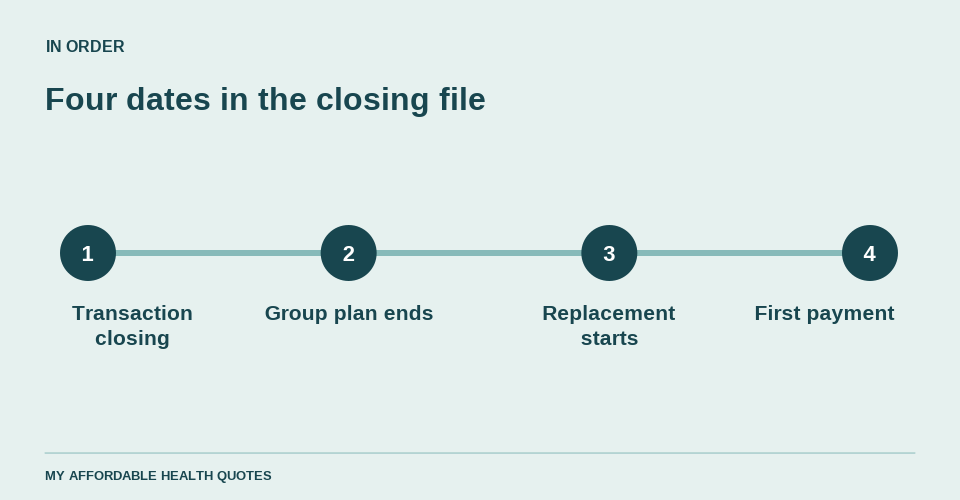
A business sale can produce a large payment and an immediate need for new health insurance. The purchase price does not answer the insurance question. An owner must establish when existing coverage ends, whether a buyer or former business offers continuing benefits, and what private plans fit the household afterward. At the same time, the tax adviser must translate the transaction into an income forecast. These tasks should be coordinated before closing rather than left until the final payroll has stopped.
For a Wyoming owner, the practical work often includes comparing individual coverage through the federal Marketplace and directly available ACA-compliant options. The appropriate route depends on eligibility, plan availability, and the household's needs. This guide addresses the handoff process, not how to structure a sale or reduce taxes. The transaction team should decide legal and tax treatment; the insurance comparison should use those decisions accurately without treating every dollar received as ordinary household income.
Ask what happens to the existing plan
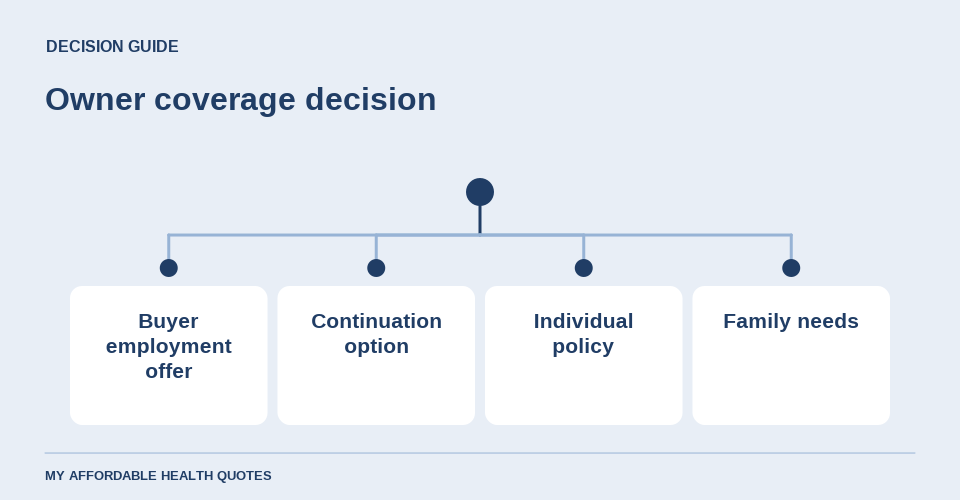
Start with the policy and employer arrangement currently covering the owner. A sale of business assets, a sale of ownership interests, and continued employment with the buyer can create different practical situations. Do not assume that because the business name remains on the building, the same benefit arrangement remains available. Ask the plan administrator or transaction counsel for a written explanation of the owner's eligibility after closing and the date any existing coverage ends.
If the buyer offers employment, obtain the benefit summary and eligibility date. A promise that benefits are part of the offer is not enough to coordinate a family member's scheduled care. If continuation coverage may be available, request the actual notice and premium information. Avoid relying on a verbal estimate from someone whose role is negotiating the purchase price rather than administering the health plan. The closing checklist should identify who is responsible for each benefits confirmation.
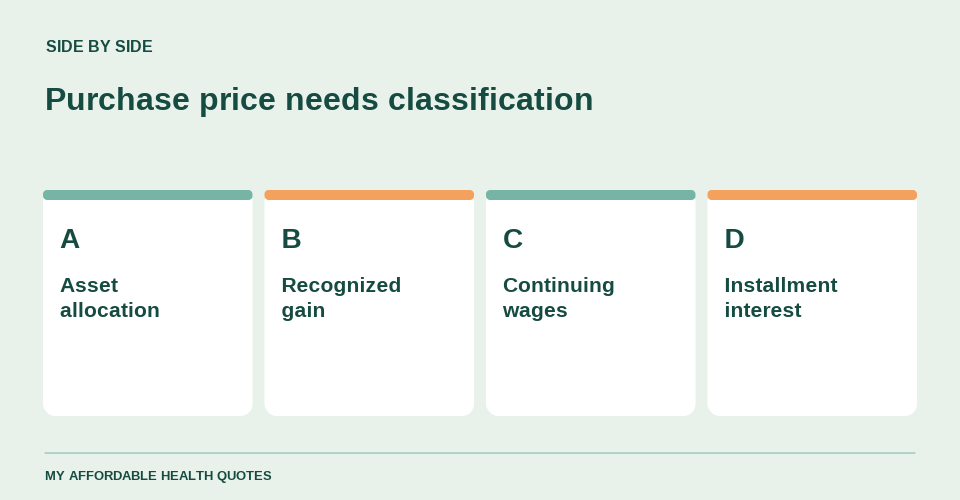
Separate the sale price into its relevant parts
The IRS explains in its business-sale guidance that a sale can involve multiple assets and tax treatments. An insurance worksheet should not simply copy the headline purchase price from the agreement. Ask the tax adviser for the expected amount and timing of income relevant to the household forecast. Retain a short explanation that distinguishes transaction proceeds from recognized income and identifies assumptions that are still unresolved.
There may also be wages, consulting payments, interest, or other amounts after closing. List them separately from the sale itself. A continuing advisory contract is not necessarily part of the same income category as payment for a business asset. The insurance agent does not need to interpret a complex purchase agreement. A concise, adviser-prepared forecast is more useful than a pile of legal documents with an instruction to find the right number.
A hypothetical closing calendar
Imagine a Wyoming owner who expects to close a transaction in September and remain available to the buyer for several months. The owner assumes the existing health plan will continue through year-end. During the benefits review, the administrator identifies an earlier end date. That discovery changes the coverage work immediately even though the purchase price and closing date remain unchanged. A replacement plan must now be evaluated sooner, including its network and start date.
The tax adviser separately explains that the transaction will not produce the same household-income result as the amount deposited at closing. The owner records the estimate, planned advisory compensation, and a spouse's income in one forecast. This example deliberately supplies no tax amounts: the useful lesson is the sequence of confirmations. The household needs both a valid coverage timeline and a supported income estimate. Neither can safely be inferred from the size of the closing wire.
Installment payments create a second planning year
If payments extend beyond the closing year, do not assume that income is recognized in the same pattern as cash receipts. IRS Publication 537 describes installment-sale rules and their limitations. Ask the transaction's tax adviser how the actual arrangement is treated, including interest and any components that follow different rules. The insurance forecast should reflect that professional analysis rather than a simple division of the sale price by the number of payment years.
Maintain separate forecasts for the closing year and the following year. The first may include salary, business profit, and a transaction event; the next may include different payment streams and little operating income. A renewal application copied from the closing year can therefore be as misleading as an application that ignores the sale entirely. Mark one-time amounts and continuing amounts clearly, and schedule a review when the final closing statement becomes available.
Keep the provider network on the transaction checklist
The insurance comparison should include the household's existing physicians, facilities, medicines, and anticipated treatment. An owner may have been covered under a group product for years and assume that a familiar carrier offers the same network individually. Verify the exact individual policy instead. If a family member uses a specialist outside the local area, ask about that specific provider and location. The company name on the card is not a substitute for a network check.
For a Wyoming household, geographic access can be central to the comparison. Write down where care is actually obtained, including any cross-state travel, and ask how each candidate policy handles routine and specialist services there. This is a question to verify for the specific plan, not a claim that every rural household needs the same product. Include travel time and appointment availability in the practical review alongside premiums and deductibles.
Budget without confusing wealth and available cash
A completed sale may improve the household balance sheet while leaving substantial obligations for taxes, debt, escrow, or future commitments. Identify which funds are actually available for premiums and medical bills. Do not choose a high patient-cost exposure merely because the purchase agreement contains a large number. The household should be able to explain how it would pay an early claim before relying on future installments or restricted proceeds.
Compare the full premium for each policy over the intended coverage period. Then estimate recurring care costs and examine the out-of-pocket limit for covered in-network services. Keep exclusions and out-of-network exposure visible. A short-term or fixed-benefit product should not be treated as equivalent to comprehensive coverage just because the monthly charge is lower. If such a product is discussed, ask for the actual contract and a clear explanation of what it does not cover.
Enrollment permission and effective dates need their own review
Losing qualifying employer coverage may create an enrollment opportunity, but the actual facts and timing must be evaluated. HealthCare.gov describes options after losing job-based insurance. A business sale itself is not a universal substitute for a qualifying event. Ask the Marketplace or insurer which enrollment rules apply and what evidence is required. Keep the coverage-end notice, not merely the business-sale announcement.
Confirm the new policy's start date before ending any coverage that remains available. Pay the required first premium and retain the carrier's confirmation. If the household chooses continuation coverage initially, ask how and when it could later move to individual insurance. Do not assume that canceling continuation coverage whenever convenient will create a new enrollment window. A written timeline makes these constraints visible while there is still time to compare alternatives.
Give each adviser a bounded question
The attorney can clarify transaction obligations and the benefit provisions in the agreement. The plan administrator can confirm eligibility and termination. The tax professional can classify income and forecast the coverage year. The licensed insurance agent can compare available policies and assist with enrollment. These roles overlap in conversation but should not be collapsed into one person's guess. A one-page summary with the latest confirmed answers helps the team work efficiently.
When an assumption changes, notify the people whose work depends on it. A delayed closing can alter the income forecast and the benefit timeline. A new employment agreement can introduce a different insurance offer. An amended payment schedule can affect future planning. Keep the summary dated so an old version does not circulate as though it remains current. This discipline matters most in the final days before closing, when many unrelated documents compete for attention.
Check the first month after the sale
After the transaction, verify that the new insurance account lists the correct household members and effective date. Give updated information to providers and pharmacies. Review any claims that span the old and new policies, and keep access to the former insurer's records for unresolved bills. At the same time, reconcile the actual closing statement with the income forecast and ask whether an application update is needed. Completing the sale does not automatically complete these administrative tasks.
For help comparing individual coverage after a Wyoming business exit, request assistance from My Affordable Health Quotes with the confirmed coverage-end date and adviser-supported annual income estimate. Keep transaction documents and sensitive tax records in the appropriate secure channels. The desired result is a planned handoff: benefits end and begin on understood dates, the household knows its costs, and the financial information behind the application can be traced to reliable records.
Put one person in charge of collecting coverage confirmations during closing week. Give that person the broker’s direct contact and a personal email address for the departing owner. After the sale, verify the effective dates shown for the owner, spouse and each dependent individually. A confirmation naming only the subscriber leaves an important question unanswered for the rest of the household.