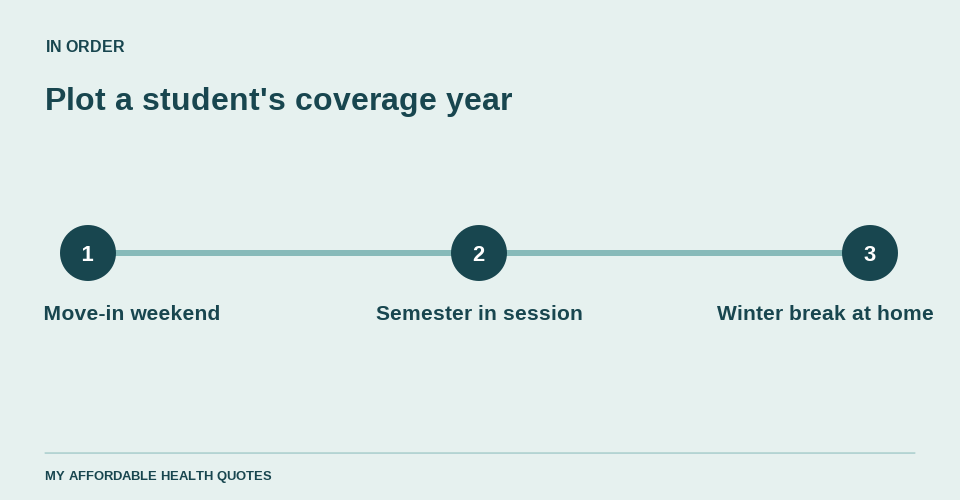
Before paying the university's health insurance charge or submitting a waiver, test the family's private plan at the student's school address. Being eligible to stay on a parent's policy is one question. Obtaining a routine appointment hundreds of miles from the family's network is another. A Wisconsin family can discover the difference before move-in by walking through a semester with its actual policy, the university's insurance documents, and the student's expected dates away.
In this example, two self-employed parents live near Madison and their adult daughter will attend an out-of-state college. Her parents expect her to visit Wisconsin during winter break and return to campus for most of the summer. They have a comfortable income, yet they would rather spend deliberately on usable coverage than learn after a bill arrives that their daughter has two cards and no convenient routine provider. The comparison begins with the student's schedule, not the parents' premium.
Ask the university what the health fee buys
Look at the bursar's bill and locate each health-related charge. A mandatory student health fee might help fund the campus clinic, while a separate charge enrolls an eligible student in a health insurance policy. A waiver might apply to one of these and leave the other in place. Ask the university which charge has a waiver, what evidence of comparable coverage it wants, and when it must receive the documents. Keep a copy of the requirements for the specific academic year.
Find out which campus services the student can use with only the health fee. An office visit might be available while imaging, lab work or outside referrals are billed elsewhere. Ask how a student receives care during holidays, evenings, a summer research term, or a period away from classes. A center that serves students well in October may operate differently during the break. Knowing its operating calendar avoids confusing the convenience of the clinic with the scope of an insurance policy.
Ask the campus staff for an example bill with all personal information omitted or for a plain explanation of a common referral. If a clinician orders a test that the campus cannot perform, where does the student go, who receives the order, and which insurer gets the claim? Write down the address and billing name of one likely facility. It gives the family a real destination to check instead of asking an insurer whether “college care” is covered.
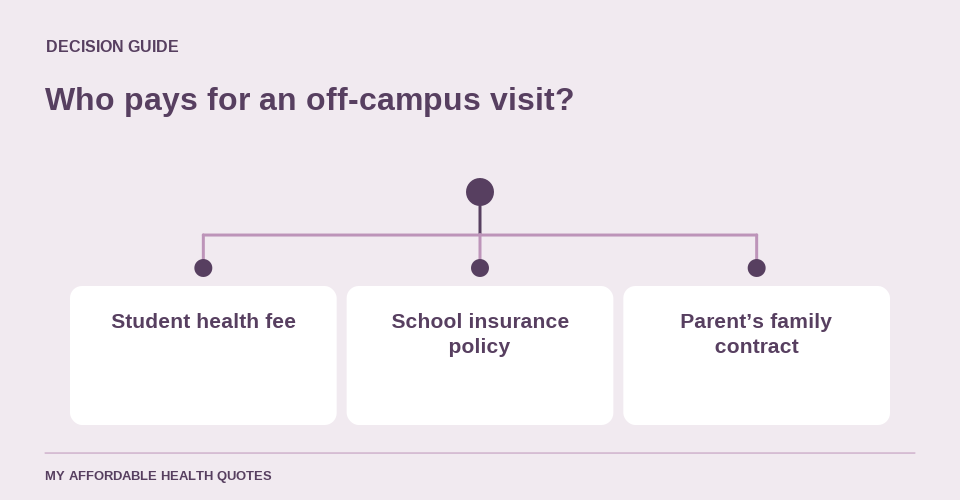
Put the home policy through three campus situations
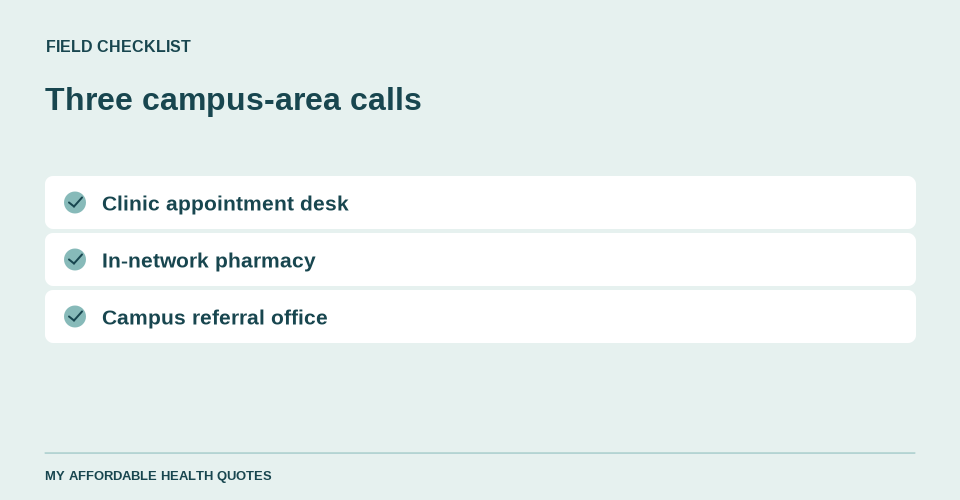
Start with an ordinary visit for a new concern that can be scheduled. Ask the family's insurer to identify a participating practice close to campus that accepts the exact product. Reach the practice and ask whether it sees new patients and how appointments are booked. A provider listed thirty miles from a dorm might be technically accessible and practically difficult for a student without a car. Check the trip on an actual weekday rather than measuring distance from one city center to another.
Next, investigate a regularly filled prescription. Use the relevant drug name, strength and form with the insurer's pharmacy tool or member team. Ask about participating pharmacies accessible from the student's housing and whether an existing prescription can be filled away from the home pharmacy under the plan. The pharmacist and prescribing clinician can address transfer or prescribing questions. Insurance participation alone does not establish that a specific medicine can be dispensed across state lines or on a particular schedule.
Finally, ask about an urgent problem after the campus clinic has closed. Identify nearby in-network urgent care if one exists and distinguish that service from emergency care. For a suspected emergency, seek emergency help promptly rather than waiting to resolve an insurance question. A policy's emergency protections do not establish that it covers routine follow-up at the same hospital's outpatient offices. Put an appropriate follow-up contact on the student's list even if the household is comfortable with emergency coverage.
Read the student insurance policy as if the family lived near the school
If the university offers an insurance policy, obtain its Summary of Benefits and Coverage, certificate and coverage dates. Ask whether it requires the school clinic to act as a starting point before outside specialist visits. If the student leaves campus for vacation, is a campus referral still required or is there an exception? How do telehealth, mental health, labs and prescription services work away from school? These are questions about that particular plan, not about student plans as a group.
Compare the academic calendar with the policy's effective dates. Graduation, a leave of absence, a transfer, or a change in enrollment status can affect eligibility or renewal. Ask the administrator what the policy says rather than relying on the date printed on a tuition statement. Students staying for a summer internship may remain in the same apartment while school enrollment and coverage rules change around them. The insurance year and the lease year solve different problems.
Test the opposite direction too. The school's network may be strong near campus but have limited ordinary care back in Wisconsin. The student might want to keep a longstanding clinician for an annual visit at home. The family plan may support that relationship more easily. Count the number of trips when it is actually feasible to see that clinician and learn whether continuity is important enough to change the insurance decision. Avoid assuming a brief holiday visit leaves time to arrange every needed appointment.
Work out what dropping one member would really save
Look at the family premium with and without the student under the actual policy. The difference can be smaller than a household expects and depends on how coverage is priced. If the family receives Marketplace assistance, ask the Marketplace how a change to the covered members or household circumstances would affect the calculation. Accurate tax household and residence information matters, especially where a student lives in another state. HealthCare.gov explains that college students' options depend partly on where they live and their tax situation.
For a hypothetical comparison, suppose the college policy costs an additional two thousand dollars for its coverage period. Suppose removing the student from the family plan would reduce household premiums by twelve hundred dollars over that same interval. The difference in premiums is eight hundred dollars before deductibles, possible trip costs and the price of care on either plan. If the family's premium would stay unchanged, the incremental premium is instead the full two thousand. These invented amounts explain the calculation only. Ask both plans about effective dates before projecting savings.
Keeping both policies deserves a separate inquiry. Ask each insurer how it handles coordination of benefits, how the student should present the cards, and whether a secondary payer requires a processed claim from the primary insurer. Two deductibles, two directories, and two sets of referral requirements may be involved. Holding a second policy does not guarantee every remaining balance is paid. Obtain instructions from the plans before assuming that either arrangement lowers the family's costs.
Give the student practical control of the plan
An adult student may wish to handle claims privately while asking a parent for help with payments. Discuss contact preferences and account permissions together. Ask the insurer what authorization it needs before speaking to a parent about an adult member's information and how the student can obtain explanations of benefits. Let the student decide who receives records and which numbers to call. The family can plan jointly without sharing account passwords or posting personal health details in a quote form.
Store a short, useful contact list on the student's phone. Include the campus clinic, the insurer's member number, the pharmacy, and any school insurance administrator. Record the practice names associated with the first routine appointments rather than a long list of every nearby hospital. If the student will visit a therapist by video, confirm where the student will physically be at the appointment and whether the clinician can serve someone there. HHS explains why a state line can matter even when the internet connection is unchanged.
Before completing the waiver, the Wisconsin parents and their daughter can answer one final question together: if the student needs care on a Thursday afternoon in November, what happens first, who pays the first bill, and who helps when something goes wrong? Ask the same question for a January visit at home. If one answer depends on an appointment the practice cannot actually schedule or a benefit neither insurer can confirm, keep investigating before surrendering an enrollment choice. For questions about an insurer regulated in Wisconsin, the state's Office of the Commissioner of Insurance provides a consumer complaint process. Bring the competing policies and the school waiver requirements to any quote discussion so that the chosen coverage fits both places the student calls home.
One last document is easy to overlook. Save the university's actual waiver decision alongside the evidence used to request it. A confirmation that the website received an application is different from confirmation that the waiver was approved and the charge removed. Check the student account after the decision and make sure the effective insurance arrangement matches what the family budgeted. Set a reminder ahead of the next year's waiver window, when the product name, the student's address, the university's requirements or the participating clinic could change.
At the start of term the student can save the health center's weekend instructions and locate the nearest participating option the family identified. Repeat that check when moving from dormitory housing to a semester-long placement or internship. The student's school may remain the same while the real starting point for an appointment changes by several hours. A current address gives the insurer a much better way to locate practical options.
Sources and further reading
- HealthCare.gov: Coverage options for college students
- HealthCare.gov: Comparing health plans
- HHS: Licensing across state lines
- Wisconsin Office of the Commissioner of Insurance: Consumer complaints