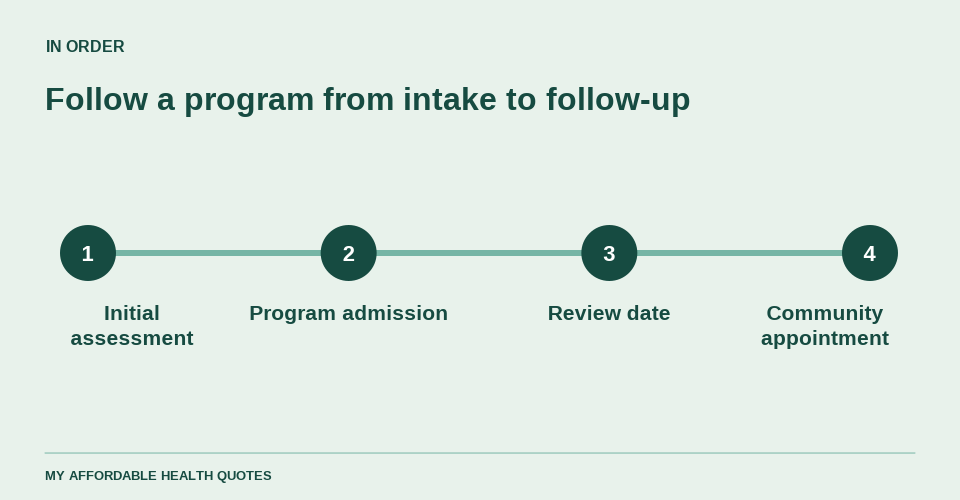
A therapist recommends that a patient be evaluated for an intensive outpatient behavioral health program. The patient's private insurer lists the treatment center in its directory. Somewhere between those two facts lies the question that matters to the household: can the patient get assessed, attend the recommended program on its actual schedule and continue care afterward? A center may run several programs at several locations under one corporate name. Being able to find its logo tells a family relatively little about the service it is trying to arrange.
Imagine a self-employed Florida architect whose care team has recommended an assessment. The architect has existing outpatient support and plans to continue discussing medical decisions with that team. This discussion follows a planned insurance and scheduling inquiry. Clinical decisions about level of care, immediate safety, treatment frequency and timing belong with qualified professionals. If someone needs emergency assistance, seek emergency care promptly. For a routine comparison of private quotes, the starting point is identifying the program the clinician has in mind and the specific question its assessment is expected to answer.
Identify the intended program instead of searching for the building
A treatment center might offer ordinary office appointments, intensive outpatient programs and services in other settings. Ask the referring clinician which kind of assessment they recommend, and ask the receiving program whether it conducts that assessment for someone with the patient's circumstances. Obtain the program name, the campus address, the billing entity and the contact who handles admissions. If a centralized line serves several Florida locations, ask which office will actually conduct the visit. The network may differ across locations, services or products even where branding and advertising look identical.
Ask what the intake appointment decides. Is it an administrative screening call, a clinical assessment, an evaluation that the insurer may bill separately, or an interview that takes place only after authorization? Find out whether completing it reserves a place. A program might review the record promptly but have a waiting list for the appropriate group schedule. The architect needs to know the next available assessment date and, separately, what the program can currently say about an admission date. The referring team should know about any delay so it can give appropriate guidance.
Ask the insurer to look up the level of service
HealthCare.gov explains that Marketplace plans include mental health and substance use disorder benefits, including behavioral health treatment. Its guidance also describes parity protections that apply to these benefits. Those protections matter, but a general statement about mental health coverage cannot establish that a particular program, at a particular location, will be approved for an individual. Ask the plan to identify its rules for the proposed level of care, the process for initial review and who can submit a request. Ask whether a separate behavioral health administrator manages the network or authorizations.
Use the full name of the quoted health plan, not just the insurer's national brand. Ask the administrator to verify the program itself, the location and any separately billing professionals the program identifies. If the quoted policy is outside the Marketplace, clarify what kind of coverage it provides and what contract governs the service. A salesperson's general description of private mental health benefits is not a determination for this care episode. If the plan needs an assessment before it can evaluate admission, record that condition and investigate coverage for the assessment separately.
Translate a proposed week into a usable calendar
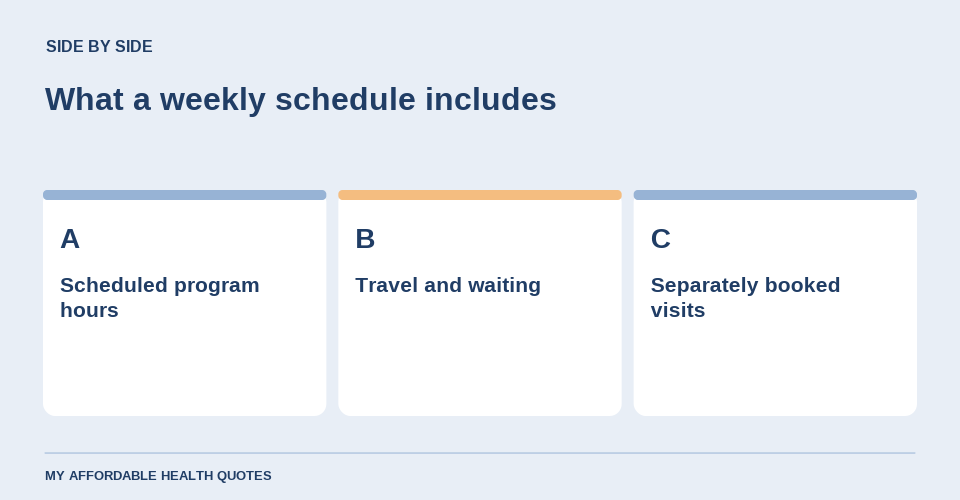
Suppose the center describes attendance on three mornings each week with an occasional individual visit at another time. The architect asks what start and finish times apply, how early a participant should arrive and whether every element takes place on the same campus. The actual schedule is the program's to explain. If the plan under review only offers a different location, ask that program for its own schedule. A directory cannot tell the family whether two options are equivalent in practice or whether a participant can attend consistently around work and caregiving.
Consider two fictional travel arrangements. At one site the round trip takes forty minutes and parking is predictable. At another the round trip takes ninety minutes and the family needs childcare for the entire visit. Multiply the travel difference across the expected week, then add the time the program itself has described. Record travel and childcare separately from insured medical cost. For someone billing clients by milestone, missed working hours may be recoverable on another day. For someone scheduled to attend inspections, a substitute may need to be paid. Use what the household will actually do rather than assuming that every hour away equals its usual billable rate.
Find out how the program measures an approved period
The program may describe a treatment schedule in weeks while an insurer communicates approval using dates or units of service. Ask the administrator to explain what has actually been approved, which services it includes and who requests review if more care is recommended. Get the program's description of how it communicates with patients near a review date. If the clinician recommends a different schedule later, ask how that change reaches the insurer. The patient should not be expected to convert a clinical recommendation into billing units without help from the program.
Then ask for an estimate that explains its assumptions. Is the member responsible for a daily charge, a percentage of an allowed amount or separate charges for different components? Does the estimate include the intake assessment? Could a separately practicing clinician bill for an evaluation? If a quoted amount assumes the deductible is already satisfied, check that assumption against the insurer's current information. For a family comparing a new plan year, model the accumulation period that will actually apply. Estimates for three visits to a conventional office do not automatically describe a week of services under a program benefit.
Keep permissions matched to the patient's preferences
A partner may help the architect manage client calls, drive to appointments and track the deductible. That practical assistance does not tell the program or insurer which information the architect wants shared. Ask the program how to authorize help with transportation or scheduling without sharing additional clinical details, if that is the patient's preference. Ask the insurer independently what access another person would need to discuss a claim. A patient may want substantial assistance early on and later prefer to manage arrangements personally. Both offices can explain how to change the relevant permissions.
For the household's own calendar, record the minimum information necessary for a driver or caregiver to act. A time, pickup location and callback number may be adequate. Clinical information and insurance documents can stay in a more private file. If two programs are under consideration, label each estimate with its program and billing organization so that a helper cannot accidentally call one center to discuss another center's assessment. A small amount of organization can reduce repeated disclosure and save the patient the work of correcting a misunderstanding across several busy offices.
Arrange the next appointment before the last program day
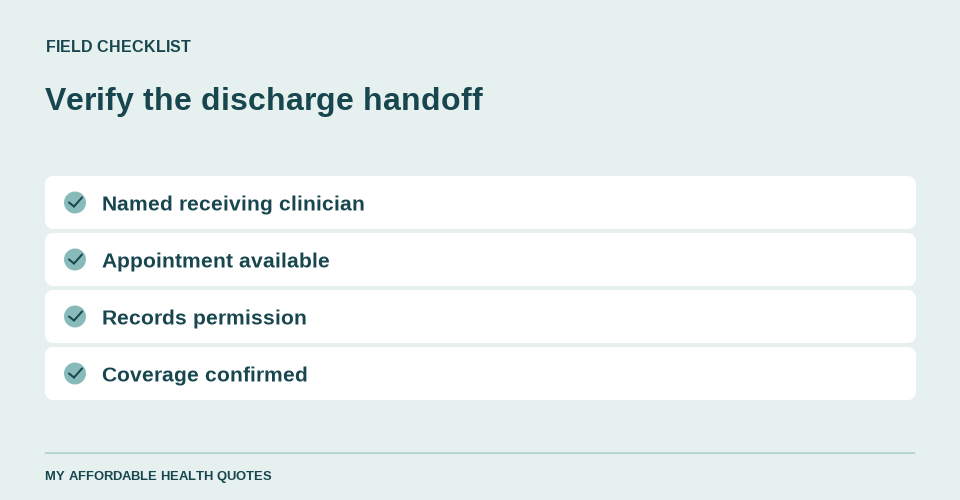
The architect expects eventually to return to less frequent outpatient visits, with timing and arrangements determined by the clinical team. Ask the program how it plans that handoff, whether the original therapist can resume visits and when the receiving clinician needs records or authorization. An established therapist may no longer hold the patient's former appointment slot. An insurer's directory may list another clinician without indicating new-patient availability. Check that the next appointment exists and the clinician is participating under the policy in force on that visit date. The person waiting for transfer should know whom to contact with ongoing care concerns.
If the insurer denies admission or continuation, request the written decision, the applicable criteria and appeal instructions. Ask the clinical team to address the immediate care plan while the administrative issue is reviewed. Keep track of the deadline and any expedited process that may apply to the circumstances. A complaint about a directory listing and a dispute about a clinical coverage determination may require different contacts. Florida's insurance consumer assistance service can help route state-regulated coverage questions. HealthCare.gov also describes how to challenge certain health insurance decisions and when additional review may be available.
A quote comparison is ready when the household can describe a plausible first week and a plausible handoff at the end. The first week has an assessment contact, a program site, a realistic attendance schedule and an understandable estimate. The handoff identifies the professional who can accept the next visit, the records that person needs and the insurance check for that appointment. A premium difference deserves consideration alongside those details. A glossy treatment center listing cannot replace any of them when a patient is trying to organize daily life around a real care schedule.
There is one more conversation worth having when the plan lists only a single participating program within traveling distance. Ask what the administrator does if that program assesses a patient but cannot offer a place within the timeframe the referring clinician recommends. Will a case coordinator search beyond the initial directory, contact another participating center or review a request involving an outside program? Who communicates the outcome to the clinical team and to the patient? Save the contact for that process alongside the admission number. If an opening falls through, the family can pick up the existing inquiry instead of restarting a search under the broad heading of counseling.
Sources and further reading
- HealthCare.gov: Mental health benefits
- HealthCare.gov: Marketplace benefits
- HealthCare.gov: Appealing a health plan decision
- Florida Department of Financial Services: Insurance help