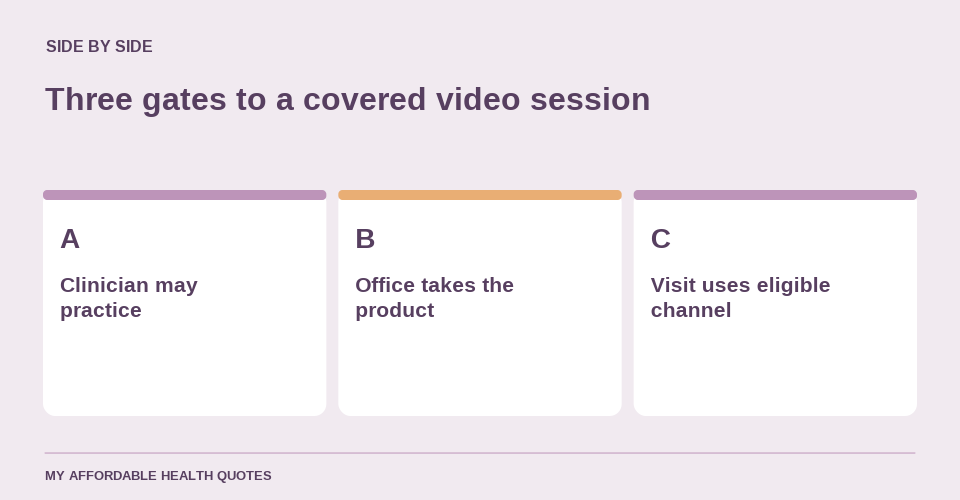
A video link that worked all summer may reach the same therapist when you are in Florida for winter. Whether the therapist can conduct that session and whether your health plan will pay for it are separate matters. Begin with the state where you will physically be during appointments, the clinician's professional status there, and the specific telehealth benefit of your policy. A nationwide phone number on an insurance card cannot answer all three questions.
Picture an independent software designer who spends part of the year at a Florida condo. Her primary residence and insurance policy are in another state. Before she commits to a three-month winter stay, she wants to know whether she can maintain a longstanding appointment schedule with her therapist. She also wants an answer she can rely on when choosing between private coverage options for the coming year. Her objective is continuity with a particular person, not simply a directory full of video providers.
Put the dates and locations on an actual calendar
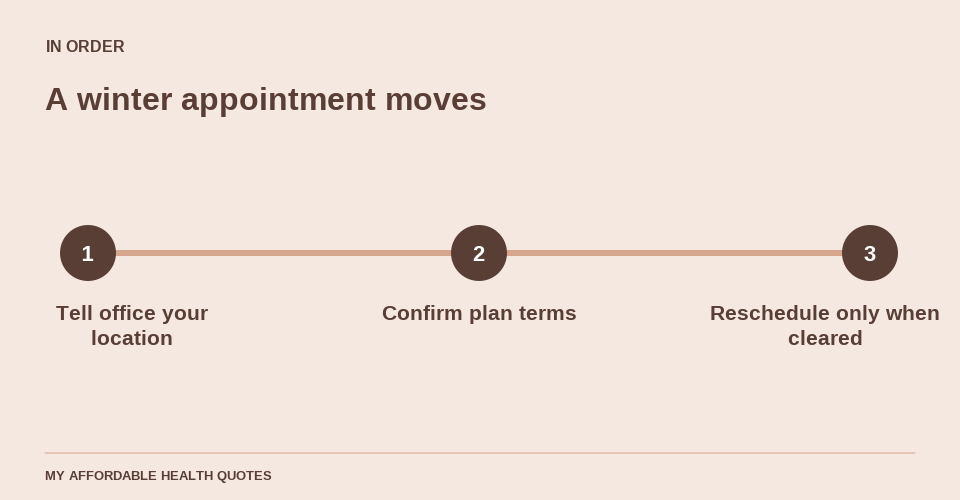
Write down the location from which you expect to attend each appointment. Include any week when you will be visiting relatives, attending a business conference, or driving between homes. The location that matters for professional licensing can be the patient's physical location during the appointment. HHS describes several ways professionals may be permitted to work across state lines and advises providers to verify the patient's location. A license in one state or a longstanding treatment relationship does not settle what another state permits.
Give the therapist's office the calendar before leaving. Ask whether the professional can see a patient who is in Florida, whether that answer depends on any registration or other authorization, and whether the office permits sessions from the proposed location. The clinician or practice is responsible for assessing whether it may provide care. You do not need to interpret a licensure compact yourself. If staff tell you permission is under review, keep those visits tentative instead of treating a recurring calendar invitation as acceptance.
Consider the session on travel day. The patient may leave one state in the morning and reach another that afternoon. A hotel room in transit introduces a third location nobody discussed. Moving the appointment to a different day may be simpler than resolving an entirely new jurisdiction. Discuss timing with the clinician so changes remain appropriate to the treatment relationship. A real location supplied honestly is more useful than the address printed on the identification card.
Ask what the plan means by virtual care
Some policies describe a telehealth service as a way of reaching participating clinicians through a designated platform. Others may allow a participating office to bill an eligible video service through its own system under specified rules. An advertisement for inexpensive virtual visits says little about which of these paths includes your therapist. Ask for the provision governing outpatient behavioral health and any telehealth policy or directory associated with your exact plan.
Offer the insurer a precise description: an established outpatient patient, a named clinician billing through a named practice, a scheduled session by live video, and a patient temporarily located in Florida. Ask whether the encounter is covered under these circumstances, whether the practice participates at the billing location it will use, and what cost sharing might apply. Do not substitute the name of a general telemedicine company for the actual billing practice unless the office confirms it uses that arrangement.
Ask separately about audio-only sessions, asynchronous messages and a portal service that lets a patient schedule advice from whoever is available. Each is a different service. A quoted copay for an on-demand general health consultation might have no bearing on a scheduled behavioral health session. If you prefer your established clinician, record the answer for that exact arrangement first. You can evaluate a different service as a fallback after the clinician explains whether it meets your needs.
Verify which parts the office can actually bill
Contact the billing team as well as the clinician. Ask which payer, network and service location it intends to use, whether it can submit claims from sessions conducted while the patient is away, and what happens if the insurer denies one. An office that is permitted to see a patient across state lines may still choose not to provide or bill that service. A clinician who participates at a group office might handle a separate private practice differently. Find out who issues the invoice.
Request the practice's written fee and cancellation terms. If the only available alternative is self-pay, ask what the stated fee includes and whether a bill suitable for submitting to an insurer is available. Then ask the insurer if the policy offers any eligible out-of-network benefit in this situation. An itemized receipt and a completed claim form make it possible to request payment; they do not establish how much will be reimbursed. Consider the whole charge in your budget until there is more evidence.
The software designer can now compare two hypothetical outcomes. Under one, eligible appointments have a thirty-dollar member share for eight scheduled sessions, or two hundred forty dollars under those assumptions. Under another, she would pay a privately agreed fee of one hundred fifty dollars per session, or twelve hundred dollars for eight sessions before any reimbursement. The example is not a price estimate for Florida therapy. It shows why verifying the identity of the clinician matters more than collecting generic video copays.
Give the fallback enough time to become real
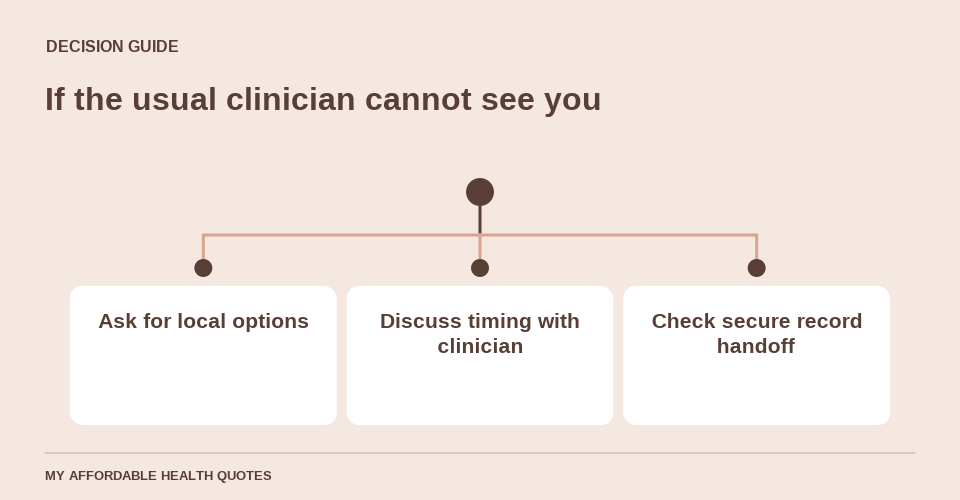
If the established therapist cannot provide care while the patient is in Florida, ask what options the clinician considers appropriate. A listed local provider does not guarantee an appointment before the trip. Contact a prospective practice about availability, the services it offers, whether a new-patient intake is required, and participation in your plan. Allow the patient and clinicians to decide whether a temporary transition makes sense. Insurance decisions should follow that discussion rather than dictate its outcome.
Check what it takes to share relevant information between offices. Some patients want the visiting clinician to receive a summary while others prefer to discuss details privately. Use the offices' secure processes for any authorized release. Ask who prepares the summary, how long that normally takes and how progress will be communicated back if the patient chooses. A consumer quote form is not the place to paste treatment notes or describe a diagnosis to a general audience.
Consider foreseeable changes to the trip. If the designer must return home earlier or remain in Florida longer, whom should she call first? A clinician's availability or authorization may change over time. The plan might also renew while she is away, potentially changing network terms. Set a date to recheck these facts before the first appointment under the next policy. Knowing who owns that check can prevent an old recurring appointment from being billed under an assumption nobody revisited.
Put service reliability and dollars on the same page
For each candidate policy write down the answer to four practical questions. Can my preferred clinician see me from my planned location? Can the practice bill this product for that encounter? What will I probably owe, and which part is still uncertain? If the visit cannot happen, how long would it take to arrange the next suitable option? A plan that looks expensive on premiums may be worth considering if the answers preserve essential continuity. A cheaper option might also work well when a confirmed local practice is available.
Take the plan's written response and ask the billing office whether it describes the same service the practice intends to submit. If the answer differs, invite each party to identify the disputed point precisely. One office may be talking about a clinician's professional permission while another is talking about the contracted billing group or platform. Resolving that mismatch is more productive than collecting another broad statement that virtual therapy is covered. For coverage questions about an insurer under its jurisdiction, Florida's Department of Financial Services offers consumer help; the regulator for a policy issued elsewhere may be different.
For the first eligible session, check the explanation of benefits when it arrives. Confirm that the service date, office name, amount allowed and patient responsibility match the arrangement you discussed. If the office charged in advance, use its receipt when reconciling the account. Early detection of a billing problem matters more when a series is planned; one incorrect claim can be corrected before it becomes eight. Keep sensitive documents in the insurer's or clinician's secure channel and limit your personal planning sheet to the facts needed for coverage.
At the end of the winter stay, tell the office when the patient will return to the original state. Confirm which location applies to the next scheduled session and whether any temporary arrangement needs to close. The task is complete when the patient knows who can actually provide the service on both sides of the trip, the practice and payer agree about billing, and the patient has a practical next contact if either answer changes. That is the level of detail worth bringing to a licensed agent when requesting next year's quotes.
For this comparison, a dated message confirming the appointment location and billing arrangement carries more weight than the words “virtual visits included” on a plan brochure. Save both, but base the winter budget on the more specific answer.
Privacy at the winter address also affects whether a scheduled appointment is usable. A seasonal rental may have shared rooms or unreliable connectivity at the hour previously reserved for therapy. Ask the therapist what setting and connection they need for the visit, and discuss what to do if the call disconnects. Establish those arrangements directly with the practice while confirming coverage and location rules with the insurer.
Sources and further reading
- HHS: Licensing across state lines
- HealthCare.gov: Comparing health plans
- HealthCare.gov: Marketplace benefits
- Florida Department of Financial Services: Insurance help