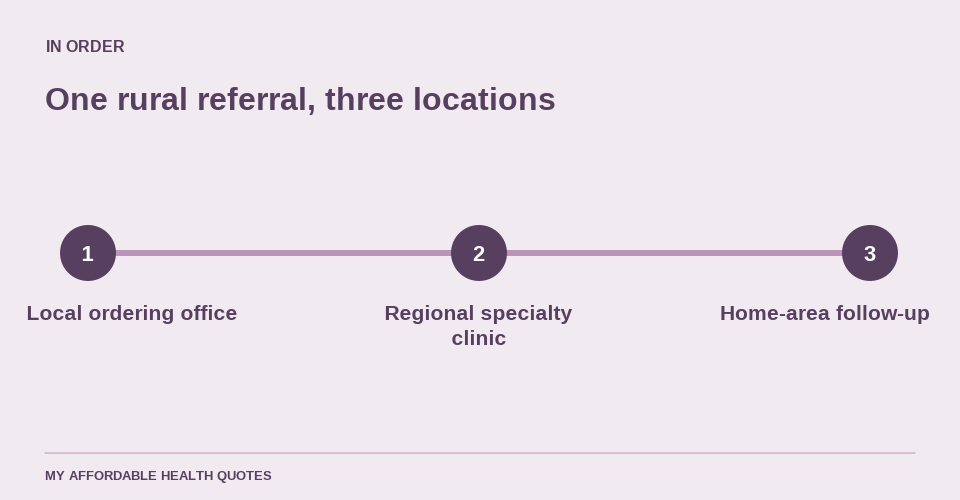
For a rural South Dakota household, a specialist listed in a directory can be several hours away. The relevant cost is the complete journey to obtain and use an opinion. It includes which appointments occur at the destination, which can be completed near home, how the results travel, and how many times someone must leave work. A quote comparison that stops at the specialist copayment will miss much of the decision.
Imagine a self-employed equipment dealer who lives outside a regional hub and has been referred for a nonemergency specialty evaluation. He can arrange transportation and take a weekday off, but he needs to coordinate a delivery schedule and a family member's availability. A closer office offers appointments only on selected days. A more distant center may be able to coordinate several services on one trip. Neither choice can be judged by mileage alone. This example is a way to compare access and is not a suggestion about which clinical services he needs.
Draw a trip with a beginning and an end
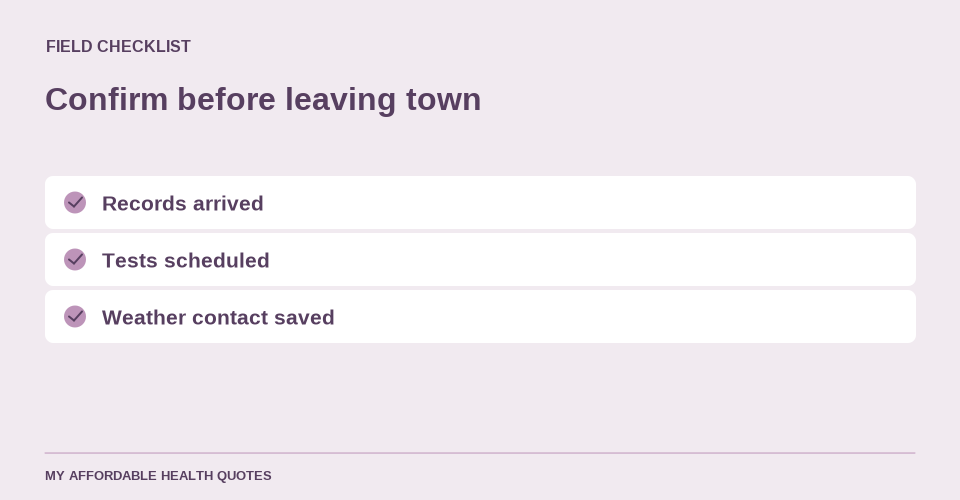
Ask the referring office what the receiving clinic needs before it will review the referral. It might want a recent report, prior images, a medication list or a particular intake form. Find out who sends each item and how the receiving office confirms arrival. An incomplete referral can turn a scheduled first visit into a planning appointment that produces another long trip. A phone call about missing material is cheaper than discovering the gap after a drive.
Ask the destination clinic to describe an ordinary first day for someone referred for this kind of evaluation. Is the specialist available in a single building? Could tests, if ordered, take place elsewhere? Does the clinic schedule such services in advance or decide after the consultation? Staff cannot guarantee a clinical plan before the patient is evaluated. They can usually explain the administrative sequence and tell you which offices handle each step. Write down those offices rather than labeling the entire trip with a hospital brand.
Then ask what usually returns home. Will a summary go to the local clinician? Who tells the patient what further appointments are needed? Can the referring practice arrange subsequent tests if clinically appropriate? Does the destination require another visit before discussing results? A return trip can be worthwhile if needed, but it should appear in the comparison as a possibility. A plan that supports more follow-up close to home could function differently from one with an identical specialist copayment.
Verify the plan at the level of each building
Start with the exact product offered for the household's home county. South Dakota's Division of Insurance provides consumer resources on health insurance, and individual market participation can vary by location. A plan available in another part of the state or under an employer contract may carry a similar name without being available to your household. Use the complete product name and network in each conversation. A statewide carrier name alone is not evidence that the distant clinic participates.
Verify the consulting practitioner, the billing practice, the facility address and any lab or diagnostic department you reasonably expect to use. The referring office may simply know that many of its patients go to the regional center. The insurer is better positioned to identify the network terms that apply to a particular contract. The destination can supply the names and addresses it actually bills under. Keep the two answers next to each other and follow up when one party uses a nickname the other cannot locate.
Ask whether the plan needs a primary care referral, advance approval, or use of a particular facility for certain services. Establish what can be confirmed before enrollment and what requires membership or a clinical order. If the carrier will only explain the general procedure, write that down rather than turning it into a favorable prediction. A formal request may depend on facts nobody has yet. The real question for the quote comparison is whether there is a workable process and what the family would need to do.
Put miles, hours and the plan estimate in different columns
For a hypothetical comparison, picture a ninety-mile round trip for each of three visits to the nearer office. That totals two hundred seventy miles. The regional clinic might require one two-hundred-mile round trip and a follow-up that can happen locally. The more distant site could involve fewer miles in total. If the first consultation leads to another regional visit, the arithmetic changes again. Count actual round trips rather than multiplying one-way distances by the number of appointments.
Now translate travel into household logistics. Does the appointment require two adults to be away from work? Is lodging necessary because the clinic begins testing early? Is someone available to stay with children, pick up livestock supplies or receive a scheduled delivery? These are personal expenses and time commitments. Keep them separate from medical cost sharing so that your own budget does not imply the insurance policy will pay for them. Ask for written terms if a specific policy describes a travel allowance.
Compare the plan's estimate using the appointment types and sites the clinic supplied. A physician's estimate may omit a separate facility amount. A family that has already met part of its deductible may face a different immediate charge from one starting a new coverage year. If you are choosing between future policies, use the same assumptions for both. Try an early-year trip and a late-year trip and identify which costs change. The comparison should still make sense when the timing moves by a few weeks.
Test the scheduling promise
Ask which steps genuinely can be combined. Two services inside the same medical center might use different scheduling systems, require separate orders or be available only on different days. A scheduler might offer a first appointment without seeing another department's calendar. Before committing to a trip described as coordinated, request an itinerary with the building addresses, arrival times and contact numbers. Ask which appointments have been booked and which are still conditional on a clinician's decision.
Leave room for travel conditions without making assumptions about care. Get the destination's policy for cancellations related to road conditions or weather and ask how to reach a person if a delay becomes likely. If an appointment moves, will any existing insurance authorization still cover the new date? Would a missed test also move the follow-up consultation? A long-distance patient needs a clear recovery plan for the schedule. The clinical team can advise on any concerns about delaying care; a calendar or cost calculator cannot.
Find out whether a follow-up proposed by video is available from the patient's actual location and whether the plan and office agree about billing. If the receiving specialist practices across the state line, professional authorization can depend on the patient's physical location. HHS explains the options available to practitioners across state boundaries. Do not assume that a video appointment on the printed itinerary has been checked against the plan product or the clinician's ability to see the patient after returning home.
Verify what the household will have in hand afterward
Request a specific handoff. Who receives the report, who communicates results, and which office can answer billing questions after the trip? If follow-up imaging or lab work is approved near home, ask whether the destination accepts the local facility's format and whether additional interpretation fees may apply. You are trying to avoid both needless repetition and mistaken assumptions about what a distant specialist can use. Clinicians should decide whether a repeat service is medically appropriate.
For the equipment dealer, one realistic purchasing test is to call two candidate plans with the same referral map. Under each, list the nearest office that is both participating and taking appointments, the center that can handle the more complex evaluation, the practical return options and the number of significant unknowns. The cheapest monthly premium might still be appropriate if the household prefers its verified route. The higher premium might offer little additional value if the key clinic cannot schedule the patient. Let the actual itinerary explain the trade-off.
If plan documents and a directory disagree, ask for clarification in writing and keep dated evidence of the specific listing. Contact the insurer first for its explanation and use its internal review procedures for an actual adverse decision. South Dakota's Division of Insurance publishes complaint and consumer guidance describing when it can assist. A regulator, agent or clinic can help more effectively when given the product, place of service, reason for the inquiry and dates. These details are more useful than a claim that a whole company has a bad network.
Before requesting quotes, boil the exercise down to one sentence you can give the agent: “I need a plan that supports a local starting appointment, a regional specialist at this location, and a practical return path for these likely services.” Add your own limits on travel days and what you can spend if the trip changes. Those constraints turn an advertised network into a comparison grounded in the life you need to keep running at home.
When the referral is complete, use the actual bills and travel dates to revise your estimate. That record can guide the next renewal more reliably than a directory search performed long before you understood the route.
For a winter appointment, ask the receiving clinic how it communicates weather-related closures and whether a canceled visit keeps its place in the scheduling queue. A refundable room and the contact details for rescheduling can matter more than a small difference between quoted nightly prices. The clinician should advise what to do about the care interval if travel conditions prevent the original visit.
Sources and further reading
- South Dakota Division of Insurance: Consumer resources
- HealthCare.gov: Comparing health plans
- HealthCare.gov: Summary of Benefits and Coverage
- HHS: Licensing across state lines