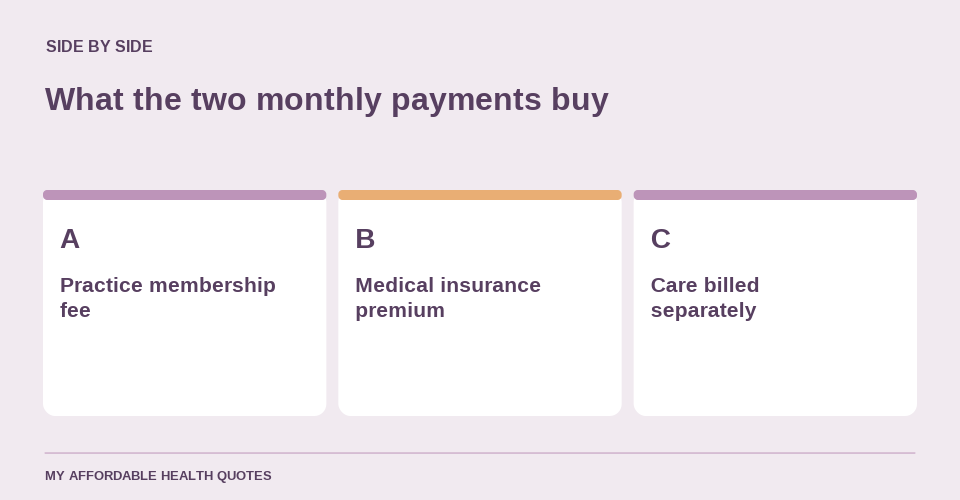
A Virginia fractional chief financial officer likes the idea of paying a physician a monthly fee for primary care. Forecastable expenses are familiar territory. What is harder to forecast is the boundary between the membership and the private health policy the household is also considering. Can the doctor send the patient to a specialist under the plan? Does a blood draw include the laboratory analysis? Would a family member who rarely uses primary care benefit from joining? Read the agreement and the insurance policy as two purchases responding to different parts of the same care journey.
Ask what creates an entitlement to an appointment
Start at the practice. Request the proposed agreement, its effective date and a written description of included services. Ask when new patients can book their first visit, how the practice handles messages and what a member should expect if the usual clinician is away. A monthly fee may purchase access to a defined set of primary care services under the contract. The details matter for a consultant who spends much of the week in client meetings. A promise of a quick reply during business hours serves a different need from a scheduled extended appointment on a particular morning.
Virginia law addresses agreements under which a patient or certain other parties pay a periodic fee for ongoing primary care. Read the statutory description and the required agreement disclosures. A qualifying direct primary care agreement is distinct from comprehensive health insurance. Even if the member relies heavily on the practice, the agreement needs to be evaluated for the services it actually includes. Ask the office whether it separately participates in the network on the insurance quote, and whether it submits claims for anything. State law permits certain network participation, but that possibility does not establish this physician’s arrangement.
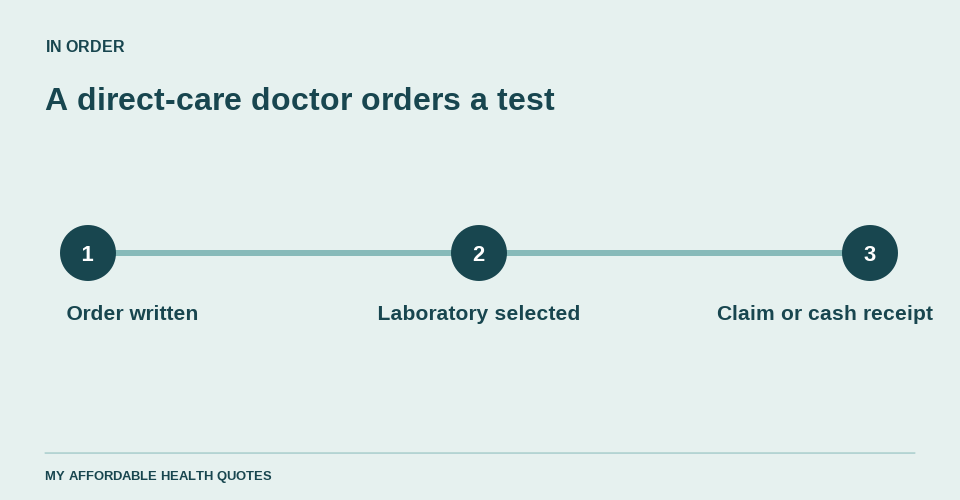
Follow a blood test from order to result
Consider an ordinary example. The member sees the physician for a scheduled visit. The physician decides a blood test is clinically appropriate. The practice can draw the specimen, but another laboratory may perform the analysis. Ask four concrete questions. Is the visit included? Is there a collection charge? Who bills for the actual test? Is discussing the result covered under the agreement? A clinic can handle the entire interaction smoothly while separate parties handle the money. The answers may depend on whether the member accepts a cash arrangement or asks for a covered lab service through the insurance plan.
Now ask the prospective health insurer which laboratories participate for the exact product. Can an order from this practice be used at a participating laboratory? Are there requirements relating to the ordering clinician or laboratory location? If the practice advertises a low cash price for a particular test, ask what it includes and whether the purchase will produce an insurance claim. A cash arrangement may be attractive in its own right. It should enter a budget as an out-of-pocket payment unless the insurance carrier confirms an applicable process for credit or reimbursement under the policy.
Examine the referral before you need it
A direct-care clinician might refer the member to a cardiologist, dermatologist or another specialist. Giving a patient a clinical recommendation is one action. Satisfying a particular plan’s referral or authorization rules is another. Ask the insurer whether it requires an assigned primary care provider, whether the direct-care clinician can serve in that role and how an eligible referral must be submitted. A flexible practice model does not override a policy requiring specific administrative steps. If another participating primary care provider must be involved, understand what that means for attendance, records and possible additional expense.
Use a plausible example drawn from the household’s own routine. The consultant would like the direct-care physician to coordinate ongoing care with an established specialist in Richmond. Confirm the specialist and address under the policy. Ask the specialist’s office what it needs to schedule and the direct-care practice how it transmits records. If a referral expires, determine who owns the renewal. Each party can be competent and responsive while their processes still fail to connect. A clear explanation from the insurer about the specific handoff has more value than a general assurance that the doctor refers anywhere.
Compare the total annual arrangement
Take invented figures for an adult, using twelve full months of enrollment. A direct-care fee of ninety dollars a month costs one thousand eighty dollars a year. Suppose one insurance policy costs sixty dollars a month less than another. The annual premium difference is seven hundred twenty dollars. Buying the lower-premium policy plus the membership would still cost three hundred sixty dollars more in combined fixed payments than buying the higher-premium policy alone, before considering care. That result can be perfectly reasonable for the household. It should simply be visible before making a decision.
Add plausible expenses under each arrangement, such as a separately billed laboratory test, a specialist visit and the insured share of outpatient imaging if ordered. Use the specific policy’s benefits and realistic allowed amounts where available. Avoid treating the annual deductible as a bill that necessarily arrives every year. Also avoid assuming every dollar paid to the practice reduces the deductible. Ask the insurance carrier what it recognizes and keep expected monthly payments separate from possible costs when care is used. This gives the household a clear view of fixed commitments and remaining financial exposure.

Decide who in the household actually joins
A family discount can obscure who receives which services. Confirm whether pediatric care is available, which clinicians see which ages, whether each person signs an agreement and what happens when an adult dependent moves elsewhere. A partner who spends weekdays near another office might prefer an in-network practice closer to work. Another partner might value longer visits enough to join alone. Compare adult-only, selected-family-member and whole-household pricing where those options exist. Separate insurance premiums from optional membership charges so the family can see the cost of adding each person.
Access to records also matters. Ask how adults communicate privately, how parents obtain access for a child and what happens to portal access as family circumstances change. A practice willing to text members may still need secure channels for certain documents. If the consultant is buying a membership for a spouse, let the person receiving care decide how they want the practice to contact them. A shared business inbox makes poor sense for sensitive messages. Ask what number the office uses for routine communications and how to reach it if the member’s usual clinician is unavailable.
Consider the care neither contract promises to provide at the practice
Ask how the office advises members to handle a possible emergency and what after-hours support actually means. Emergency care belongs with appropriate emergency services and should never be delayed to obtain a membership appointment. For ordinary planned specialty treatment, a surgical facility and treating specialist can each have their own participation status and charges. The direct-care physician might help coordinate records or interpret the next step without paying any of those bills. Read the medical policy for the costs and network that would apply to hospital, specialist and prescription services.
If the practice dispenses certain medicines or offers discounts, ask for the exact items, availability and pricing. A private plan’s pharmacy network and formulary still matter for drugs obtained elsewhere. Determine whether buying an item directly means no claim goes to the insurer, and how the purchase relates to the household’s cost tracking. A low-cost prescription dispensed by the practice could be worthwhile without affecting the health plan’s cost-sharing balance. A medicine outside the practice’s offering might have a very different annual cost. Review both paths with the actual medicines the household uses.
Read how the relationship ends
Ask about notice, refunds, pauses, missed payments and who can terminate the agreement. People who travel for months or leave the area midyear may care more about those terms than about a small promotional reduction in the first month. Learn how to obtain records and continue prescriptions safely with the treating team if membership ends. Ask separately how ending the membership affects any primary care assignment recorded with the insurer. Cancelling a private practice agreement and changing an insurance contract are distinct actions, with different effective dates and consequences.
Write a final comparison in the form of a household budget and a short care itinerary. The budget shows what each person will pay each month and the expected extras. The itinerary names the practice, laboratory, specialist and insurance contacts for one common scenario. Where either remains incomplete, go back to the party responsible for that missing fact. When requesting a Virginia quote, explain that a direct primary care agreement is under consideration and ask how the quoted medical plan would handle outside orders and referrals. That question connects the monthly fee to what the household wants the arrangement to accomplish.
At renewal, check actual use against expectations. Count the visits or conversations the member valued, the outside charges that surprised the household and any delays caused by the referral process. Ask whether the agreement or the insurance plan will change next year. An arrangement that worked well during a quiet consulting year may deserve a fresh comparison when travel, family needs or the practice staffing schedule changes. Keep the signed agreement and the applicable benefit booklet together so both sets of terms remain easy to revisit.
Sources and further reading
- Code of Virginia, direct primary care agreements
- Code of Virginia, disclaimer and disclosures
- HealthCare.gov, summary of benefits and coverage