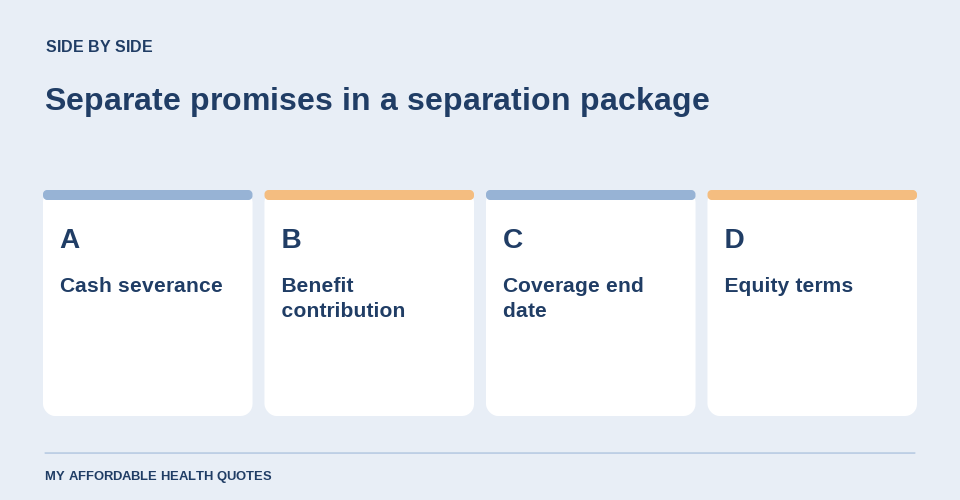
A severance package can make a job transition financially manageable, but it can also make health insurance estimates harder to read. The package may combine cash payments, temporary help with premiums, accrued compensation, and a promise about when existing benefits end. These items do not all answer the same question. A Utah household shopping for individual coverage should read the payment schedule and the benefits provisions separately before building a budget or completing an application.
The immediate goal is to know what insurance remains active and what the household expects to receive during the coverage year. Being between jobs does not mean annual income is zero. Conversely, the value printed at the top of a separation agreement is not automatically a monthly income figure. Payroll, the benefits administrator, and a tax adviser can supply the distinctions needed for an accurate insurance conversation. This guide provides a way to organize those answers without interpreting the agreement as legal advice.
Break the package into four questions
First, what cash will be paid, on what dates, and through which payroll process? Second, when does the employer health plan end? Third, does the employer contribute toward continuation coverage, and if so, for how long? Fourth, are there other compensation items such as a bonus or stock award that need separate review? Write each answer on its own line. A statement that the employer provides several months of severance does not necessarily answer all four questions.
Ask for a written benefits confirmation even when the separation agreement appears clear. The person negotiating compensation may not administer the insurance. If the agreement uses a phrase such as continued benefits, identify the policy, eligible household members, required employee payment, and termination conditions. A household member with scheduled treatment needs a definite coverage date, not a general assurance that the package is generous. Keep the contact information for whoever can resolve a discrepancy.
Use taxable wage information, not the net deposit
The IRS states in Publication 525 that severance pay is included in income. The net amount reaching a bank account reflects withholding and possibly other deductions, so it should not automatically be treated as the amount relevant to an annual income estimate. Ask payroll which figures on the statement represent federal taxable wages and whether the year-to-date total already includes the severance payment. This helps prevent both understatement and duplication.
A lump-sum payment and a series of payroll payments can have different practical effects on the household budget. The tax professional can explain the applicable reporting year and any unusual terms. Do not spread a payment over future calendar years merely because you intend to live on it for a long time. Spending money slowly does not by itself change when income is recognized. Keep the spending plan and the income forecast as separate documents with clear labels.
A hypothetical two-year transition
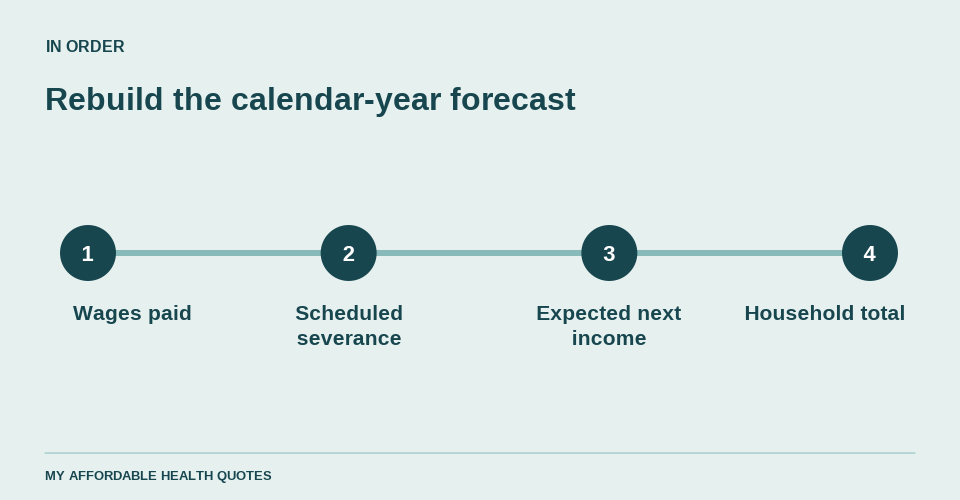
Imagine a Utah executive leaving work near the end of a year. The package includes a cash payment, a temporary premium contribution, and a final bonus whose date is not yet confirmed. The household expects a quieter earnings year afterward. Copying the current year's total into the next year's application may overstate the forecast. Ignoring the final bonus because regular employment ended may understate it. The correct response is to obtain the schedule and build a separate estimate for each coverage year.
The example does not assume that any payment can be shifted or negotiated for insurance purposes. It shows why a calendar matters. Record actual wages already received, expected payments remaining in the year, and any new work reasonably anticipated. Then repeat the exercise for the next year using only the amounts expected there. If a payment date changes, ask the tax adviser which forecast needs revision and retain the employer's updated notice.
Do not confuse premium assistance with active insurance
An employer may agree to reimburse or contribute toward certain premiums without leaving the original group coverage active indefinitely. Ask how the contribution works, whether the household must elect continuation coverage, and who receives the payment. If the household must pay first and request reimbursement, include that cash-flow requirement in the budget. If the employer pays directly, still confirm that the administrator has applied it and that coverage is active.
Also identify what happens when the contribution stops. The ongoing premium may differ sharply from the amount paid during the assisted period. Compare individual plans using the period when the household will actually bear the cost. A decision that looks attractive for one subsidized month may look different over a longer transition. Keep the contribution end date distinct from the policy end date; they are related facts but not necessarily the same event.
Gather the full household forecast
A spouse's wages, investment income, business profit, or retirement withdrawals may remain relevant while the departing employee receives no regular salary. HealthCare.gov's guidance for unemployed applicants explains the importance of considering current and expected annual sources. The household should not use the departing employee's last paycheck as a substitute for the entire household estimate. Make the source list first, then have the appropriate adviser resolve classification questions.
Keep uncertain future employment visible as an assumption. A signed offer with a known start date is different from an exploratory interview. If a new job becomes definite, update the forecast and review the benefit offer separately. The new employer's insurance may begin later than employment itself. Avoid canceling a replacement policy merely because an offer was accepted; confirm when the new coverage will actually take effect and which family members can enroll.
Compare Utah products using the correct inputs
The Utah Insurance Department's comparison tool distinguishes coverage year and location and notes that displayed rates are for an individual. That makes it a useful starting point, not a substitute for a complete household quote. Enter the correct year and geographic information, and obtain the actual family premium before comparing it with a continuation offer. A single-person rate should not be placed beside a family continuation total as though they measure the same thing.
Preserve the exact policy identifier, network name, and benefit summary for every option. Check the providers and medicines the household uses. A familiar Utah health system may participate in one product but not another, so verify the specific network. If a family member receives care outside the local area, ask about those services explicitly. Broad marketing descriptions are less useful than a written answer tied to the plan being considered.

Account for deductible progress
Leaving a group policy partway through its plan year may mean giving up accumulated deductible or out-of-pocket progress. Ask how the current plan measures that progress and whether a new policy would start fresh. Do not assume a transfer simply because both policies use the same insurer. This can materially affect a household with ongoing treatment or a procedure scheduled during the transition. The premium comparison should sit beside a realistic estimate of the care expected in each period.
A practical worksheet has one row for premiums and separate rows for recurring prescriptions, office visits, planned services, and the potential covered in-network out-of-pocket exposure. Label estimates as estimates. Do not add the full deductible to the out-of-pocket maximum as if both are independent maximum bills. Ask the agent to explain how the policy's cost sharing works for the particular services being considered.
Keep enrollment deadlines independent of payroll deadlines
The deadline to sign a separation agreement is not automatically the deadline to select a health plan. A continuation election period, Marketplace enrollment opportunity, document request, and first-premium due date can each follow a different schedule. Put them on one calendar with the responsible party. If the employer's packet is delayed, ask about coverage options promptly rather than assuming every other deadline waits for that packet.
When the household selects a policy, retain confirmation of enrollment and payment and verify the effective date. A quote is not active coverage. If a change in circumstances later opens another option, review the rules before switching. An expensive premium alone does not guarantee that an individual policy can be changed at any moment. The administrative sequence matters as much as the comparison of benefits.
Prepare for the first ordinary month
The transition can feel easy while the severance deposit is fresh and the employer is still contributing toward premiums. Build a budget for the first month after those supports end. Identify the premium source, the medical reserve, and any expected employment income. This exercise can reveal whether the chosen coverage remains manageable without relying on assumptions that were only true at the beginning of the transition.
For help comparing private health plans in Utah, request a review from My Affordable Health Quotes with the benefits-end date and a current household estimate. Keep legal interpretation with counsel and compensation classification with payroll or your tax adviser. The insurance decision should rest on confirmed dates, comparable household prices, and a clear understanding of what the separation package does and does not provide.
Preserve access to records after departure
Before the employer closes access to its payroll portal, download the permitted pay statements and benefit notices you will need. Ask how former employees obtain corrected statements or clarification later. A transition can become harder when the only evidence of a payment sits behind a login that no longer works. Keep personal copies securely and avoid mixing them with confidential employer materials unrelated to your own compensation.
When the next year begins, reconcile the forecast against the final employer documents. Identify any payment that moved to a different date and any benefit contribution that ended early. Those facts may affect tax work or a current application update. A short written reconciliation is more useful than assuming the first estimate remains accurate because the separation agreement itself has not changed.
Sources and further reading
- IRS: Taxable and Nontaxable Income
- HealthCare.gov: Unemployed Marketplace Options
- Utah Insurance Department: Plan Comparison