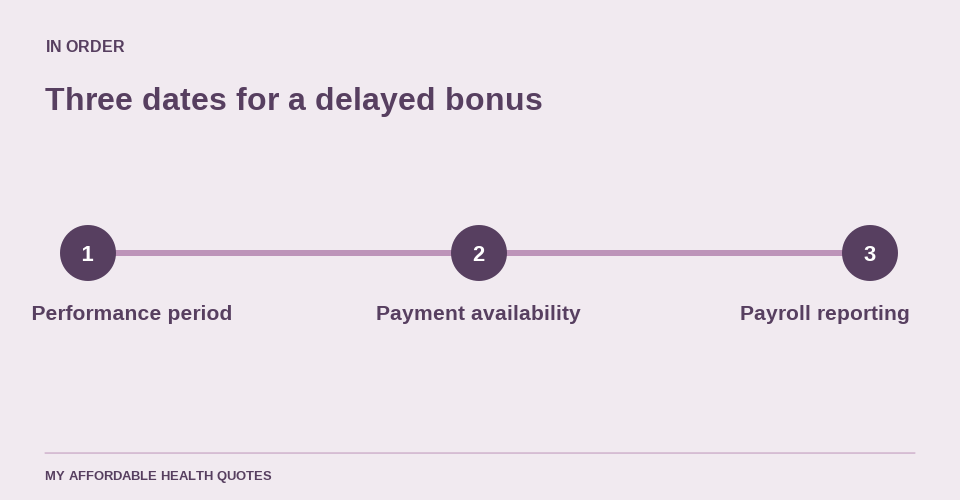
A bonus earned during one period may be paid after an employee has left the company or after a new calendar year begins. For a Utah household buying private health insurance, that timing can create a practical question: which annual income estimate should include the payment? The answer should come from payroll records and the applicable tax treatment, not from the month in which the work felt complete. A delayed payment deserves its own review even when the household has already finished its job-transition paperwork.
This guide follows the questions a household can ask in order. It does not recommend changing a payment date or interpreting a compensation agreement without professional advice. The purpose is to reconcile the bonus with an accurate coverage-year forecast while keeping insurance active and the household budget clear. A payment can be good news financially and still require an administrative update. Treating it as a separate event makes that update much easier.
What does the employer say the payment represents?
Start with the employer's description. Is it an ordinary bonus, a commission adjustment, an equity-related payment, accrued compensation, or a settlement with multiple components? The bank deposit may use a generic payroll label that hides the distinction. Ask payroll for the relevant statement and an explanation of how the amount is reflected in taxable wages. If the separation agreement refers to the payment, keep that section available for the tax adviser to review.
The IRS discusses bonuses and compensation in Publication 525. The timing of receipt or availability can matter, and special arrangements may require additional analysis. Do not decide the tax year solely from the performance period printed on a bonus notice. A payment for last year's work does not automatically belong in last year's insurance forecast. The adviser should establish the treatment from the actual facts and current rules.
If payroll cannot immediately answer, record the unresolved question and a follow-up date. Avoid entering a convenient figure merely to finish an application. A supported interim estimate may be appropriate, but it should be identified as such and revisited when the employer supplies the final information. The household should know why the estimate was chosen and what evidence is expected to refine it.
Is the amount already inside another total?
A common error is counting the same compensation twice. The household may use a year-to-date taxable wage total that already includes the bonus, then add the bonus again as a separate line. Another error goes in the opposite direction: using an old wage statement that predates the payment and assuming it remains complete. Compare the date of the statement with the payment date and ask payroll whether the total includes the event.
Make a reconciliation with three entries: the prior wage figure, the newly confirmed payment if not already included, and the revised total. Keep withholding separate. The net deposit is not a substitute for the relevant wage amount, and a withholding change does not necessarily mean the underlying income changed. This small calculation is easier to verify than a new total that appears without an explanation.
For a household with both spouses receiving bonuses, label each source with the earner and employer. Similar payment dates do not make the payments interchangeable. If one spouse remains on employer insurance and the other seeks individual coverage, the household-income rules may still require both sources. The application should reflect the appropriate household picture, not only the earnings of the person receiving the new insurance card.
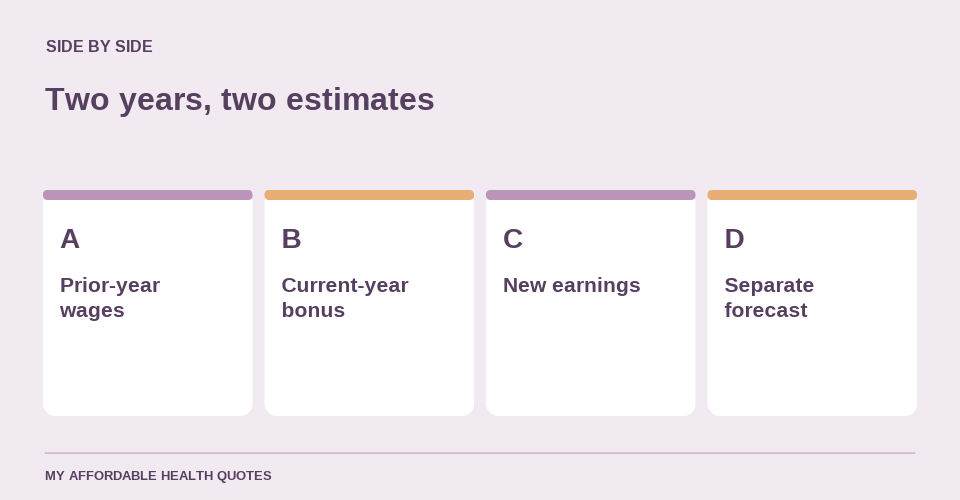
How do two calendar years stay separate?
Consider a hypothetical Utah sales manager who leaves in December and receives a final incentive payment later. The manager starts consulting and buys individual coverage for the new year. The household's planning file should contain a separate forecast for each year, with the tax adviser identifying where the delayed payment belongs. That avoids treating the final employer payment as recurring consulting revenue or assuming it disappeared when the job ended.
The next step is to mark one-time items. A bonus included in the current forecast should not automatically repeat in the following year's renewal estimate. Conversely, a scheduled payment should not be omitted because the latest completed return does not yet show it. HealthCare.gov explains that an estimate should be adjusted for expected changes. The most recent return is a reference point, not a command to repeat every line unchanged.
A useful file name includes the coverage year and the date the estimate was prepared. Keep older versions rather than overwriting them without a trace. If an adviser later asks why the application changed, the household can show the sequence: original expectation, employer confirmation, and revised forecast. That is more credible and less stressful than trying to remember a conversation months after the payment arrived.
What if the payment is uncertain?
Some compensation depends on a final calculation, continued eligibility, or another condition. Ask the employer what is known and what remains contingent. The household can use scenarios privately to understand the range of possible outcomes, but the application needs the best reasonable estimate under its instructions. Do not choose the most favorable scenario simply because it produces a lower displayed premium. Record the assumptions and update when uncertainty resolves.
The uncertainty may concern amount, timing, or both. Keep those dimensions separate. A payment expected in a certain year but with an uncertain amount is different from a fixed amount with an uncertain payment date. The tax adviser can explain how each affects the forecast. The insurance professional can help evaluate the coverage consequences using that explanation, without promising a result based on a number that has not yet been established.
Does a larger bonus mean the policy should change?
Not automatically. An income update may affect financial assistance, but the policy's network, benefits, and enrollment rules still need separate consideration. The household may remain satisfied with its coverage even if the monthly amount changes. Do not cancel a plan because a bonus arrived or assume the payment creates a special opportunity to select any new policy immediately. Ask the Marketplace or insurer about the actual options.
If a comparison is appropriate, preserve the full premium and any assistance as separate entries. Then compare the deductible, out-of-pocket limit, medicines, and provider network. The Utah Insurance Department's health-reform information identifies the state's individual-market resources and current insurer information. Availability still needs verification for the household's location and the exact coverage year. A statewide carrier list is not proof that every product is available in every county.
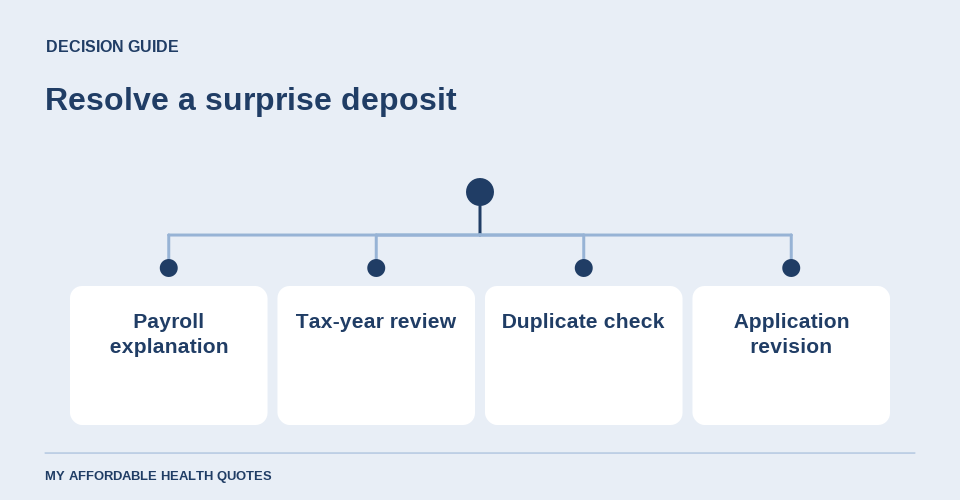
How should the money be budgeted?
A bonus deposit can create a temporary sense that future premiums and medical bills are fully covered. Before assigning it to spending, identify any tax obligation and other commitments. Then decide what amount is actually available for healthcare. A household may choose to reserve several months of premiums or strengthen its medical reserve, but that is a budgeting decision separate from the amount reported as income.
For a hypothetical $20,000 net deposit, the important question is not whether $20,000 should be entered into the application. Payroll and tax records establish that answer. The budgeting question is how much of the available cash remains after the household's obligations. Keeping those two calculations apart prevents a common confusion in which a reasonable spending plan is mistakenly used as an income-reporting method.
If the household expects another job soon, do not use an assumed start date to spend down the reserve prematurely. Confirm the employment and benefit dates first. The insurance plan should remain manageable if the search takes longer than expected. A bonus is a finite resource; an ongoing premium is a recurring obligation. The comparison should acknowledge both time horizons.
What should be checked after the application update?
Save the submission confirmation and read the new eligibility notice. Verify that the correct coverage year was updated and that household members were not accidentally removed or added. Check the next insurer bill against the expected amount. If they differ, ask the exchange and carrier to reconcile the record rather than assuming one can be ignored. Keep a brief log of the question, date, and response.
When final payroll forms arrive, compare them with the forecast and ask the tax preparer about any difference. A correction may involve tax work, the current application, or both. The household does not need to solve that distinction alone. It needs to preserve the evidence and bring the discrepancy to the professional responsible for the relevant task.
What makes the next review easier?
Create a small compensation register with one row per unusual payment. Include the employer, description, expected date, actual date, gross amount, and whether the current forecast includes it. Store the supporting statement beside the register. This is particularly useful for households with commission adjustments or delayed incentives that recur across job changes. It turns a surprise deposit into a recognizable review task instead of a new investigation every time.
For help comparing private coverage in Utah, ask My Affordable Health Quotes to review the insurance options using the current dated estimate. Bring payroll classification and tax-year questions to the employer and tax adviser. The result should be a clear chain from the payment record to the income forecast and then to the coverage decision, with no amount omitted simply because it arrived after the job ended.
Before the next renewal, confirm that the register distinguishes completed payments from still-pending awards. Remove neither category without explanation. That final check prevents an unresolved compensation item from being forgotten when attention shifts from leaving the old job to building income in the new role.
Sources and further reading
- IRS: Taxable and Nontaxable Income
- HealthCare.gov: Estimating Income
- Utah Insurance Department: Health Reform