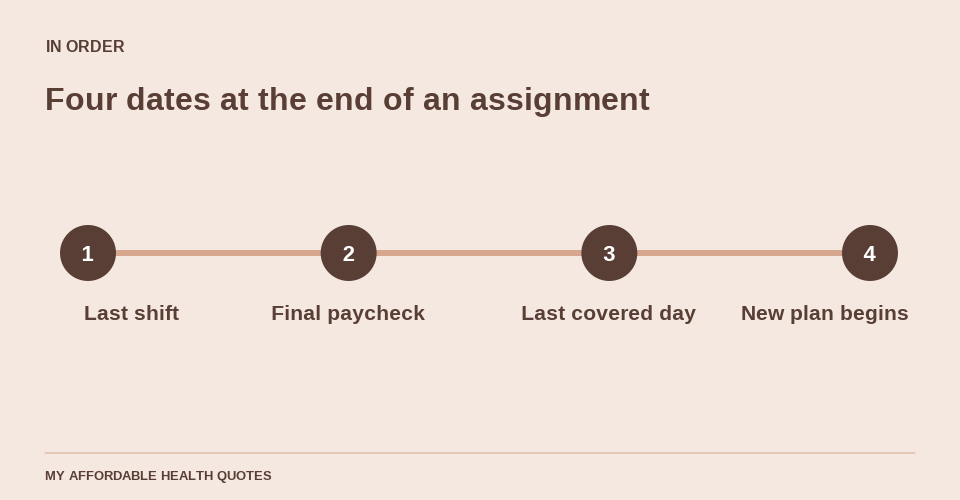
Your last agency paycheck can arrive after the last shift, and its insurance deduction may relate to a different coverage period. Do not use that deduction alone to decide when health benefits end. Ask the benefits administrator for the last covered day, ask payroll which period each deduction represents, and confirm the first covered day of any replacement. Those three answers prevent a payroll assumption from becoming an uninsured interval or an avoidable billing dispute.
This guide addresses the administrative cleanup after a clinical staffing assignment ends. It applies whether you are moving directly to another agency, taking time off, or returning to a permanent role. It does not assume that all agencies terminate benefits on the final shift or at month-end. The employer plan's rules and your actual status determine the date, which should be obtained in writing.
Separate the four dates on your calendar
Record the last day worked, the last day the agency considers you employed or eligible, the final paycheck date, and the medical coverage termination date. They may coincide, but they need not. A paycheck can include earlier hours, expense adjustments, or final deductions. A policy may follow a particular termination rule. Keeping the dates separate makes it easier to ask a precise question when something looks inconsistent.
Add the replacement policy's effective date only after it is confirmed. A submitted application, quote request, or benefits election is not necessarily the same as active enrollment. Ask whether any payment, document, or eligibility condition remains outstanding. If the new agency's orientation changes, revisit the effective date rather than assuming the original enrollment message still answers the question.
For dependents, confirm whether the termination date is the same and whether each person is included in the replacement. A family may have different next steps if a spouse uses another employer plan or children have another eligible route. Do not treat the employee's new card as proof that the entire household has transitioned.
Ask payroll to identify the coverage period
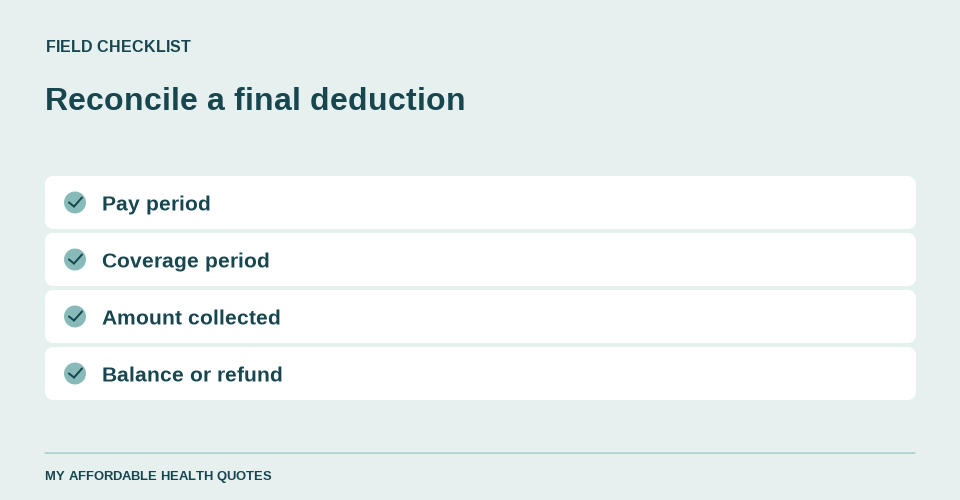
When reviewing the final statement, list each medical deduction with its pay-period dates and the coverage period payroll says it funds. Ask about catch-up amounts, advance deductions, adjustments, or refunds using the agency's explanation rather than your own assumptions. A deduction can be correct even when it appears on an unexpected paycheck, but the agency should be able to explain it clearly.
If you paid directly during unpaid weeks, include those receipts in the reconciliation. Otherwise, the final check may appear to collect an amount you believe was already paid. Send a concise ledger showing dates and amounts and ask payroll and benefits to compare their records. Avoid mixing unrelated housing or travel reimbursements into the initial insurance question unless they directly affect the deduction calculation.
Do not stop a required payment or reverse a transaction simply because the final statement is confusing. Ask for clarification through the established process and retain the response. If a refund is due, request the amount and expected method. A payroll dispute and an eligibility dispute can interact, but they are not the same issue and may need different teams to resolve them.
Obtain a usable loss-of-coverage record
Request written confirmation of the policy end date and the reason coverage is ending. This record may be needed when investigating continuation or replacement enrollment. Ask which document the new plan or Marketplace requires rather than assuming a final pay stub will satisfy every request. A statement showing deductions does not necessarily prove the exact day benefits stopped.
HealthCare.gov's Special Enrollment Period documentation guidance describes the importance of evidence of lost coverage and timely submission. If that route applies, follow the current instructions in your account and retain proof of submission. Do not assume that a requested document has been accepted merely because it was uploaded. Check the response and complete any additional requirement before relying on coverage.
Keep the employer's contact available after the assignment ends. If a document contains the wrong date, you may need a correction quickly. Use a personal email address permitted for benefits communication if access to the agency portal will end. Save authorized copies of enrollment and termination records while you can still retrieve them.
A worked final-paycheck example
Imagine a hypothetical travel nurse, Casey, whose last shift is on the twenty-second. The final paycheck arrives the following month and includes a medical deduction. Casey assumes this means health coverage continues into that month and schedules a routine visit. Before the appointment, Casey checks with the benefits administrator and learns that the deduction relates to an earlier coverage period, while the plan ended on a different confirmed date.
Casey now separates the two issues. Payroll explains the deduction and provides the period it covered. Benefits issues the termination record. Casey contacts the replacement plan about its actual effective date and any outstanding enrollment requirement. The appointment's insurance information is updated accurately. The lesson is not that final deductions are suspicious; it is that they cannot substitute for a coverage-date confirmation.
For a hypothetical reconciliation, suppose the final statement shows $150 in medical deductions while Casey expected $100. Payroll explains that $50 was a documented catch-up amount from an unpaid week. Casey checks the earlier statement and any direct-payment receipt. If the amount had already been paid, Casey asks for a correction with evidence. If not, the ledger is updated. No conclusion about the last covered day is drawn from that arithmetic alone.
Now suppose the insurer's portal still displays active coverage after the employer's stated termination date. Casey asks whether the eligibility file is pending an update and requests clarification before relying on the portal for nonurgent planned care. A delayed system update does not create a safe basis for assuming benefits continue indefinitely. Casey keeps the written response and gives providers the confirmed information.
Compare continuation with replacement using real dates
If continuation coverage is available, request the actual election materials, premium, deadlines, and effective-date rules. The Department of Labor explains that COBRA can allow eligible workers and family members to keep job-based coverage after qualifying events, but eligibility and cost must be checked. Do not estimate the full premium from the employee deduction alone, since the employer may previously have paid part of the cost.
Compare any replacement option on the same timeline. Ask about network access, medications, a new deductible, and the date coverage can actually begin. A lower monthly price may not be useful if it starts after an important gap or excludes essential care. Conversely, continuity is not automatically the best value for every person. Use the actual options and your care needs rather than a blanket rule.
If you elect continuation while evaluating alternatives, understand the consequences of voluntarily ending it later. Do not assume every cancellation creates a new enrollment opportunity. Check the relevant Marketplace or employer-plan rules before acting. The transition decision should be made with the enrollment route confirmed, not with the hope that another plan will accept an application whenever you are ready.
Route late-arriving claims by the date of care
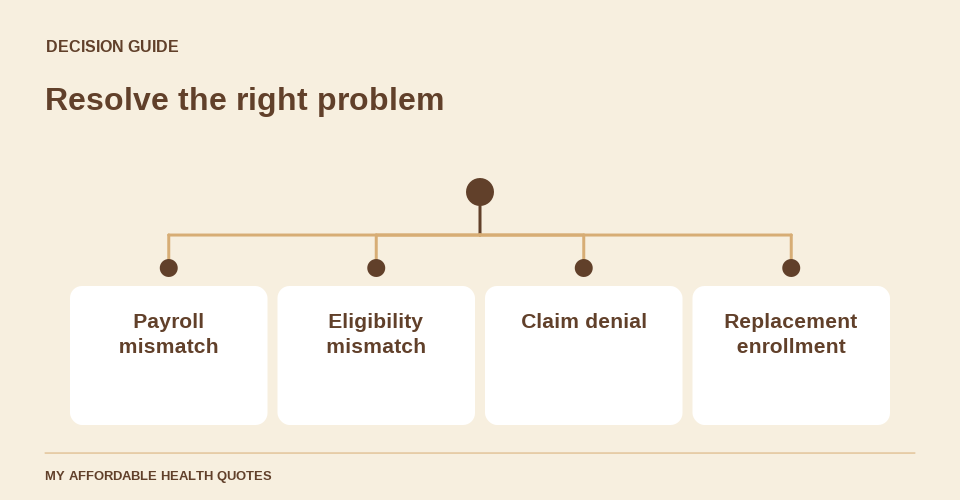
A bill received after the assignment ends may relate to services that occurred while the old policy was active. Give the provider the insurance information for the service date rather than automatically replacing it with the newest card. Keep the old member details and plan contact until outstanding claims are resolved. The date a statement arrives does not determine which policy applies.
If a claim is denied for inactive coverage, compare the service date with the confirmed eligibility record. Ask whether the issue is a mistaken termination date, an incorrect member identifier, or another reason. Send the relevant evidence to the appropriate administrator. Do not ask the provider to change the service date to fit coverage; the record must accurately reflect the care received.
The Department of Labor's claims guide explains the role of written denial reasons and plan appeal procedures. Request the actual notice and keep its deadlines visible. An agency's promise to correct an eligibility file is helpful, but ask how affected claims will be reprocessed and how you will know the correction is complete. Informal conversations should not replace a required formal appeal when one is needed.
Check the family's transition and recurring payments
Verify that each dependent has an active path after the old plan ends. A spouse may need to complete a separate employer enrollment, and a child's record may require documentation. Put those tasks on the same calendar as your own transition. The final paycheck is an employee record, so it can easily distract from dependent enrollment details that are managed elsewhere.
Review automatic payments and member accounts after the transition. Cancel or update payment arrangements only according to the plan's instructions and confirmed termination. Do not assume that deleting an app or removing a card from a digital wallet ends a policy. Conversely, do not keep paying a terminated arrangement without asking what the payment represents. Obtain written confirmation for material changes.
Keep a secure archive with final deductions, direct-payment receipts, coverage dates, election notices, and important claim correspondence. Exclude unnecessary clinical detail from the payroll folder. A clean record makes a later question easier to answer and prevents you from repeatedly requesting documents from an agency you no longer work with.
Build the check into every assignment exit
Before your last week, send a short request for the medical termination date, final deduction schedule, continuation information, and document access after departure. Ask the new employer or plan for its confirmed start date at the same time. This turns an end-of-contract scramble into a routine handoff and makes any gap visible while there is still time to investigate options.
The final reconciliation should answer four plain questions: what did I pay, what period did it cover, when did coverage end, and what coverage follows it? If one answer is missing, ask the responsible team directly. A reassuring paycheck line is not enough, and a confusing deduction is not proof of lost benefits. Confirmed dates and reconciled payments provide a much firmer basis for your next clinical assignment.
Sources and further reading
- Changing jobs and job loss
- COBRA continuation coverage
- Confirming a Special Enrollment Period
- Filing a claim for health benefits