If you plan surgery before starting a Texas travel assignment, evaluate coverage for the recovery period as carefully as coverage for the procedure. Follow-up visits, rehabilitation, prescriptions, testing, and equipment may occur under a different policy or in a different location. Ask your treating clinician whether the work and travel timeline is medically appropriate, then align the insurance and provider arrangements with that clinical plan.
This is not advice about when to have surgery or when to return to work. Those decisions belong with your treating professionals and the relevant employment process. The insurance task is to identify which policy is active for each expected service date and whether the appropriate providers and services are covered. A paid surgical claim does not automatically settle every later recovery expense.
Start with the clinician's recovery outline
Ask the treating team what follow-up is expected, which visits need to occur with the original practice, and what could appropriately be handled elsewhere. Include any anticipated therapy, testing, equipment, and medication needs. The outline may change as recovery progresses, so treat it as a planning tool rather than a guarantee. Do not design a coverage schedule that pressures the clinician to shorten recovery for an assignment.
Discuss the physical demands of the proposed work and travel accurately. A clinical assignment can involve lifting, prolonged standing, overnight shifts, or a long drive to temporary housing. Obtain any required work-status documentation through the proper process. The recruiter needs appropriate information about availability and restrictions, but a detailed medical record should be shared only through suitable channels.
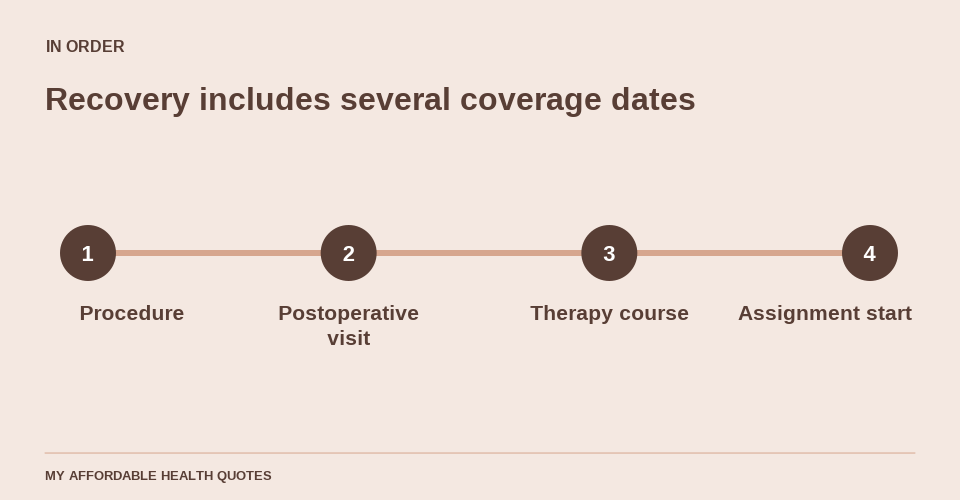
Place the expected services on a calendar with the procedure, current policy end date, new policy start date, and assignment orientation. This simple exercise often reveals the real issue: a postoperative appointment may occur after the old plan ends but before the new network has been checked. Address that gap in information before assuming the transition is straightforward.
Verify each provider and setting involved
Confirm the surgeon, facility, and other planned service providers with the insurer and their billing teams. For recovery in Texas, verify the local therapist, specialist, laboratory, or equipment supplier under the policy that will apply. HealthCare.gov recommends checking the exact network through insurer and provider confirmation. Use the specific practice address and product, not just the carrier name.
Ask whether referrals or authorizations are required for postoperative services. A surgery approval may not cover every therapy visit or a different facility. If the plan changes, ask whether a new review is necessary and who submits it. Do not assume that the phrase postoperative care means all later services are bundled or exempt from separate coverage rules. Billing and benefit treatment depend on the actual service and arrangement.
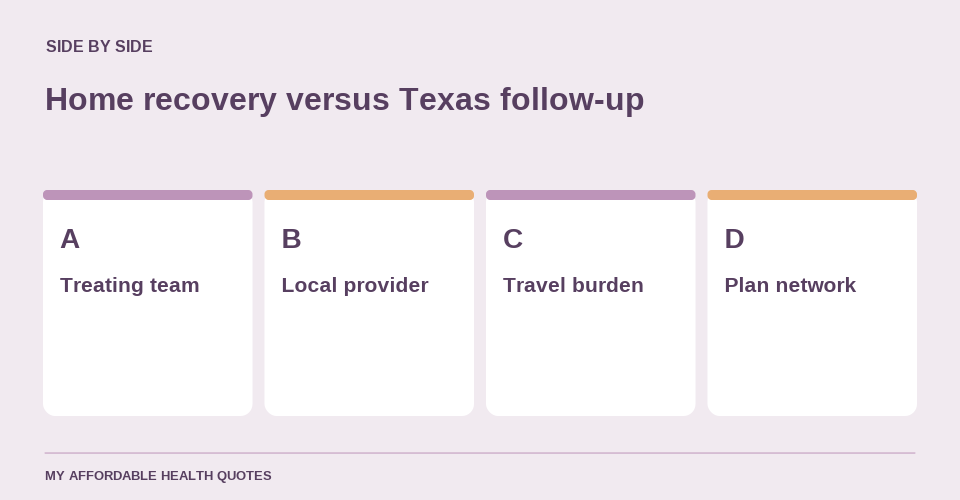
If a local provider needs records before accepting care, assign responsibility for the transfer. Confirm that the receiving practice has the relevant documents and can offer an appointment when needed. An in-network provider with no timely appointment may not solve the continuity problem. Ask the insurer for access assistance if appropriate care cannot be located within a clinically suitable timeframe.
Clarify how the policy change affects the plan
Ask the current insurer which services remain associated with its coverage dates and how later claims should be submitted. Ask the new insurer about the proposed follow-up under its own benefits. Keep the two conversations separate enough that each administrator answers for the policy it controls. A reassurance from the old insurer cannot guarantee the new plan's network or authorization decision.
Review deductibles and out-of-pocket amounts for both policies. Spending under the old plan may not transfer, so do not treat a nearly met deductible as protection under a new product without written confirmation. Ask for estimates using the expected service dates and new cost-sharing. Label estimates as estimates, since recovery needs and claims can change.
Also ask what happens if the Texas assignment is delayed or canceled. If the new agency coverage depends on a particular eligibility event, a changed start date can alter the recovery coverage plan. Obtain the agency's effective-date rule in writing. Do not cancel the current policy solely because orientation appears on a calendar while the new benefits remain unconfirmed.
A worked recovery transition
Imagine a hypothetical travel physical therapist, Chris, who has a planned procedure at home and hopes to begin a San Antonio assignment afterward. The surgeon outlines a follow-up visit and a possible course of rehabilitation, with return-to-work decisions based on actual recovery. Chris initially compares only the procedure's deductible and assumes the rest will be routine.
Chris then maps the timeline. The first follow-up is under the current policy, but several possible therapy visits would fall after the new agency plan starts. Chris asks the new insurer about the specific Texas therapy practice, visit requirements, and any authorization. The practice requests records before confirming an appointment. Chris coordinates those tasks while keeping the surgeon's clinical review separate from the employer's scheduling needs.
For a hypothetical budget illustration, suppose six therapy visits are anticipated and the estimated patient share differs by $30 per visit between two available arrangements. That creates a $180 planning difference, assuming all six occur and the estimates are accurate. Chris also considers transportation, appointment availability, and the possibility of a changed treatment course. The calculation does not establish which route is medically appropriate or guarantee the final bill.
If recovery takes longer than expected, Chris tells the agency through the appropriate process and asks whether benefits dates change. The medical decision is not overridden by a desire to preserve the original insurance schedule. Chris reevaluates continuation or other eligible coverage using the revised facts. This is a more reliable approach than beginning work prematurely because the health-plan transition was never checked.
Distinguish continuing care from automatic out-of-network permission
Ask whether the new plan has a transition-of-care process that could be relevant to an existing treatment course. Do not assume that every plan change creates a right to continue indefinitely with an out-of-network surgeon or therapist. The plan may have criteria, documentation, and time limits. Request a written determination and identify which services and dates it covers.
Likewise, protections that apply when a provider leaves a network are not necessarily identical to the situation in which you voluntarily move or switch policies. Describe the actual event accurately. A customer-service representative can direct you to the applicable process, while the treating team can explain clinical continuity needs. Avoid selecting a plan based on a general statement that continuity is always protected.
If no suitable participating provider is available, document the access issue. List the practices contacted, appointment dates offered, and any clinical timing information supplied by your treating team. Ask the insurer how it will help locate appropriate care. This gives the plan a concrete problem to address rather than a broad request to cover any provider you prefer.
Plan medication and equipment logistics
Check postoperative prescriptions under the plan that will be active when they are filled. Ask the pharmacy and clinician about lawful and appropriate dispensing arrangements during travel. Do not assume an early refill or transfer is automatic, and do not alter medication use to fit a moving date. Keep the prescribing practice's contact information available in case the destination pharmacy needs clarification.
For equipment, ask who supplies it, whether the supplier participates, whether authorization is required, and whether rental or purchase terms affect a move. A device provided before departure may create follow-up obligations or billing questions after arrival. Confirm how repairs, returns, or replacements are handled. Keep equipment instructions and supplier contacts with the recovery plan.
Arrange practical support consistent with the clinician's advice. Transportation to a follow-up, help with luggage, or a suitable place to recover may matter even when not covered by health insurance. Keep those costs and arrangements visible rather than assuming medical coverage pays for every logistical need. The insurance plan and the recovery support plan should complement each other.
Review claims while details are still fresh
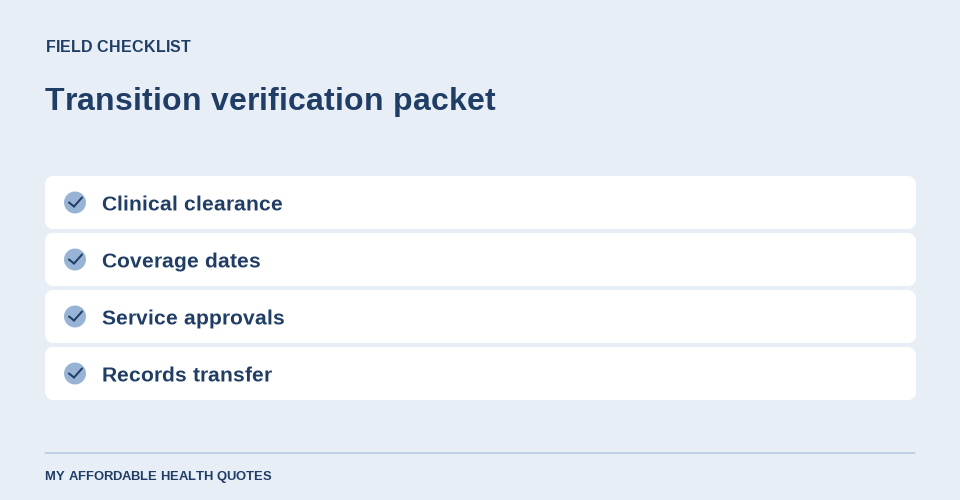
Save estimates, authorizations, coverage confirmations, and explanations of benefits. When a bill arrives, match it to the service date and policy that applied. A bill received after the move may still relate to care under the old plan. Give the provider accurate insurance information rather than asking it to submit everything to the newest card.
If a claim is denied, obtain the specific reason and follow the relevant correction or appeal process. The Department of Labor's claims guide explains the role of plan documents and written denial information for employer coverage. Keep formal deadlines visible while the provider and insurer discuss the issue. A promised callback does not necessarily pause an appeal deadline.
Make the assignment decision with the whole recovery picture
Before committing to the final start date, confirm the clinical plan, work clearance process, active coverage dates, and essential local appointments. Some uncertainty is unavoidable, but identify it honestly. If a key appointment or authorization is unresolved, ask the appropriate party what remains and when it can be addressed. Do not let a signed housing lease become the reason to ignore an unresolved care need.
For a future Texas assignment after a procedure, request a health coverage comparison using the entire recovery pathway. Name the follow-up services and dates rather than asking only whether surgery is covered. The useful question is whether the sequence from treatment through return to work is medically appropriate, administratively coordinated, and financially understood. That broader view protects against surprises that a procedure-only estimate cannot reveal.
Keep a short handoff summary for yourself: who manages clinical recovery, who verifies the plan, who schedules local care, and who receives updates if the timeline changes. Clear ownership reduces the chance that everyone assumes someone else handled a necessary step. It also lets you focus on recovery rather than reconstructing administrative conversations after a long shift.