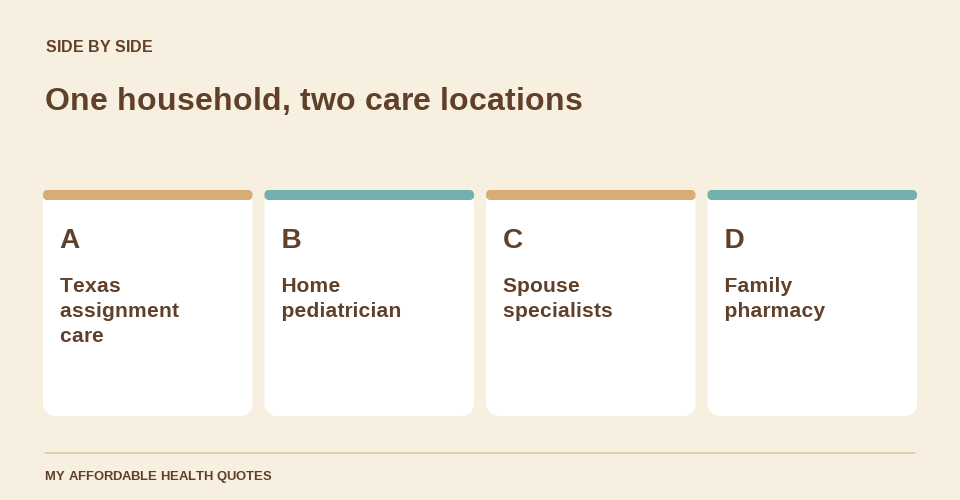
When you take a Texas clinical assignment while your spouse or children remain at home, evaluate health coverage in both locations before enrolling the family. A plan that provides convenient care near the assignment may not support the family's established doctors, and a plan that works at home may offer limited routine access in Texas. The comparison needs named providers, exact networks, and confirmed dependent enrollment, not a broad promise of national coverage.
The key decision is whether one policy can reasonably serve the whole household or whether another eligible arrangement deserves comparison. This is not an argument that families should always split coverage. Separate policies can add administrative work and separate deductibles. It is a way to prevent the traveling employee's needs from becoming the only needs considered when an agency benefits election is completed quickly.
Build two care maps with one household budget
On the assignment side, list the Texas location where you will live, likely routine care needs, regular medications, and any follow-up that will occur during the contract. On the home side, list each family member's essential clinicians, facilities, prescriptions, and scheduled services. Include the actual practice address when a clinician works at more than one location. A carrier's presence in both states does not establish that the same product includes both sets of providers.
Mark each item as essential, preferred, or flexible. An established specialist relationship may be essential, while a particular retail pharmacy may be flexible if another participating location is nearby. This classification helps the household discuss tradeoffs without pretending every preference has the same weight. Medical decisions about changing treatment or clinicians should include the relevant treating professionals, especially when continuity is important.
Use a single budget worksheet for all household premiums and expected care, even if you investigate multiple coverage arrangements. Otherwise, one person may compare the employee deduction while another compares a separate premium without realizing that both will be paid. Record uncertain amounts as estimates. Do not treat an advertised employee-only contribution as the family price.
Verify the exact dependent network
Ask the agency for the full plan and network names, benefits summary, and dependent eligibility information. Search the directory using those details. CMS's provider-network guide specifically recommends checking doctors and facilities for dependents as well as the person enrolling. Follow that advice literally: verify the pediatrician, spouse's specialist, and relevant hospital rather than assuming the network check you completed for yourself covers the household.
Contact the insurer and provider offices when a relationship is central to the decision. Ask whether the exact product participates at the exact location and whether the office accepts new patients if needed. For a child receiving recurring services, ask about the relevant benefit limits and authorization process. Network participation answers who can provide covered care; it does not answer every service-level coverage question.
Also ask how routine care works outside the primary service area. The Texas Department of Insurance explains differences among HMO, EPO, PPO, and other network arrangements, but those labels are not a substitute for reading the particular plan. A PPO label does not mean every provider is in-network, and emergency protections do not establish broad routine coverage. Ask the insurer to describe the family's intended use explicitly.
Check enrollment for each person
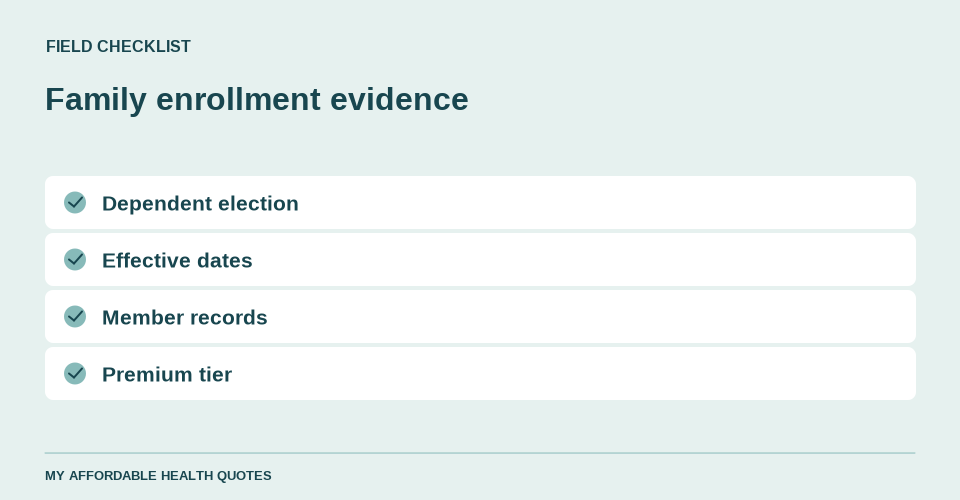
Confirm that the election includes the intended spouse and children, that any required documentation has been received, and that the effective dates are correct. Keep the enrollment receipt and verify the member records. A family premium deduction is useful evidence of payment, but it is not the only evidence you need that every dependent is active. Errors in names, birth dates, or relationship records can become visible only when a claim is submitted.
Ask who receives cards and notices while you are away. The parent at home needs access to the correct member information and a practical way to communicate with the plan, subject to its authorization and privacy rules. Do not assume that being married automatically gives unrestricted access to another adult's health information. Set up permitted account access and communication preferences through the insurer's process.
Keep renewal and document requests from getting lost in your travel schedule. A notice mailed to temporary housing or sent to an agency email account can be easy to miss. Establish one reliable address and email arrangement that complies with the plan's requirements. Update actual changes promptly, but do not invent a residence merely to obtain a preferred network or price.
A worked two-location comparison
Consider a hypothetical occupational therapist, Sofia, taking an Austin assignment while her spouse and two children remain near their established home. The agency offers employee-only and family coverage. Sofia's own expected needs are modest, but one child has regular specialist visits and the spouse uses a recurring medication. The initial benefits conversation focuses on the hospital network near Austin, which leaves most of the household's practical needs unanswered.
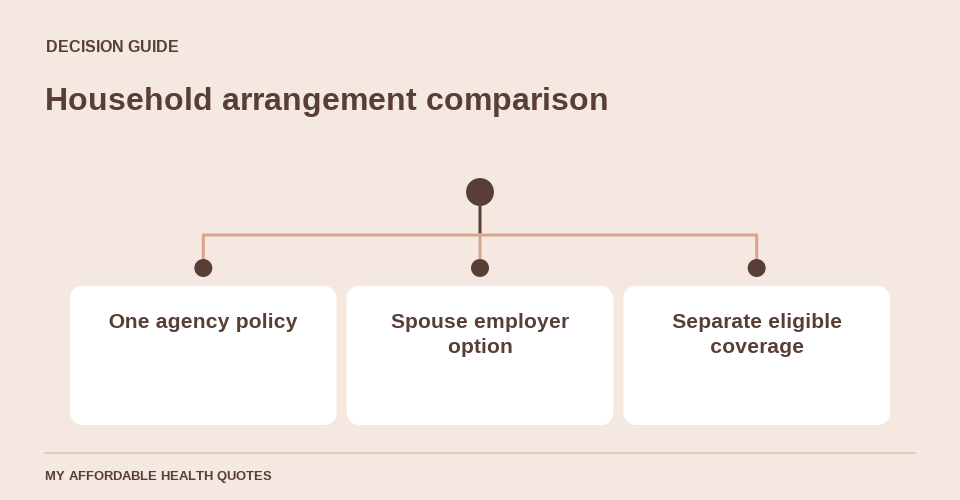
Sofia builds two maps and compares three arrangements: everyone on the agency plan, Sofia on the agency plan with the family using the spouse's available employer coverage, and another individually eligible arrangement if appropriate. She asks for actual premiums and verifies the same home clinicians under each candidate. She does not assume eligibility for financial assistance or an enrollment window; those questions are checked before treating an option as available.
For illustration, suppose one arrangement costs $180 less per month in combined premiums but excludes the child's usual specialist from its network. Over a six-month comparison period, the premium difference is $1,080. That arithmetic is not a recommendation to pay more or less. It tells Sofia the size of the financial tradeoff to investigate while asking about appropriate participating alternatives, expected treatment costs, and the clinical consequences of changing providers.
Another arrangement keeps the specialist but uses separate deductibles for Sofia and the family. Sofia records that structure rather than assuming everyone contributes toward one shared family amount. She also considers who will manage claims, cards, and renewals while she is working away. The final decision balances verified access, affordability, and administration, rather than choosing the lowest family deduction in isolation.
Understand the deductible arrangement you are comparing
Read the benefits summary for individual and family deductibles and out-of-pocket limits. Ask how one family member's spending is treated and how the household amount accumulates. If family members use separate policies, do not assume spending under one policy counts toward another. If a plan changes during the year, ask whether any credit applies rather than expecting previous spending to follow automatically.
Use two hypothetical care scenarios: one family member with significant covered expenses, and several members with moderate expenses. These scenarios can reveal differences that a single family deductible number hides. Keep premiums separate from cost-sharing and identify expenses that do not count toward the plan's limit. The purpose is not to predict a precise medical year but to understand where the household could face concentrated costs.
Consider children's eligibility separately where relevant. HealthCare.gov explains that children may qualify for CHIP under state-specific rules even when parents do not qualify for Medicaid, and eligibility affects Marketplace savings for the child. Do not omit household members or alter application facts to make a preferred arrangement appear available. Follow the application's instructions and obtain qualified help for complex tax-household circumstances.
Prepare for the assignment ending early
Ask how family coverage ends if the assignment is canceled, you change agencies, or you take time off. The spouse and children may be relying on the policy even when your own care needs are minimal. Request the termination rule and any continuation information before the family leaves established coverage. A household transition can involve several appointments and prescriptions, so a vague expectation that another contract will begin soon is not enough.
If coverage actually ends, obtain the date and reason in writing and investigate available continuation or replacement routes. Check the start dates for every family member. Do not assume that selecting a new employee plan automatically enrolls dependents, or that a child's pending appointment can be billed under the old plan after termination. Give providers updated information and ask about any authorization that must be renewed.
Give the parent at home a usable coverage file
Prepare a concise file with the plan name, member information, insurer contact, participating pharmacy, and key coverage dates. Include the process for requesting documents or reporting an eligibility issue. Keep sensitive clinical records in appropriate secure systems rather than combining everything into a broadly shared travel folder. The practical aim is to let the parent at home obtain care without waiting for you to finish a twelve-hour shift.
Agree on a routine for unusual bills and renewal notices. For example, the person receiving a document can save it securely and flag its deadline, while the person responsible for benefits contacts the administrator. This division of work reduces duplicated calls and missed requests. It also prevents a claim problem affecting a child from being treated as a minor issue simply because the traveling employee has not personally used the plan.
When you request a coverage comparison for a Texas assignment, say clearly that the household will use care in two locations. Provide the essential provider list and actual coverage dates rather than only the employee's age and ZIP code. A useful recommendation must work for the family that remains at home as well as the clinician who travels. The assignment is temporary, but the consequences of an overlooked dependent need can last well beyond the contract.