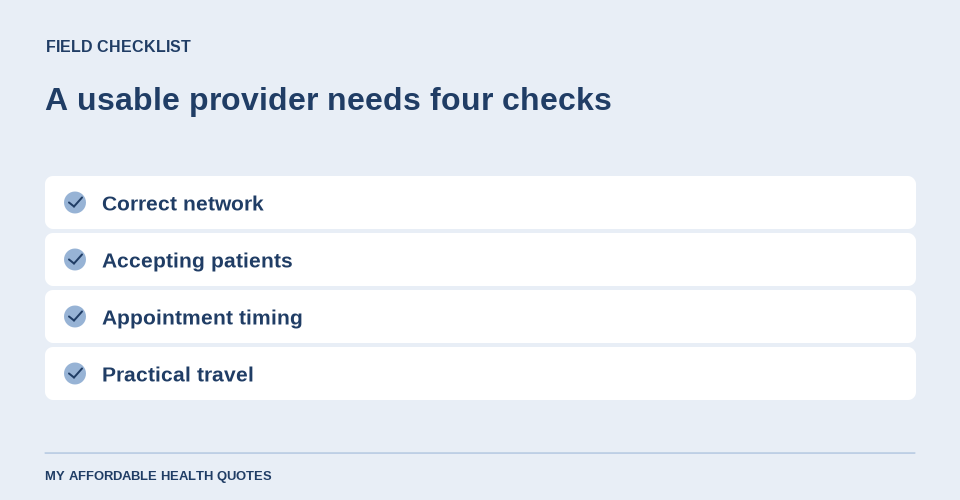
Before accepting a rural Arkansas clinical assignment, test whether your health plan provides practical access to the care you expect to need. A directory entry is useful, but it does not tell you whether the office accepts new patients, offers the relevant service, or can see you during the contract. Confirm those details with the provider and insurer before treating a large provider count as evidence that the plan fits the assignment.
This is not a claim that every rural location lacks care or that a particular Arkansas county has inadequate networks. The point is to evaluate the actual location and product instead of relying on assumptions in either direction. A smaller community may have a convenient participating practice for your needs, while a plan that looks broad on paper may require a regional trip for a particular specialist or test.
Begin with the service you need, not a radius
List the expected services during the assignment: routine primary care, a specialist follow-up, regular therapy, laboratory work, imaging, or prescriptions. Identify which need an established relationship and which may be occasional. Ask your treating clinician about appropriate timing and transfer needs before moving recurring care. A map of all local clinicians is less useful than a verified path to the particular service you need.
Then identify the exact place you will stay and the facility where you will work. Rural assignments can involve a meaningful drive between housing and the worksite, so searching only the hospital ZIP code may miss the most practical options. Use both locations and the actual roads you expect to travel. Do not assume a straight-line distance on a directory map reflects the real trip.
Keep your schedule in view. An office an hour away may be workable on a day off but difficult between consecutive shifts. Repeated therapy visits can create a different burden from one annual appointment. Record frequency and timing alongside distance. This turns a vague concern about access into a concrete comparison the insurer or agent can help address.
Use the directory as the first check
Search the exact plan and network, not merely the insurer's public provider page. Confirm the clinician's name, specialty, address, and service location. If a result appears under several products, make sure you have selected the product being offered. A familiar carrier brand can support different networks with materially different participation.
HealthCare.gov's verification process uses more than an online search: confirm participation with the practice and the company administering the coverage. Follow that sequence for essential care. Ask the office whether it accepts the specific product, whether it is taking new patients, and when the needed appointment is available. If the office only accepts certain referral sources or requires records before scheduling, add that requirement to the plan.
Save the date and result of the check. Availability may change, so this is not a guarantee of a future appointment. It is a way to show what you investigated and to identify unresolved barriers. If the directory and office disagree about participation, ask the insurer to clarify rather than simply choosing the answer you prefer.
Follow the care pathway beyond the office
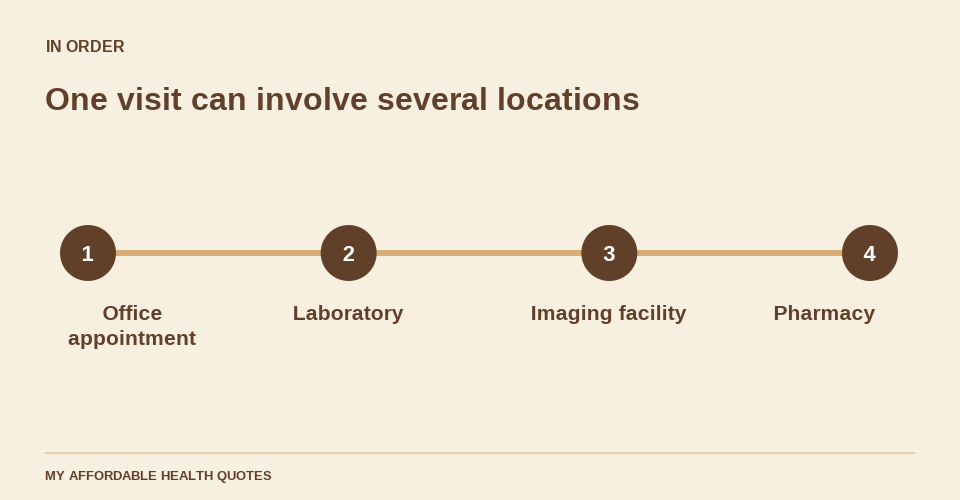
Ask where laboratory work, imaging, and referrals are usually sent. The local office may be convenient while the associated service is farther away or outside the network. Confirm those locations separately when they are likely to matter. A covered office appointment does not establish the billing or network status of every test ordered afterward.
For a specialist, ask whether any preliminary consultation or testing must occur before the visit. A directory can show an available specialist without showing that the intake process takes several weeks. If your assignment is short, the sequence may not fit unless started early. Coordinate records through secure clinical channels and confirm that they have been received.
Check pharmacy access with the same specificity. Verify the participating location, counter hours, and ability to dispense your regular medication. A pharmacy inside a familiar retail chain may have limited hours or a different specialty process. If delivery is an option, ask about the actual address and storage requirements rather than assuming temporary housing is an easy receiving location.
A worked rural-access comparison
Imagine a hypothetical respiratory therapist, Quinn, considering an assignment in a smaller Arkansas community. Quinn needs one specialist follow-up and periodic laboratory work during the contract. The agency's plan directory lists a local primary care office and a regional specialist. At first glance, the coverage appears to meet every need.
Quinn calls the specialist and learns that the earliest new-patient appointment falls after the assignment would end. The local office can handle some routine needs but cannot replace the specialist's role. Quinn contacts the insurer with the service required, expected dates, and offices already tried. The insurer identifies another participating option, which Quinn verifies directly before treating the access issue as resolved.
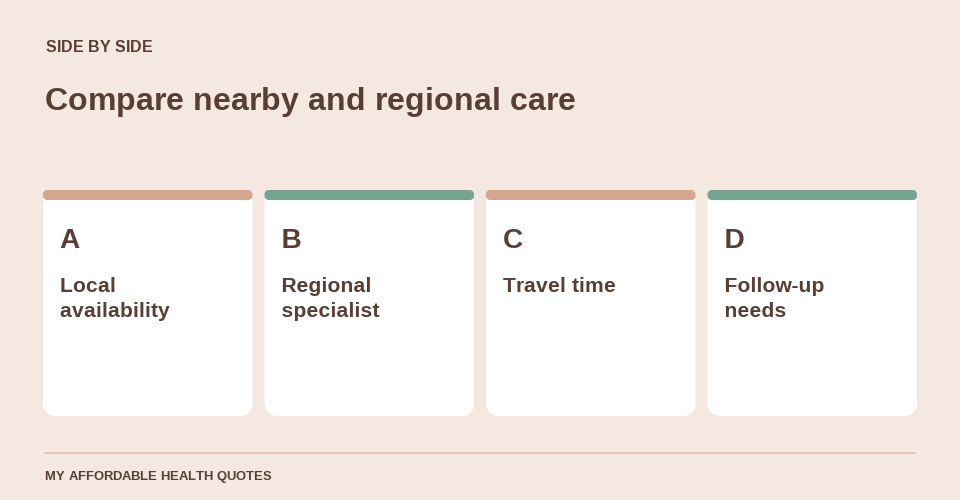
For a hypothetical logistical calculation, suppose the verified specialist requires a ninety-minute drive each way and the appointment itself may take two hours. Quinn reserves at least five hours before adding possible delays. If the appointment also needs separate testing, another trip may be necessary. This is not a cost estimate or a claim that rural care always requires long travel; it shows how to translate a specific verified arrangement into a realistic schedule.
Quinn compares this route with an eligible alternative plan and with clinically appropriate continuity at home. The decision includes actual premiums, medical cost-sharing, travel burden, and appointment availability. Quinn does not assume that the alternative is better merely because it has a larger advertised network. Both options must pass the same practical test.
Ask the insurer for access assistance when needed
If participating options cannot provide the needed service within an appropriate timeframe, ask the insurer how to obtain help. Describe the problem precisely: the service, location, clinical timing information, and providers contacted. Ask whether the plan can locate another participating provider or whether a formal exception process is available. Do not assume an exception is automatic or schedule expensive out-of-network care based only on frustration with the directory.
Have the treating clinician provide relevant medical information when timing or specialized care is important. The insurer needs to understand the actual service requirement, not just your preferred appointment day. Keep a record of calls and written responses, including any authorization or arrangement that is approved. Confirm what service, provider, dates, and cost-sharing the approval covers.
The Arkansas Insurance Department publishes regulatory health and network-related resources, and consumer assistance may help with matters within its authority. Some employer plans are governed through a different route. Identify the product and funding arrangement before assuming the state office can decide every dispute. Ask where the issue belongs and preserve the plan's own appeal deadlines while seeking help.
Use telehealth as a specific option, not a blanket substitute
Ask whether the service can appropriately occur by video and whether the clinician is permitted to treat you from your actual location. Then check the health plan's benefit and provider requirements. A covered virtual primary care service may not replace a specialist examination, testing, or a procedure. Clinical suitability and insurance payment are separate questions.
Test the internet connection and privacy of your housing before relying on repeated virtual appointments. A mobile connection that works for messages may not support a stable video visit. Ask what happens if the connection fails and how in-person follow-up is arranged. A plan feature is only useful if it can be used under the actual conditions of the assignment.
For recurring care, keep a local in-person route identified even if most visits are virtual. This is not an instruction to obtain unnecessary visits. It is a practical contingency for a clinician who determines that an examination or test is needed. Ask the insurer to explain how that referral would work within the network.
Budget time and money honestly
Keep premiums, medical cost-sharing, and personal travel costs in separate columns. A longer drive or missed work period can affect your decision, but those expenses are not automatically reimbursed by health insurance. Use actual mileage and schedule assumptions when estimating the personal burden, and mark them as estimates. Do not blend them into a supposed insurer quote.
Evaluate repeated visits as a series. One manageable regional trip can become difficult when needed weekly. Ask the clinician whether an alternative schedule or location is appropriate, without changing treatment solely to reduce travel. If no workable option exists, that is meaningful information for the assignment decision. A higher contract rate may not compensate for a care arrangement that you cannot realistically maintain.
Confirm the first appointment before relying on the plan
For an essential service, obtain the appointment or intake confirmation when possible before arrival. Verify which records and insurance details the office needs. Keep the insurer's participation confirmation and any authorization information accessible. If the appointment is conditional on record review, label it conditional rather than treating it as fully secured.
Recheck after housing or schedule changes, and again if the assignment is extended. A different location can alter practical access even when the policy is unchanged. Share updated insurance information with providers promptly if the agency changes products. The test is not something completed once for all future rural work; it is tied to a particular plan, service, place, and time.
When requesting coverage help for a rural Arkansas assignment, bring a short list of essential services and the actual housing location. Ask for assistance finding a usable care pathway rather than simply asking for the biggest network. The strongest comparison combines verified participation with appointment availability and realistic logistics, giving you a clearer picture before you commit to the contract.
Sources and further reading
- Getting regular medical care
- CMS provider-network guide
- Arkansas regulatory health resources
- Arkansas consumer assistance