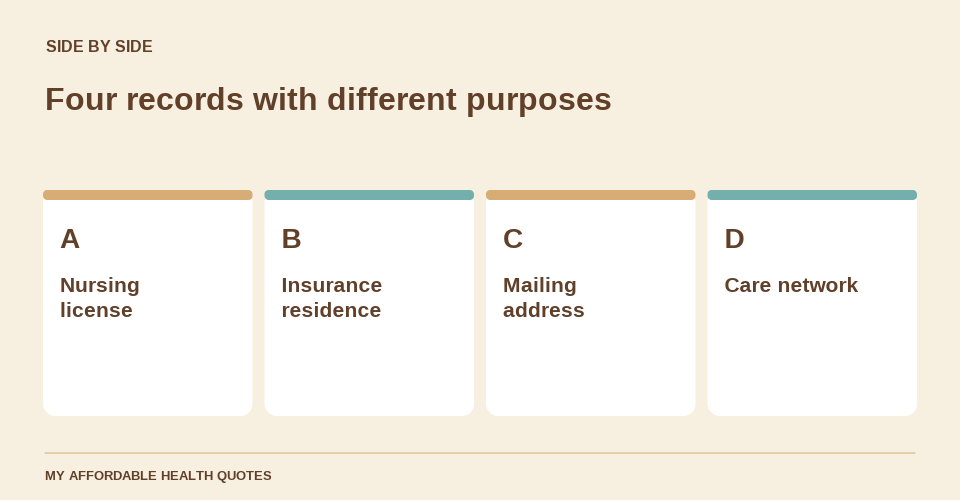
A multistate nursing license can authorize practice under the Nurse Licensure Compact, but it does not make your personal health insurance network nationwide. Before a Mississippi assignment, separate the licensing question from the coverage question. Confirm your authority to practice with the appropriate nursing resources, and confirm residence requirements and routine-care access with the insurer or Marketplace. One answer cannot be used as evidence for the other.
Travel nurses often manage several addresses at once: a legal residence, temporary housing, a mailing destination, and the location where care is received. These records can serve different purposes. The solution is not to force every system to show the same address regardless of the facts. It is to understand what each system asks, provide accurate information, and obtain clarification before a change affects eligibility or access.
Understand what the compact actually addresses
The Nurse Licensure Compact's official explanation describes a multistate license issued by the nurse's primary state of residence and recognized for practice in participating jurisdictions, subject to its requirements. Its purpose is professional authorization. It does not describe the benefits of your employer health plan, the geographic network of an individual policy, or how a medical claim will be paid while you work away from home.
NCSBN's residence guidance also explains that primary state of residence for compact purposes concerns legal residency, not simply ownership of property. Do not assume that owning a home, renting a room, or keeping belongings in a state independently resolves a licensing question. If your circumstances change, use the board of nursing and compact resources to determine what must be reported or updated.
Keep licensing documents in a separate section of your assignment file from health-plan documents. That small organizational choice reinforces the distinction. A recruiter may need evidence of authority to practice, while an insurer may ask different questions about residence and service area. Sending one document to both parties does not mean both have accepted it for every purpose.
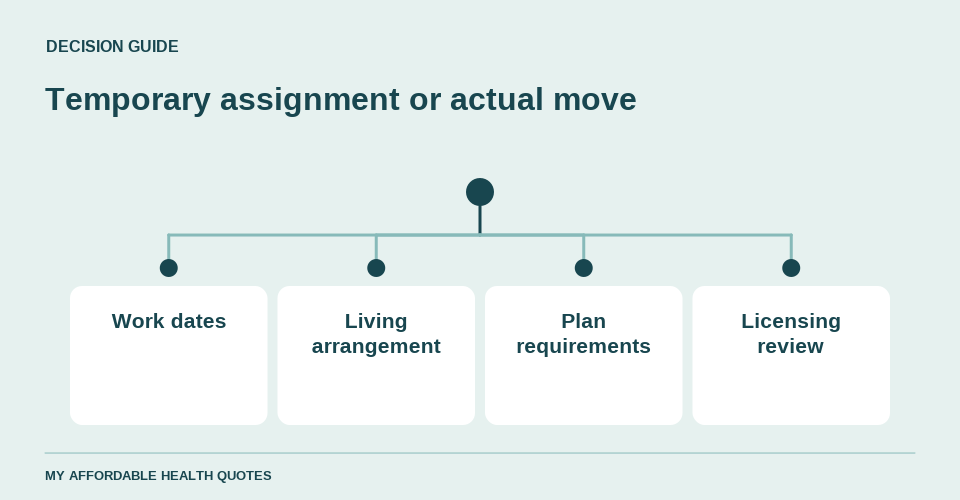
Ask the health plan what temporary travel changes
Tell the insurer the actual situation: you will work in Mississippi for a stated period, live in temporary housing, and may retain a home elsewhere. Ask whether the policy remains available under its residency and service-area terms and how routine care is covered at the assignment location. Use the exact product and network name. A general carrier customer-service page may describe several different products.
Ask about primary care, specialists, prescriptions, and any recurring services you expect to use. Emergency coverage is not a substitute for routine access. A plan can provide emergency protections while limiting ordinary out-of-area care. Likewise, an out-of-network benefit may involve different cost-sharing and restrictions. Obtain the specific explanation rather than translating a national brand name into a promise of nationwide in-network care.
If the plan asks for an address update, clarify which address field it means and why. A mailing address can differ from a residence address in some systems, but you must follow the actual application's instructions. Do not choose an address because it offers a preferred premium or network if it does not accurately answer the question. Ask the insurer or Marketplace how to represent a temporary work arrangement.
Do not assume every assignment creates a moving enrollment event
HealthCare.gov identifies certain residence changes that may qualify for a Special Enrollment Period, including specific seasonal-worker circumstances. It also states that some moves, such as travel only for vacation or medical treatment, do not qualify. The CMS moving guide describes additional conditions, including prior qualifying coverage in many situations. A short clinical assignment should therefore be evaluated on its facts rather than automatically labeled a qualifying move.
Ask the Marketplace serving the relevant location what applies to your actual change and what documents are needed. Explain where you live and work, the expected duration, and the existing coverage accurately. Do not cancel a policy first and assume a new enrollment opportunity will be approved afterward. Confirm eligibility and effective dates before relying on a replacement.
Similarly, do not assume that declining agency coverage creates an enrollment event for any individual policy you prefer. The available route depends on the applicable rules and circumstances. A quote request is not an eligibility determination. Keep the steps separate: establish whether enrollment is available, compare the product, complete enrollment, and verify coverage.
A worked temporary-assignment example
Imagine a hypothetical nurse, Jules, with an established home outside Mississippi who accepts a thirteen-week assignment near Hattiesburg. Jules has a multistate license and assumes the same geographic flexibility applies to a home-state health policy. Before departure, Jules asks the insurer about routine care at the temporary location and discovers that the policy's local network is much more limited than expected.
Jules does not solve this by changing the residence field to the assignment address without asking whether that is appropriate. Instead, Jules explains the living arrangement to the insurer and, if exploring Marketplace options, to the relevant enrollment assistance source. Separately, Jules confirms the licensing requirements for the assignment through the nursing process. The two reviews proceed with accurate facts but answer different questions.
Suppose the existing policy remains eligible but provides limited routine access in Mississippi. Jules compares the practical alternatives that are actually available, such as an eligible agency option, appropriate scheduled care at home, or another permitted coverage route. The decision incorporates prescriptions and essential clinicians, not just a hypothetical emergency. Jules does not infer that a compact privilege changes the insurer's network contract.
Now suppose Jules decides to relocate permanently rather than complete a temporary contract. That new decision triggers a fresh review of licensing, insurance residence, enrollment, and contact records. Jules does not reuse the temporary-travel answer as though nothing changed. The example illustrates the value of updating each system based on the actual event rather than letting one address change silently stand in for several separate decisions.
Keep tax questions in their own lane
Travel compensation can raise tax-residence and tax-home questions, but those concepts should not be casually substituted for insurance residence or compact residence. If a recruiter uses the term tax home, ask a qualified tax professional about the tax issue and ask the insurer about the insurance issue. This guide does not determine tax treatment of stipends, deductions, or travel expenses.
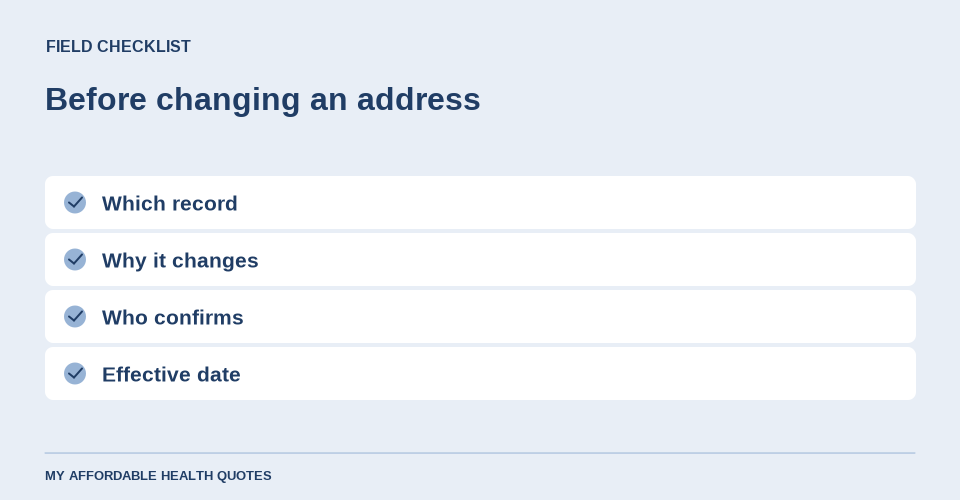
A useful personal record can list the question, the responsible professional or agency, the facts supplied, and the answer received. That structure prevents advice about one system from being repeated as a rule for another. For example, an accountant's explanation of travel expenses does not establish a provider's network participation, and an insurer's acceptance of a mailing address does not establish licensure eligibility.
Keep documents accurate and consistent with the underlying facts, while recognizing that different forms may request different information. If two answers appear contradictory, ask each party to clarify its definition rather than changing facts to make the forms look similar. Accuracy matters more than superficial consistency of every address field.
Review the family's location separately
If a spouse or children stay at home while you work in Mississippi, verify their routine access under any proposed policy. A plan that solves your local needs may create a problem for the family. Check the exact doctors, pharmacies, and facilities in both locations. A family enrollment decision should not be based solely on the traveling nurse's work ZIP code.
Ask how dependent eligibility and residence are handled under the actual plan. Do not infer the answer from a general Marketplace article if you are enrolling in an employer policy, or vice versa. Use the applicable documents and administrator. If the household has complex living arrangements, obtain help before submitting assumptions as facts.
Also confirm where notices and cards will be sent and who can act through the plan's authorized process. Temporary housing is not always a reliable mailing location. A missed document request can create a coverage problem even when the original application was accurate. Establish a communication arrangement that remains usable during travel and after the assignment ends.
Recheck at extension, relocation, and return
At each major change, ask whether the previous answer still applies. An extension may turn a brief stay into a longer arrangement; a permanent relocation may change residence; a return home may restore practical access to the original network. Do not assume the administrator will infer those changes from payroll or a professional license update. Report required changes through the proper process.
Keep a simple before-and-after summary: where you lived, where you worked, what coverage was active, and which date each change took effect. This record can help explain an enrollment or claim question later. Avoid adding unnecessary patient or employment-sensitive information. The purpose is a clear account of your own coverage circumstances.
For future Mississippi assignments, ask two direct questions early: am I properly authorized to practice here, and can my health plan support the care I need while I am here? Answer them with the appropriate sources rather than treating a multistate license as a universal travel credential. Clear separation makes both reviews easier and reduces the risk of discovering a network limitation only after you need care.
When requesting a plan comparison, describe the actual temporary or permanent living arrangement and the household's care locations. Ask the professional helping you to flag unresolved residence or enrollment questions. A useful comparison begins with eligibility that is accurately established, then evaluates benefits. It does not begin by selecting the most attractive address or assuming every traveling clinician has the same rules.
Sources and further reading
- How the Nurse Licensure Compact works
- Primary state of residence
- Special Enrollment Periods
- CMS moving Special Enrollment Period guide
Related insurance guides
- Working for Two Staffing Agencies in Mississippi: Resolve Overlapping Health Benefits Before a Claim
- Night-Shift Travel Clinicians in Mississippi: Compare After-Hours Care Before Choosing a Plan
- Your Final Agency Paycheck Is Not Proof of Your Last Covered Day: A Travel Clinician’s Reconciliation Guide