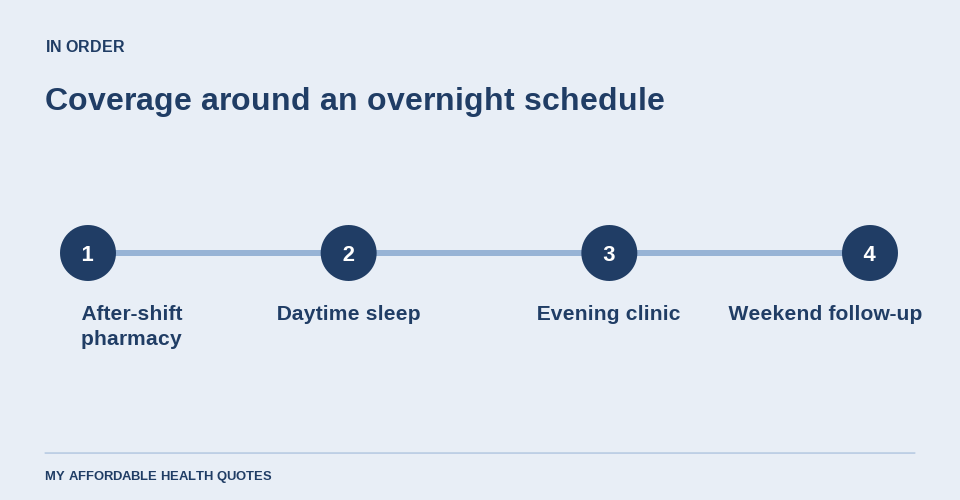
A health plan can have a reasonable-looking provider directory and still be awkward for a clinician working nights in Mississippi. The question is not simply whether a clinic is nearby. It is whether an appropriate participating provider can see you at a usable time, whether the pharmacy is open when you can collect medication, and whether virtual care is available under both the plan and applicable professional rules. Test those practical details before choosing coverage.
This guide helps compare access around a work schedule. It does not tell you which symptoms belong in urgent care or an emergency department. Seek clinical advice when deciding where to obtain care, and do not delay an emergency because a preferred location is closed. Insurance planning is useful precisely because it can reduce the number of administrative decisions you face when you are tired, unwell, or between shifts.
Build your schedule map before your provider map
Write down your expected shift pattern, commute, sleep window, and days off. Leave room for orientation and occasional schedule changes. A clinic open until five may technically have extensive hours yet be difficult to use if you finish at seven in the morning and need to sleep before returning that evening. Avoid treating every free hour on a calendar as equally usable time.
Next, identify the kinds of nonemergency access you expect to need. You might want an initial primary care appointment, recurring counseling, laboratory testing, prescription pickup, or a follow-up with a specialist. These services have different scheduling constraints. Separating them prevents you from assuming that a convenient walk-in clinic can replace every element of an ongoing care relationship.
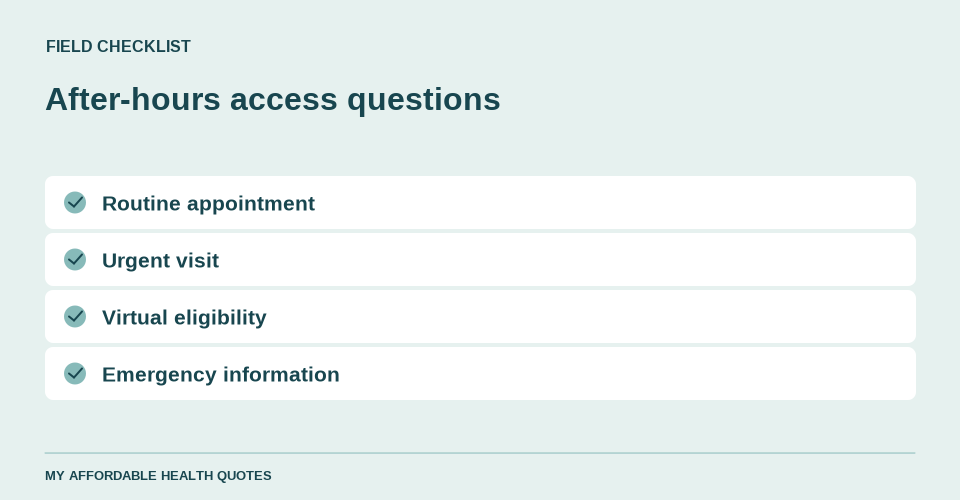
Make a second list for unexpected needs: the insurer's advice line if offered, participating urgent care locations, the plan's virtual service, and emergency information. This is a contact list, not a personal triage algorithm. Use the plan's own descriptions and ask how each service is billed. A service marketed as available around the clock may still have limits on location, visit type, clinician availability, or the problems it can address.
Verify actual appointments, not just directory entries
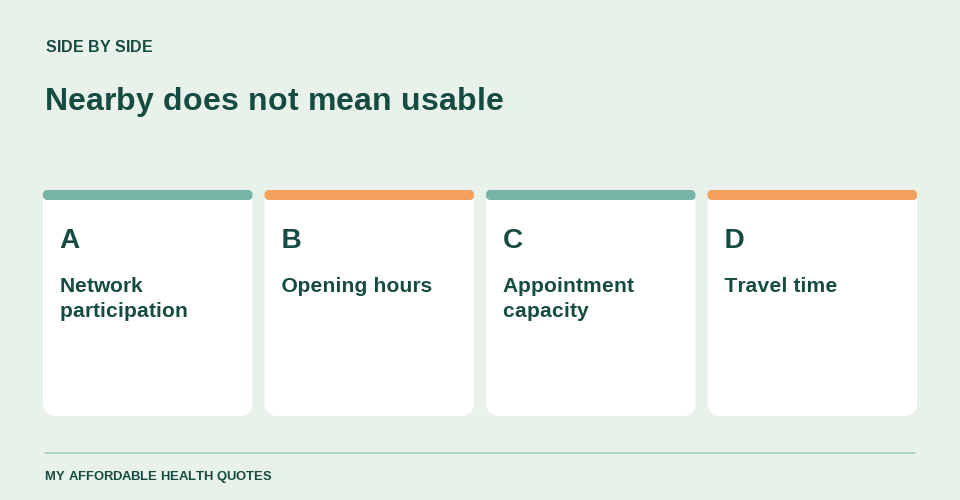
Search the exact product's network near your temporary housing and near the facility where you work. Those two starting points can produce different practical options. Then call the offices that appear most promising. Ask whether they are accepting patients under your specific plan and whether the appointment type you need is available at the hours shown. A directory's general business hours do not necessarily describe new-patient appointment slots.
HealthCare.gov recommends checking the insurer's directory and contacting the provider as part of network verification. Add a scheduling question to that process: what is the next appointment available before or after a shift? If you need laboratory work, ask whether collection hours differ from the practice's office hours. If you need an established primary care relationship, ask whether a walk-in service can provide the follow-up you expect.
Record the date you checked and the answer you received. Appointment availability can change, so the record is not a guarantee of a future slot. It is evidence that you evaluated access rather than relying on a map pin. If every reasonable participating office has an obstacle, contact the insurer for assistance locating care and describe the specific service, schedule constraints, and locations you have already tried.
Compare the cost of different service settings
Read the benefits summary for primary care, urgent care, emergency care, laboratory work, and telehealth. Ask whether the deductible applies to each and whether a facility charge or separate test could be billed. Do not assume an evening appointment is billed the same way as an office visit simply because the building looks like a clinic. Ask the provider how the location is classified and verify the relevant benefit with the insurer.
A lower copay can be attractive, but it should not be the only factor. If an appointment requires an extra unpaid day, a longer drive, or repeated rescheduling, the practical burden can outweigh a small fee difference. Keep those personal costs separate from the insurance estimate so that the comparison remains honest. Travel time is a real consideration, but it is not a covered claim merely because you include it in your planning worksheet.
Do not use your access to the hospital as an employee as evidence that personal care there is covered. Employment privileges, occupational health services, and ordinary health insurance benefits are different arrangements. Ask what occupational health handles for work-related needs and where you should obtain unrelated personal care. The employee badge and insurance card answer different questions.
A worked comparison for an overnight assignment
Imagine a hypothetical laboratory professional, Dana, on a thirteen-week assignment near Jackson. Dana works four overnight shifts in a typical week and needs a routine follow-up during the contract. Plan A lists a participating office ten minutes from housing, while Plan B lists an office twenty-five minutes away. A quick map comparison appears to favor Plan A.
Dana calls both offices. The closer office only offers the needed new-patient visit during the middle of Dana's usual sleep window, and its next available date is late in the assignment. The farther office offers an early-evening appointment on a day off. Dana then verifies the exact network and estimated cost-sharing for each. The longer drive may be the more workable option, but the decision is based on confirmed details rather than a general preference for a broader network.
For a hypothetical personal-cost calculation, suppose an inconvenient appointment would require a $40 ride and one unpaid hour, while the evening appointment would require $12 in transportation with no missed work. Dana writes those assumptions in a separate column from the plan's premium and medical cost estimate. The calculation is not a universal price comparison; it shows how a schedule can change the practical value of access.
Dana also asks what happens if the follow-up requires a test. The evening office sends some testing to a separate laboratory with different hours. That discovery changes the plan: Dana arranges the office visit and testing on compatible days rather than assuming everything will happen at one stop. This is the level of detail that a provider count alone cannot supply.
Check virtual care from your actual location
Virtual care may help with scheduling, but it is not automatically portable across every state. HHS explains that interstate professional practice depends on licensing and other applicable permissions, and providers should verify the patient's location. Tell a home clinician that you will physically be in Mississippi during the appointment. Do not give a home address in another state as though it describes your location at the time of care.
Separately, ask the insurer whether the visit is covered under the specific product, whether a designated vendor is required, and what cost-sharing applies. A clinician being permitted to treat you does not establish that the plan pays for the visit. A covered telehealth benefit does not establish that your preferred clinician can legally provide it from every location. Both checks are necessary.
Consider privacy and follow-up as practical issues. Temporary housing may not provide a quiet space for a sensitive visit, and a virtual appointment may lead to an in-person examination or testing. Ask how follow-up is arranged before treating a video service as your entire care plan. Keep a secure way to receive messages and documents while moving between assignments.
Make prescription access fit the shift pattern
Check the pharmacy network and the actual opening hours of the location you expect to use. Some stores have different hours for the retail floor and pharmacy counter. Ask whether weekend hours, delivery, or an allowed longer supply could help, subject to the prescription, pharmacy, plan, and applicable rules. Do not assume a national chain means every branch has identical network status or services.
If you use a specialty medication, confirm the required pharmacy and delivery process separately. A shipment that arrives while you are working or sleeping may need a safe receipt arrangement, especially when storage conditions matter. Ask the pharmacist about handling and timing. Do not leave a medication in an unsuitable place merely because the insurance claim was approved.
Use the findings to choose, then recheck on arrival
At the end of the comparison, you should be able to name a plausible routine-care office, a pharmacy, and the plan's after-hours assistance route. Keep any unresolved question beside the premium rather than hiding it in notes. If two plans have similar costs, confirmed appointment access may be a meaningful difference. If one has a much higher premium, decide whether the added convenience and care options justify that expense for your circumstances.
Recheck the most important details after arrival and after any schedule change. A new housing location or rotation can change which office is practical. Keep the contact list on your phone and in a secure backup, but avoid storing unnecessary medical details in a document shared with coworkers. The goal is a small, usable plan for your own care, not a comprehensive directory you will never consult.
When requesting help comparing coverage for a Mississippi night assignment, describe the actual schedule and the services you need. Asking for a plan with good after-hours access produces a better conversation when it includes specific days, locations, and appointment types. A health plan should be evaluated against the life you will be living during the contract, including the hours when you are awake and able to obtain care.