When a Tennessee facility cancels shifts, the immediate loss of pay is obvious. The effect on agency health insurance may be less obvious. Do not assume one short week automatically terminates coverage, and do not assume guaranteed contract hours automatically preserve it. Ask the staffing employer how the health plan measures eligibility, what happens during unpaid time, and how employee premium payments are collected when a paycheck is smaller than expected.
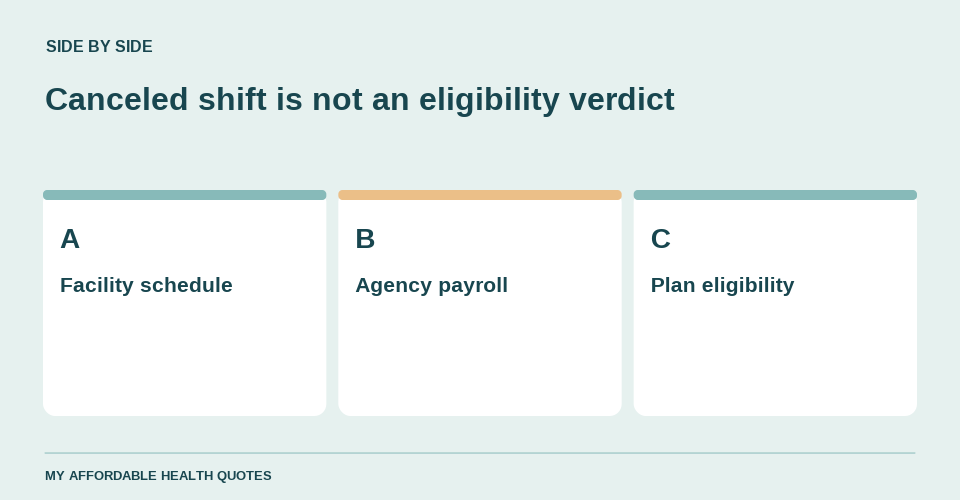
This is a benefits-administration question triggered by a scheduling change. The facility controls its staffing needs, the agency administers your employment relationship, and the health plan applies its eligibility terms. Those roles can overlap operationally, but a charge nurse's comment about next week's census is not a coverage determination. Your objective is to connect the schedule change to the actual rule without inventing an hours threshold that may not apply to your arrangement.
Identify the measurement the plan actually uses
Begin by asking whether eligibility is evaluated by scheduled hours, paid hours, employment classification, an averaging period, or another standard in the plan documents. Request the applicable section rather than a generic statement that full-time employees receive benefits. Ask how canceled shifts are recorded and whether guaranteed pay, paid leave, orientation, or other time is counted. The answer may depend on the employer's policy; there is no useful universal number to substitute for the document.
Also ask when any change would take effect. A reduced-hours week and a future coverage termination can occur on different dates. You need to know whether the agency expects a status review, whether a notice will be issued, and whether there is anything you must do before that review. Document the current answer even if the agency expects your schedule to recover. A prediction about future staffing should not be the only evidence supporting continued insurance.
Keep the assignment contract nearby, but do not treat its pay guarantee as the entire health-plan contract. One document may describe compensation if the facility cancels a shift, while another defines benefit eligibility. If the documents appear inconsistent, ask the agency to reconcile them in writing. A useful response explains which provision applies to the exact circumstance rather than repeating that the company values its clinicians or normally takes care of these issues.
Track money and coverage separately
A smaller paycheck can create a premium-collection problem even when eligibility continues. Ask whether missed employee deductions will be taken from the next check, billed directly, or handled another way. Obtain any due date and payment method from the benefits team. Do not send money to an unfamiliar person merely because a recruiter says an urgent payment is needed. Use the employer's established payment channel and retain the receipt.
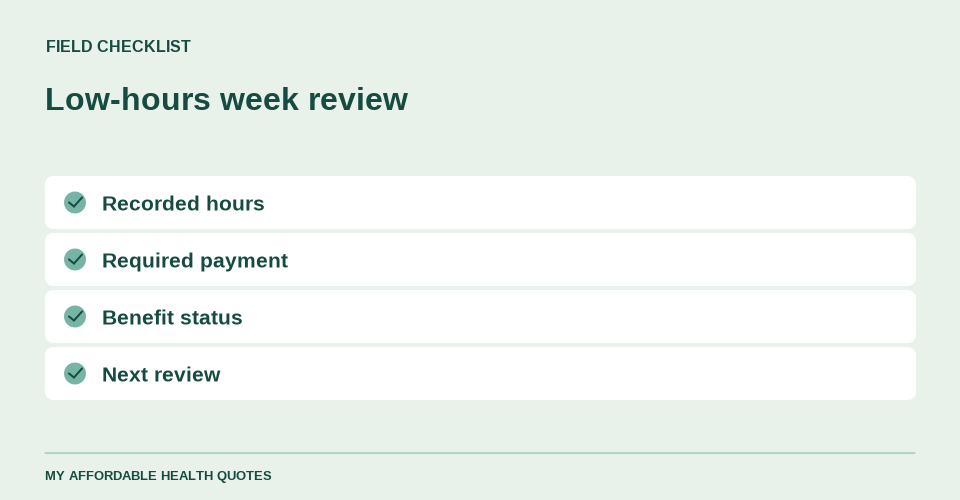
Make a simple ledger with the pay period, hours worked, any guaranteed hours paid, medical deduction, dependent deduction if separate, and any balance the agency says remains due. This ledger is not an attempt to calculate legal eligibility independently. It lets you spot a missing payment instruction or an unexplained double deduction early. Compare it with the benefits department's records before assuming that an unusually large deduction is either correct or improper.
Then check the coverage record itself. An active member portal is useful evidence of the current system status, but ask about any pending termination or retroactive correction if hours are under review. Conversely, a missing portal update may be an administrative error. Keep the distinction visible: payroll records describe money, eligibility records describe enrollment, and the plan documents explain how the two are supposed to interact.
A worked low-census example
Imagine a respiratory therapist, Malik, on a hypothetical Nashville assignment. His normal schedule has three twelve-hour shifts each week. During one week the facility cancels a shift, and the next week it cancels two. Malik's paycheck falls sharply. He hears from another traveler that benefits disappear below a particular number of hours, but that traveler works for a different agency. Malik decides not to use that story as his eligibility rule.
He sends his own benefits team the two affected pay periods and asks four questions: whether his eligible status has changed, what measurement period applies, whether any premium amount remains unpaid, and when he should expect written notice if coverage will end. The team confirms that it is reviewing hours under the employer's stated process and provides a payment instruction for the current month. Malik keeps the reply with his schedule and pay statements.
Suppose the next paycheck includes two medical deductions because the earlier check could not support the full amount. Malik compares the total with the written payment explanation. If the numbers agree, he records the balance as resolved. If they do not, he asks payroll and benefits to reconcile the same pay periods together. He does not cancel coverage simply because a deduction looks wrong, since cancellation could create a separate enrollment problem.
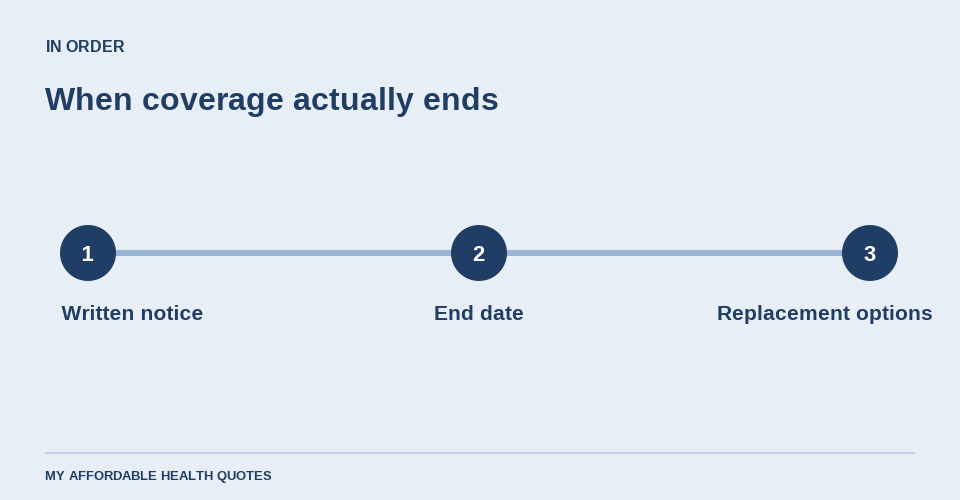
Now suppose the agency ultimately confirms that eligibility will end on a specific date because the assignment is being reduced permanently. Malik requests a notice of that end date and asks which continuation options apply. He compares those options with any eligible replacement coverage using actual start dates. The important transition is from uncertain reduced hours to documented loss of coverage, not from a rumor about hours to an immediate purchase.
Separate temporary fluctuation from an ended assignment
Ask whether the agency still considers you on the same active assignment. A few canceled shifts, an unpaid personal break, and an early contract termination can produce different employment records. Explain the facts accurately; do not describe a termination as a vacation or a vacation as a layoff because one label seems more helpful. If the agency's terminology is confusing, ask it to state both the employment status and the health coverage status plainly.
If the facility offers a reduced schedule for the remaining contract, evaluate the whole revised arrangement. Calculate the expected pay, housing costs, employee premium contribution, and practical ability to attend your own appointments. A plan that remains active may still be difficult to afford after substantial income reduction. That financial concern is legitimate, but it is distinct from whether the plan legally or contractually terminates.
Before accepting a transfer to another facility through the same agency, ask whether there will be any benefit interruption between assignments. The same company name does not answer whether the transfer is recorded as continuous employment, a new eligibility event, or another classification. Ask the administrator to use the exact end and start dates. If the answer depends on the transfer being finalized, mark it as conditional until the paperwork is complete.
If coverage will end, compare the transition deliberately
The Department of Labor explains that certain reductions in hours can be qualifying events for COBRA when the applicable conditions are met. COBRA is not available in every employment arrangement, and the cost can differ substantially from the amount previously deducted from payroll. Request the actual election materials and premium rather than estimating from your employee share. Consider whether dependents need to continue even if you select another route.
A documented loss of qualifying coverage may also create a Marketplace enrollment opportunity, subject to its rules. Do not assume that voluntarily dropping an active plan because hours are inconvenient produces the same result. Check eligibility, documents, and effective dates before taking action. If you are already receiving Marketplace financial assistance while employment benefits change, provide accurate information through the appropriate application process rather than relying on an informal calculation.
For comparison, use the remaining assignment period and a plausible next step. One plan might be attractive for continuity with an existing clinician; another might fit a longer period of independent coverage. Do not choose solely by comparing one month of premiums while ignoring a new deductible, prescriptions, network access, or the timing of the next agency offer. Label uncertain future employment as uncertain instead of treating it as guaranteed coverage.
Escalate a disagreement with a focused record
If the agency says coverage continued but a claim is denied as inactive, request the denial and the eligibility dates submitted to the administrator. Send the relevant pay periods and written confirmation, keeping unrelated compensation disputes out of the initial claim correction request. Ask for a specific action: correct the enrollment record, explain the termination basis, or reprocess an identified claim. A focused request is easier to investigate than a long account of every scheduling frustration.
The Tennessee Department of Commerce and Insurance provides consumer assistance for matters within its authority. Some employer plans instead involve federal benefit oversight or another state's insurance jurisdiction. Start by identifying the plan's sponsor and funding arrangement, then ask the appropriate agency where the complaint belongs. Preserve formal appeal deadlines while a regulator or employer reviews the issue; a request for help does not necessarily replace the plan's own appeal process.
Negotiate clarity before the next low-census week
For your next Tennessee offer, request written answers about canceled shifts, eligibility measurement, unpaid weeks, catch-up deductions, and transfer gaps before signing. You are not asking a recruiter to guarantee that census will never fall. You are asking how an ordinary staffing change flows through benefits administration. Those answers can be as important as a small difference in the advertised hourly rate.
Keep your final checklist short enough to use: what changed in my schedule, what changed in my employment status, what payment is due, and what coverage dates are confirmed? If all four answers are documented, you can make a coverage decision with fewer assumptions. If one remains unresolved, ask that question directly before replacing or canceling a policy. The purpose is to preserve access to care while responding to the financial reality of a disrupted assignment.