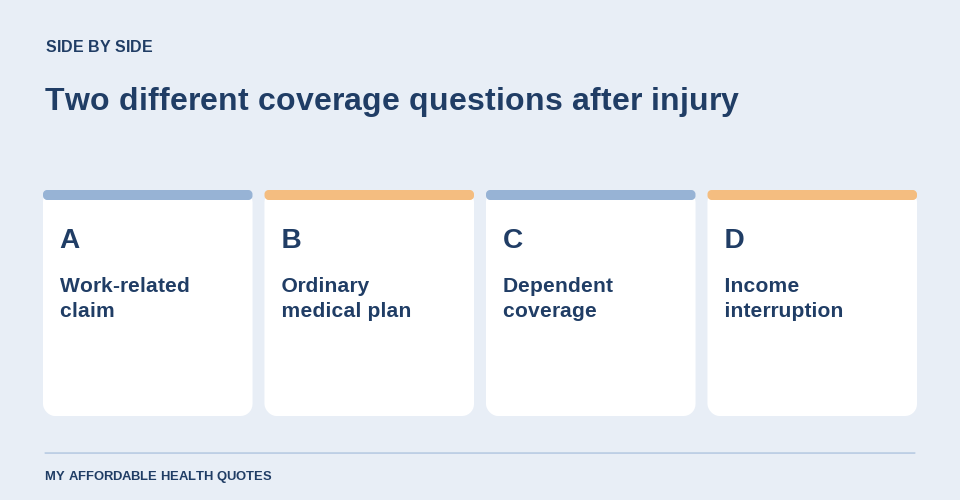
If you are injured while providing mobile or home-based clinical care in Louisiana, seek appropriate medical attention and promptly report the incident through the employer's required process. Do not assume your ordinary health insurance is the only coverage involved, and do not assume every injury during an assignment is automatically a compensable work injury. Workers' compensation and personal health coverage answer different questions that should be handled accurately and separately.
This article is an administrative planning guide, not a determination of eligibility or legal advice about a particular injury. Work-relatedness, employment status, jurisdiction, and the facts of an incident can matter. Louisiana's official injured-worker guidance explains that qualifying job-related injuries or illnesses may involve medical care, partial wage replacement, and other benefits. If a claim is disputed or the responsible jurisdiction is unclear, obtain help from the appropriate workers' compensation agency or qualified counsel.
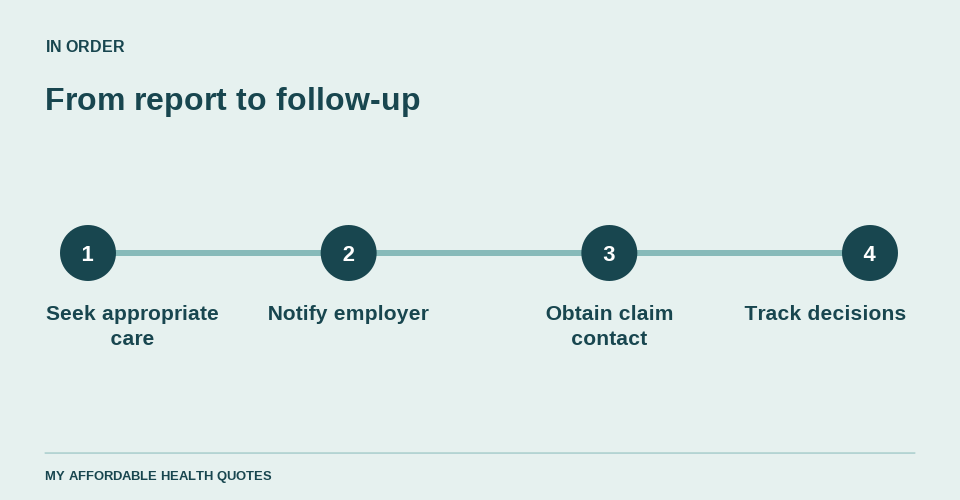
Know the reporting route before your first visit
Mobile clinicians may work in several homes or facilities while being employed by a staffing agency, health system, or another organization. Before beginning the assignment, ask who receives an injury report and how to reach that person outside ordinary office hours. Keep the employer's process accessible rather than assuming the patient location has the same reporting system as a hospital unit.
Ask what to do if the immediate supervisor is unavailable and where emergency information is posted or supplied. This is not an instruction to delay urgent care while finding a form. It is a way to avoid administrative confusion after the immediate medical need has been addressed. A short contact list is more useful than discovering after an incident that the recruiter is not the claims contact.
Confirm your employment relationship and the entity responsible for the relevant coverage. Do not decide workers' compensation eligibility solely from the label contractor, traveler, or per-diem on an informal message. Classification and legal coverage can require a more careful review. Ask for documentation and appropriate advice if the arrangement is unclear before relying on an assumption about protection.
Describe the incident accurately
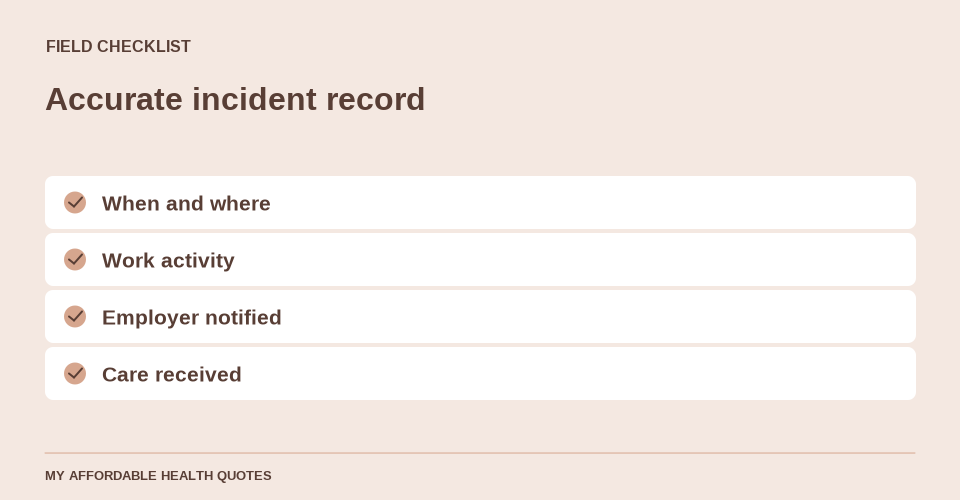
Record the date, time, location, activity, and people notified as soon as reasonably possible. Use factual language about what happened and what you observed. Avoid guessing about a diagnosis or rewriting the event to fit a preferred insurance route. Medical professionals can assess the injury, and the responsible process can evaluate the claim based on accurate facts.
Protect patient privacy when documenting an event in a home or clinical setting. Do not copy patient charts, photographs, or identifying information into a personal folder unless authorized and appropriate under the applicable process. Ask the employer how necessary incident information should be recorded securely. Your own claim documentation should not create an unrelated confidentiality problem.
The Louisiana Department of Insurance's workers' compensation brochure emphasizes prompt reporting to the employer and obtaining medical attention. Follow the current instructions that apply to your situation rather than waiting to see whether discomfort disappears or whether a future shift is affected. If you are uncertain whether an event is work-related, report the facts and ask how the question should be evaluated.
Identify the claim contact and next step
After reporting, ask for the claim administrator or insurer information and any reference number. Confirm what documents are needed from you and how treatment authorization or provider selection is handled under the applicable process. Do not assume the rules are identical to your ordinary health plan's network or referral rules. A familiar doctor may still need to follow a different administrative route for a work-related claim.
Keep written notices and deadlines together. Ask for clarification when a verbal answer is ambiguous, especially if it concerns approved treatment, work status, or a denied service. A recruiter may help you reach the right office, but the recruiter should not be treated as the final authority on a disputed benefit decision. Direct important questions to the entity responsible for the claim.
If the claim is denied, request the stated reason and the appropriate dispute procedure. Louisiana's official guidance describes a disputed-claim process, but the correct action depends on the issue and jurisdiction. Do not substitute a general internet form for individualized advice when rights or deadlines are at stake. Keep the original notice available when contacting the agency or a qualified professional for help.
A worked mobile-care scenario
Imagine a hypothetical home-health clinician, Rosa, on a Louisiana assignment. During a patient visit, an incident occurs while Rosa is performing a work task. Rosa obtains appropriate medical care and reports the event to the designated employer contact, documenting the time, location, activity, and notification. Rosa does not decide on her own that it must be billed as an ordinary illness simply because she already has a health insurance card.
The employer provides a claims contact, who requests information and explains the next administrative steps. Rosa gives treating providers accurate information about the incident and claim. If a provider asks about other insurance, Rosa answers truthfully and asks the relevant administrators how billing should be handled while responsibility is being reviewed. She does not conceal the possible work connection to make a claim process faster.
Separately, Rosa asks the agency benefits department whether her regular medical policy and her child's dependent coverage remain active while she is off scheduled work. The workers' compensation review does not answer that question automatically. The benefits department explains the employment-plan rule and any required employee premium payment. Rosa keeps that confirmation in a separate coverage record so unrelated family care is not overlooked.
Suppose Rosa receives a medical bill while the work claim is unresolved. She contacts the provider and claims administrator with the reference information, asks what status the bill reflects, and keeps all notices. She does not assume that ignoring the bill is safe or that paying it guarantees reimbursement. If the disagreement persists, she seeks appropriate assistance using the actual documents and deadlines.
Protect ordinary health coverage during time off
A work-related claim and an employer medical plan can operate on different eligibility rules. Ask whether reduced hours, leave, or assignment termination affects the medical plan, and obtain the actual end date if coverage will stop. This matters for unrelated conditions, routine prescriptions, and dependents whose care has nothing to do with the injury. Do not let the work claim become the only benefits issue on your calendar.
Ask how employee premium contributions are collected when there is no normal paycheck. A direct payment, catch-up deduction, or another arrangement may apply, depending on the plan. Use the documented process and keep receipts. A wage-replacement payment from another source should not be assumed to include medical premiums or to continue ordinary enrollment automatically.
If regular health coverage will end, evaluate available continuation or replacement options with confirmed effective dates. Do not assume that having a workers' compensation claim creates the same enrollment rights as every other coverage event. Explain the actual loss of medical coverage to the relevant plan or Marketplace and ask which rules apply. Keep the claim's treatment needs separate from the household's general medical coverage needs.
Keep income and work-status questions distinct
Ask the treating professional and employer how work restrictions are communicated and what duties are appropriate. Do not equate an assignment cancellation with a medical determination that you can or cannot work. The clinical assessment, employer's available work, and benefit claim are related but different decisions. Accurate written information helps prevent one from being used as a substitute for another.
If a wage benefit is available, request the calculation and payment explanation from the responsible administrator. Variable travel compensation can make the paperwork difficult, so retain pay statements and assignment records. Do not assume every allowance or payment component is included in a particular benefit calculation. A disputed calculation may require specialized advice rather than a rough percentage applied to your latest paycheck.
Also review any separate disability policy according to its own terms. Report other benefits as required and ask how they interact. Avoid assuming that multiple policies will each pay the full lost income. The practical goal is an accurate picture of available support, waiting periods, and obligations, not an optimistic total made by adding unrelated brochure figures.
Plan a move or return home while a claim is open
If the assignment ends and you plan to leave Louisiana, tell the claims administrator and treating team before changing treatment locations. Ask how follow-up, records, authorizations, and contact information will be handled. Do not assume that a move automatically closes the claim or that any provider near home can take over without coordination. Clinical and administrative continuity both need attention.
Provide a reliable mailing and electronic contact arrangement for notices, and keep copies of important records you are entitled to retain. A temporary housing address can become obsolete quickly. If a deadline or appointment arrives after you move, you need a process that will still reach you. Keep patient information out of personal claim files unless appropriately authorized.
Use the experience to improve assignment onboarding
For the next mobile-care contract, verify the injury-reporting contact, employment entity, ordinary medical-plan eligibility, and payment process during leave before starting. These questions are especially useful when you travel between patient homes and do not have one central workplace office. A clear process can reduce confusion without promising that every possible incident will qualify for benefits.
When comparing personal health insurance, remember that it is only one part of the protection needed for mobile clinical work. It should cover your ordinary medical needs according to its terms, while work-related claims must be addressed through the appropriate process. Keeping those categories distinct supports accurate reporting, protects dependent coverage from being forgotten, and makes it easier to ask the right office for the right decision.
If you face an actual disputed injury, use current official Louisiana resources and individualized professional help rather than relying solely on this general workflow. The useful preparation is a factual record, a known contact, and a clear understanding of which question remains unresolved. That foundation makes any subsequent review more efficient and reduces the temptation to guess about coverage.
Sources and further reading
- Louisiana injured worker questions
- Louisiana workers compensation dos and donts
- State workers compensation officials