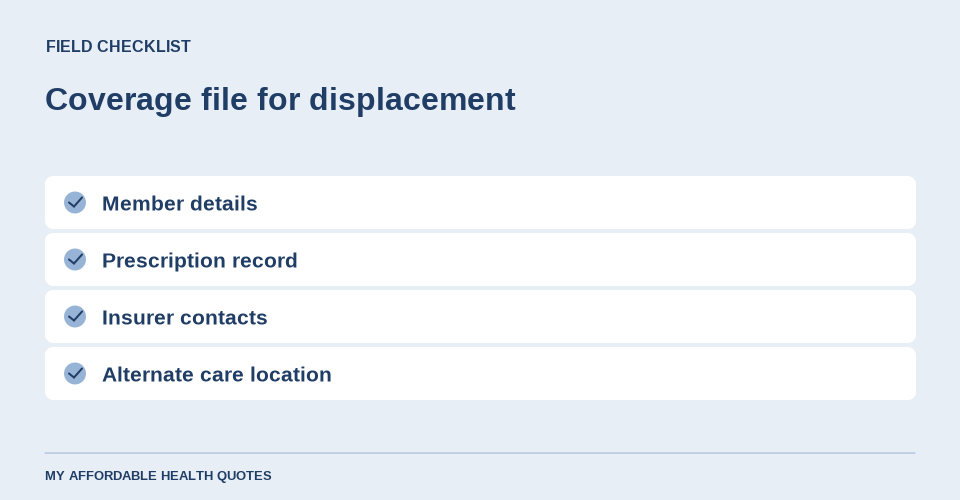
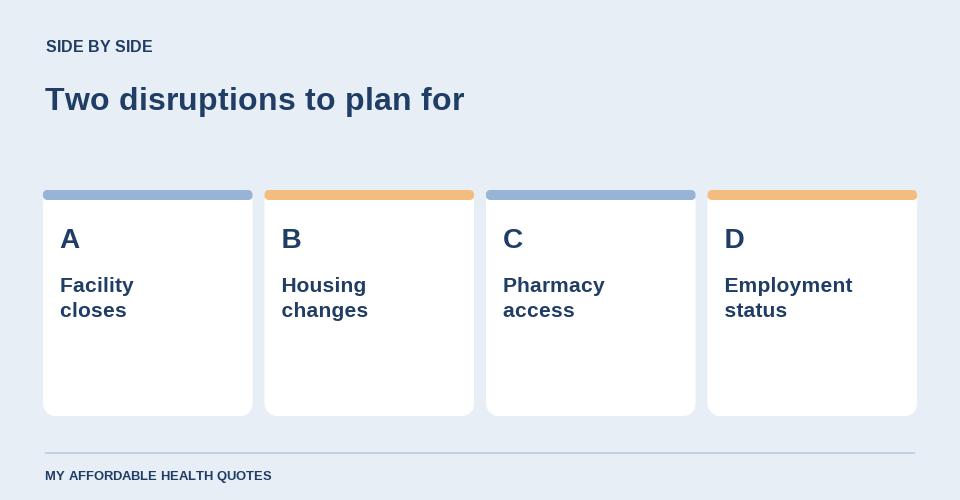
A Louisiana travel assignment can be disrupted by an evacuation even when your health policy remains active. Temporary housing may become inaccessible, a pharmacy may close, and routine care may need to occur outside the usual area. Prepare a compact coverage and medication plan before a storm threatens travel. The aim is to make active benefits usable during displacement while separately checking whether the assignment disruption changes employment-based eligibility.
This is preparedness guidance, not a forecast or an instruction to remain in or leave an unsafe location. Follow official emergency directions and your employer's lawful safety procedures. Insurance questions should not delay emergency care or evacuation. Because emergency orders can be event-specific and time-limited, do not assume that a rule issued for a previous storm applies to the next one.
Separate physical access from insurance status
Ask two independent questions: can I reach appropriate care, and what coverage is active? A policy can remain in force while its usual providers are temporarily unavailable. Conversely, a clinic can be open while your agency benefit is ending because an assignment was terminated. Keeping the questions separate prevents a reassuring answer about one from hiding a problem with the other.
Before the assignment begins, ask the agency how it communicates benefit changes if the facility closes, shifts are canceled, or the contract ends early. Obtain the benefits administrator's contact information independently of the recruiter. If normal email access is tied to the assignment, establish a permitted personal contact method for notices. Do not assume that evacuation automatically preserves or terminates coverage; ask about the actual employment and plan facts.
Keep the exact plan name, member identifier, group information, and important coverage dates in a secure accessible place. Include a copy of the insurance card and a way to reach the insurer without relying on a bookmarked page on one device. Avoid putting passwords in an unprotected document. A password manager or another secure recovery method can preserve access without turning an emergency folder into an identity-theft risk.
Plan where routine care could occur if displaced
The Louisiana Department of Insurance's preparedness guidance recommends identifying network care and asking what coverage applies when you are displaced. Choose one or two plausible destinations based on your actual family or evacuation plan, then ask the insurer how routine services work there. Do not assume that coverage outside the normal area is identical to emergency coverage. Ask about the exact product and likely services.
If you have recurring treatment, involve the treating practice before travel. Ask what records another provider would need and how the practice communicates during a closure. Identify any appointment that cannot simply be rescheduled without clinical discussion. You do not need to predict every destination, but you should know who can help coordinate care if the usual site becomes unavailable.
For an unexpected access problem, contact the insurer and explain the closed facility, displaced location, and needed service. Ask what assistance or exception process is available under the current circumstances. If the insurer refers to a disaster policy, request its effective dates and geographic scope. A general statement that the company is helping affected members is less useful than a clear instruction that applies to your situation.
Prepare medication supplies through the proper channels
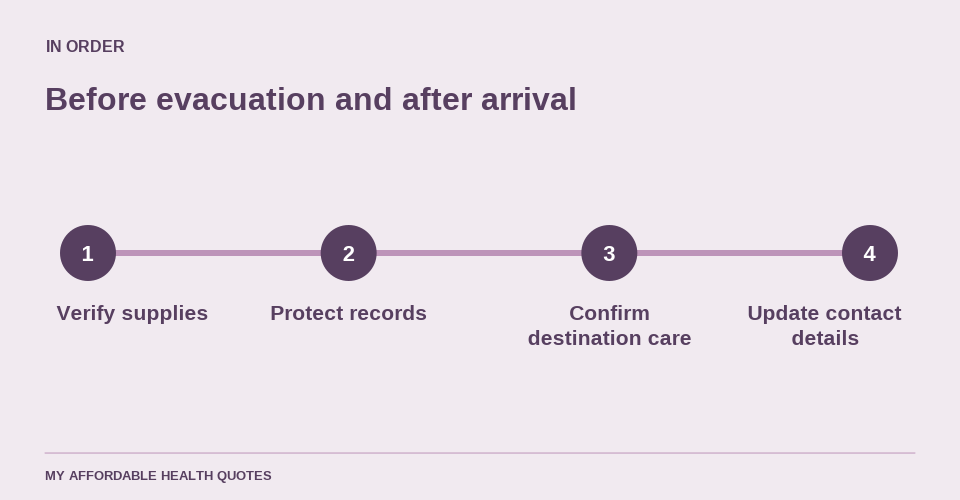
Review the supply on hand and the next refill date before conditions deteriorate. Ask the pharmacist, prescriber, and insurer about appropriate early refill arrangements if access may be disrupted. FDA guidance encourages maintaining an up-to-date medication list and planning for pharmacy interruptions. It does not mean every early refill is automatically approved or that every medication can be stored the same way.
Keep the medication name, strength, instructions, prescriber, and pharmacy contact available securely. Ask a pharmacist about storage and transport, especially for temperature-sensitive medicines. Follow labeled instructions and professional advice. A cooler, vehicle, or temporary hotel refrigerator may not provide the conditions a particular product requires. Do not use an improvised storage method simply because it appears to work for another medicine.
Protect containers and records from water damage, and consider how you will access them during travel rather than packing everything in luggage that could be separated from you. If supplies are lost, damaged, or exposed to unsuitable conditions, ask the pharmacist or clinician what to do. Do not assume a medicine is safe because its appearance is unchanged or replace a prescribed regimen with an over-the-counter product without professional advice.
A worked displacement scenario
Imagine a hypothetical travel sonographer, Theo, working near the Louisiana coast. Theo has an agency health plan and a regular prescription. A developing storm may require leaving temporary housing for several days. Theo's preparedness file identifies the insurer, prescription details, agency benefits contact, and a participating pharmacy near a family member's home inland. Theo checks current official instructions and follows the evacuation plan when directed.
Before departure, Theo asks the pharmacy about the remaining supply and whether an appropriate refill can be arranged. The insurer explains the process that applies to this event, including any documentation or limits. Theo records the instruction rather than relying on a social-media post claiming all refills are automatically free during storms. The pharmacy and prescriber handle any clinical or dispensing requirements.
After arriving at the temporary destination, Theo learns that the facility assignment is suspended. Theo asks the agency whether employment and health benefits remain active and how any required employee contribution will be collected without the usual paycheck. This is separate from asking the insurer where a local routine visit would be covered. Theo keeps both answers, since one addresses eligibility and the other addresses access.
Suppose Theo incurs a covered visit at an approved alternate location and receives an unexpected bill. Theo compares it with the insurer's instructions, saves the claim information, and asks whether the event-specific arrangement was applied. Theo does not assume every charge is exempt from cost-sharing. The goal is accurate processing under the applicable rules, not an unsupported expectation that a disaster makes all medical services free.
Use current emergency information carefully
State and insurer emergency measures may have particular dates, locations, and affected populations. Read the current notice rather than a search-result headline. Confirm whether it applies to your policy type and circumstances, especially if the agency plan is sponsored outside Louisiana or is self-funded. A rule directed at certain regulated insurers may not answer every employer-plan question.
Ask whether a deadline extension changes your obligation or merely changes the time allowed to complete it. For example, a payment accommodation may not eliminate the premium itself. Get the amount, due date, and process in writing when possible. Avoid stopping payments based on an unverified assumption, and retain proof of any attempted payment if normal systems are unavailable.
Likewise, document a claim or appeal deadline that falls during displacement and ask what relief, if any, applies. Keep copies of notices and the date received. If you cannot use the normal submission method, contact the plan for an alternative and retain evidence of the attempt. An emergency is a reason to ask for clear instructions, not a reason to presume every administrative requirement disappears.
Account for equipment and recurring services
If you use medical equipment or supplies, ask the supplier and clinician about transport, power requirements, replacement arrangements, and an alternate service location. Coverage of replacement equipment depends on the policy and circumstances; do not assume it follows the same process as a prescription refill. Keep the supplier's contact and relevant equipment information available without exposing unnecessary clinical records.
For recurring laboratory work, therapy, or other scheduled services, ask how a temporary interruption should be handled medically. Then check coverage for the proposed alternative site. Do not reverse that order by choosing a site solely because it appears in a directory and asking the clinician afterward whether it is appropriate. The appropriate service and the payable service need to be aligned.
Keep household responsibilities visible
If dependents are with you, include their cards, medication records, and care needs in the preparedness plan. If they remain at home, make sure the person caring for them can reach the insurer and knows whether agency benefits are affected. A disruption to your assignment can have consequences for family coverage far from the storm. Do not let the physical distance make those dependent records an afterthought.
Discuss who will receive mail, check notices, and manage payments if you are redeployed quickly. Temporary housing changes can redirect documents at exactly the wrong time. Give accurate contact updates through the plan's process and keep a secure copy of important correspondence. A reliable communication arrangement is often more useful than collecting a large folder of generic disaster advice.
Reconcile coverage after normal operations resume
When you return or move to a new assignment, verify the policy's status, any outstanding premium balance, and the processing of care received while displaced. Check whether temporary approvals have ended and whether routine providers or pharmacies are operating again. Do not keep relying on an emergency exception after its stated period without confirmation.
Update the preparedness file based on what actually failed or worked. Perhaps the pharmacy contact was useful but the housing address changed too quickly, or the agency notice went to an account you could not access. A short, tested process is better than a long checklist nobody can use under pressure. For future Louisiana assignments, compare health coverage with displacement logistics in mind while keeping emergency safety decisions firmly separate from insurance administration.
Sources and further reading
- Louisiana hurricane health insurance preparedness
- Safe drug use after a natural disaster
- Louisiana health insurance consumer assistance