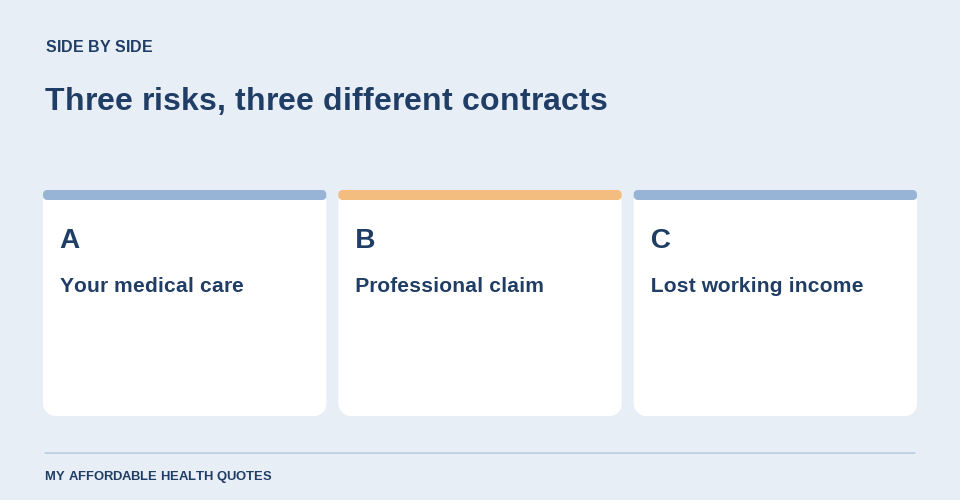
A locum tenens offer that says insurance is provided may be referring to professional liability coverage rather than your own health insurance. Before accepting the assignment, identify each policy by what it protects: personal medical expenses, claims arising from professional services, or income lost when illness or injury prevents work. These are different risks, and one contract should not be treated as a substitute for the others.
This distinction matters for physicians, advanced practice clinicians, and other professionals working temporary arrangements. The exact employment classification, contract, profession, and state affect the details. This guide does not decide whether a particular policy is legally sufficient or whether a claim will be paid. It gives you a structured way to request the documents and identify gaps before an ambiguous benefits phrase becomes an expensive assumption.
Ask the recruiter to name every coverage item
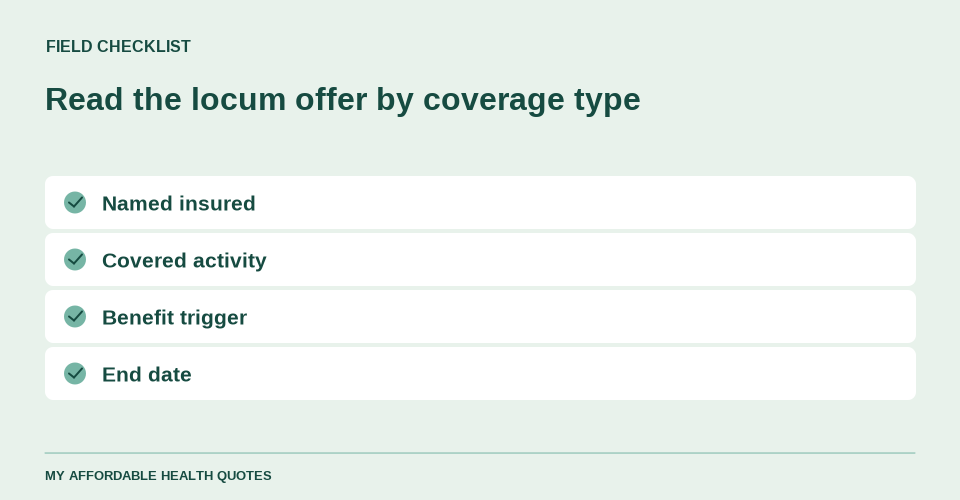
Request a written list of the insurance included with the assignment and who pays for it. For each item, ask for the insurer or plan name, policy type, effective dates, and the document that describes the benefit. If the answer is malpractice included, follow up specifically about personal medical coverage and any available disability benefit. Do not assume the recruiter intended to mislead you; the problem may be shorthand that needs to be unpacked.
Separate a benefit provided by the agency from a benefit merely available for purchase. Also distinguish a reimbursement, stipend, or allowance from an actual enrolled policy. Money intended to help with premiums does not itself create coverage. If you must buy a plan, confirm eligibility and effective dates independently before assuming the assignment's start date is also your insurance start date.
Keep the coverage list beside the contract's compensation and cancellation terms. A high gross rate may be reasonable even when you arrange your own insurance, but the comparison should include those costs. A lower rate with meaningful employer benefits may also be competitive. You cannot evaluate the tradeoff accurately if different types of insurance are bundled into one vague line called benefits.
Personal health insurance addresses your own care
For medical coverage, request the Summary of Benefits and Coverage and the detailed plan information. Verify who is eligible, whether dependents can enroll, when coverage starts and ends, and how premiums are paid between assignments. Check providers, prescriptions, and routine access where you will physically work. A plan's usefulness depends on the actual care pathway, not simply whether a medical card is issued.
Read the deductible, copays, coinsurance, and out-of-pocket limit, while keeping exclusions and out-of-network costs in view. The standardized benefits summary is designed to help compare health plans, but it is not a personal claim guarantee. If a recurring treatment is essential, ask about that service directly. Do not infer coverage from a general phrase such as comprehensive benefits without reviewing the product.
If the offer includes a limited-benefit product, identify it accurately. A policy that pays fixed amounts for specified events is not automatically equivalent to comprehensive major medical coverage. Ask what happens if actual hospital or specialist bills exceed the scheduled payment. The goal is to understand the financial protection being offered, rather than dismissing or endorsing a product based only on its monthly cost.
Professional liability addresses claims about your work
Professional liability coverage concerns claims arising from professional services. The Texas Department of Insurance's guidance explains this distinction and the need to examine the policy. For a locum assignment, ask who is insured, what activities and locations are covered, the limits, and how defense costs are handled. A certificate can provide useful evidence, but request enough policy information to understand the coverage you are relying on.
Ask whether the arrangement is claims-made or occurrence-based and what happens when the assignment ends. The practical implications can be significant, so obtain qualified advice if you do not understand the terms. Do not assume that a promise of coverage during the contract resolves every later-reported claim. Ask who is responsible for any required extended reporting arrangement and where that obligation appears in the contract.
Also ask about activities outside the assigned scope. Moonlighting, telehealth, supervisory duties, procedures at another site, or work for another agency may need separate review. Do not assume that a policy follows every professional activity because your name appears on it. Describe the intended work accurately and obtain the appropriate confirmation before relying on coverage.
Disability coverage addresses income under its own definition
Disability insurance can replace part of income when the policy's definition of disability and other requirements are met. It does not simply pay every time an assignment is canceled or you choose not to work. The Texas insurance department's consumer guidance emphasizes that the policy defines the disability, benefit period, and waiting period. Read those terms rather than assuming income protection begins on the first missed shift.
Ask what earnings are used to calculate benefits and how variable locum income is documented. Clarify whether the coverage continues between assignments and whether an agency-provided policy ends with employment. If you have an individual policy, ask how the planned work and income pattern should be reported. Avoid assuming that a benefit based on one form of earnings automatically includes every allowance or compensation component.
Keep disability coverage separate from paid leave and contract cancellation protection. A contract might provide compensation for certain canceled work, while disability insurance might respond to a qualifying illness or injury. Neither arrangement necessarily addresses the other's situation. Your financial plan may need to account for a waiting period, uncovered interruption, or ordinary time off even when a disability policy exists.
A worked locum offer comparison
Imagine a hypothetical clinician, Dr. Reyes, comparing two temporary offers. Offer A advertises insurance included and a higher daily rate. Offer B advertises a lower rate with a benefits package. Dr. Reyes asks for the itemized documents rather than assuming the offers differ only in price. Offer A's included insurance turns out to be professional liability, while personal medical coverage must be arranged separately. Offer B offers medical enrollment but still requires a separate review of its liability terms.
Dr. Reyes creates three columns: medical care, professional claims, and lost income. Each offer is evaluated in every column. For a hypothetical cost illustration, if independent medical coverage adds $600 per month to one route, that amount belongs in the compensation comparison. It does not tell Dr. Reyes whether the malpractice policy is adequate or whether any disability protection exists. Those questions remain separate and require their own documents.
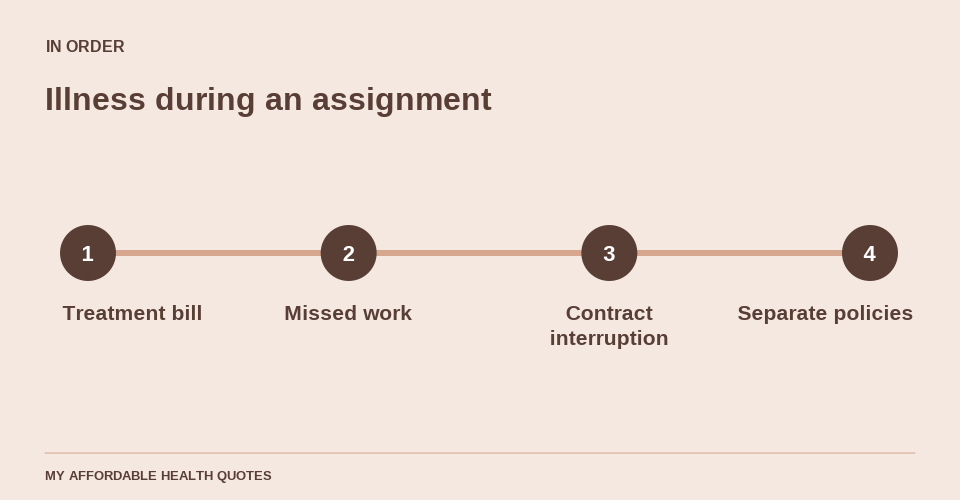
Next, Dr. Reyes imagines an illness that requires treatment and several weeks away from work. The medical plan may address covered care according to its terms. A disability policy may address some lost income if its criteria and waiting period are met. Professional liability coverage generally addresses a different category of claim arising from work. The scenario makes it obvious why a single insurance label cannot answer all three financial questions.
Finally, Dr. Reyes considers a claim reported after the locum assignment ends. That question belongs with the professional liability policy and contract, not the health plan's termination notice. Dr. Reyes asks a qualified insurance professional or attorney to explain unresolved obligations before signing. The review is focused on the actual offer rather than an assumption that a well-known agency's standard package must fit every clinician.
Check the boundaries between assignments
For each policy, record what event ends coverage and whether any continuation or portability option exists. The medical policy may depend on eligible employment, the liability policy may depend on covered professional activity and reporting terms, and the disability arrangement may have another rule. Put these dates in separate rows. A contract extension or new assignment may change one row without changing the others.
Ask who sends notices and where records will remain available after you leave the agency. Keep your own authorized copies of essential documents rather than relying on a portal that may close. Do not retain confidential patient information in a personal insurance file. The records needed for your coverage review should be handled through appropriate professional and privacy processes.
If the next assignment is in another state, verify the policies' geographic and activity scope as applicable. A professional license, health network, and liability policy do not share one universal geographic rule. Each should be checked by the appropriate party. Avoid the attractive but inaccurate idea that one nationwide label resolves every aspect of mobile clinical work.
Turn the review into a concise request
Send the agency a focused request: please identify the medical, professional liability, and disability coverage available under this offer, provide the governing documents, and confirm effective and termination dates. Add the specific activities and care needs that matter. This is more likely to produce useful information than asking whether the insurance is good.
Then compare compensation only after the missing coverage costs and responsibilities are understood. If a critical document is unavailable, label the issue unresolved and seek appropriate advice before relying on the promise. A locum opportunity can still be attractive when some coverage is self-arranged, but the decision should be based on an accurate picture of what the assignment provides and what remains your responsibility.
When requesting help with personal health coverage, make clear that you are solving the medical-care portion of the locum benefits review. Keep malpractice and disability questions with professionals qualified to assess those contracts. Clear categories make the entire review more efficient and prevent a useful policy in one category from masking an unaddressed risk in another.
Sources and further reading
- Professional liability insurance
- Medical liability insurance shopping guide
- Disability insurance explained
- Summary of Benefits and Coverage
Related insurance guides
- A Work Injury on a Louisiana Mobile-Care Assignment: Keep Workers’ Compensation and Health Coverage Questions Separate
- Louisiana Assignment Evacuation Planning: Keep Health Coverage and Medication Access Usable
- Texas Travel Assignment Delayed? Verify Day-One Health Benefits Before Canceling Your Old Plan