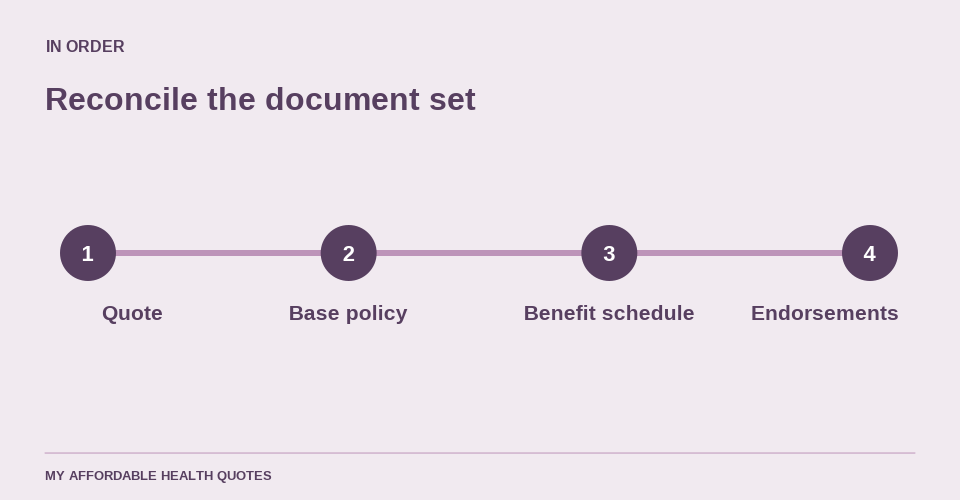
A health insurance quote is easier to understand when every promise can be traced to the document that supports it. Before buying a private policy, collect the quote, full contract, benefit schedule, exclusions, and applicable endorsements. Then reconcile them around the services that matter to you. A polished summary or familiar network logo should not substitute for this document check.
This is especially useful when a proposal combines several products or when an agent uses broad phrases such as comprehensive, major medical, or private coverage. Those words need to match the actual product. The goal is not to read every page without help; it is to identify what you are buying and locate the provisions that answer your most important questions.
Make an identity sheet before comparing benefits
Record the insurer's legal name, exact product name, policy form or identifier, state, coverage year, and proposed start date. Include the names of any separate companies providing supplemental products or services. A brand displayed prominently on a proposal may not identify every legal entity involved.
Ask the seller to classify the product precisely: individual major medical, short-term insurance, fixed-benefit coverage, another supplemental policy, or a noninsurance service. Buying directly or through an agent does not by itself determine the category. Neither does the phrase off-exchange, which describes a purchasing context rather than every feature of a product.
For an individual major-medical proposal, ask what ACA protections and requirements apply to the exact policy. HealthCare.gov explains that protections vary by coverage type. Do not assume all private products are exempt from ACA rules or that every product marketed outside the Marketplace provides the same comprehensive protections.
Build a document ledger
Create a list with each document's title, date, version, purpose, and whether you have received it. Include the quote, Summary of Benefits and Coverage when applicable, full policy or certificate, benefit schedule, exclusions, amendments, drug information, and network reference. Mark missing documents rather than silently treating the summary as complete.
Ask which documents form the insurance contract and which are explanatory or marketing material. A medical policy can describe clinical criteria without establishing that a benefit is included. A provider directory can help with network verification without defining the policy's covered services. Each document has a different job.
Keep original files with descriptive names and dates. If a revised version arrives, retain the earlier one as history and identify which is current. This makes it possible to ask why a provision changed instead of discovering later that two people were referring to different versions throughout the discussion.
Read amendments as changes, not attachments to ignore
An endorsement or rider can modify the original policy. The NAIC advises consumers to compare such documents with the original agreement and ask the insurer or agent to explain the changes. An attachment with only a few paragraphs may therefore matter more to a particular question than a long general booklet.
For each amendment, record what section it changes, when it applies, and whether it adds, removes, or clarifies a benefit or condition. Ask the insurer which provision controls if the documents appear inconsistent. Do not resolve the conflict by choosing the wording you prefer or assuming the sales summary is the final authority.
If the proposal includes an optional rider, ask its separate premium and effect on benefits. Determine whether it is part of the same policy or a distinct product. A bundle can create the impression of one comprehensive benefit even when the components have separate triggers, limits, renewal terms, and claims processes.
Translate the quote into testable statements
Take each meaningful sales statement and turn it into a question with a document reference. “Hospital coverage” becomes a request for the inpatient benefit, exclusions, cost sharing, and relevant limitations. “Prescription coverage” becomes a question about the drug benefit, formulary, pharmacy requirements, and whether the feature is insurance or a discount arrangement.
“Nationwide access” should prompt questions about the exact network and routine out-of-area care. “No deductible” should prompt a review of copays, coinsurance, benefit caps, and services outside the stated feature. The exercise is not about assuming the statement is false; it is about understanding its scope.
Write the answer in plain language next to the reference. If you cannot summarize it accurately, ask for another explanation. A useful response should let you explain what happens in a concrete situation, not simply repeat a phrase from the brochure.
Use three service scenarios
Choose one recurring need, one planned service if relevant, and one high-cost event category. For example, a household might test a regular prescription, an anticipated outpatient procedure, and an inpatient admission. The scenarios should reflect actual priorities without pretending to predict every future health event.
For each scenario, identify covered-service status, network, authorization, cost-sharing basis, exclusions, and any limit on insurer payment. Ask which parts cannot be estimated before a claim. Do not fill those gaps with invented prices. An unknown that matters to the decision should remain visible until the insurer clarifies it.
Use the same scenario for every proposal. Comparing one plan's routine office benefit with another plan's hospital example creates a false sense of comparison. A consistent service description helps reveal whether the products are even designed to provide the same kind of protection.
Separate insurer limits from your spending limits
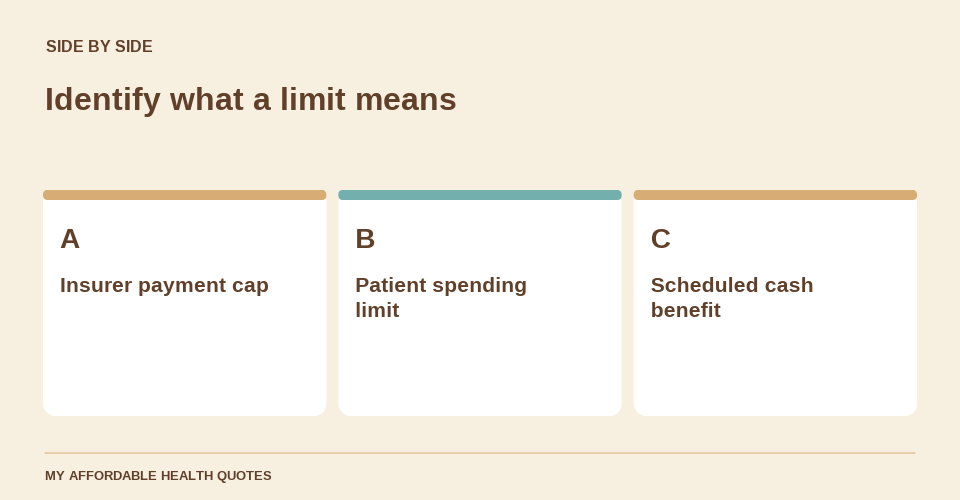
Look carefully at whether a number limits what the insurer pays or what you owe. A maximum benefit payable is not the same as an out-of-pocket maximum. Likewise, a scheduled cash payment for an event is not necessarily payment of the actual medical bill. Ask the seller to identify which type of limit appears in the proposal.
A hypothetical buyer, Sam, sees a large dollar figure beside hospitalization in one proposal and an out-of-pocket limit in another. Sam initially treats both as similar protection. Reading the documents reveals that the figures describe different obligations. The comparison must first identify how each product pays before ranking the numbers.
Ask how excluded services, out-of-network charges, and premiums relate to any stated spending cap. Do not assume every dollar the household pays receives credit toward it. The policy's definitions and applicable protections determine the calculation, and the answer should be explained for the exact product.
Confirm pricing and separate charges
Request a complete payment breakdown: insurance premium, optional products, memberships, administrative charges, and any initial payment. Ask who receives each amount and whether it recurs. A single monthly total can be convenient, but you should still know which component you can cancel or change and which remains active.
Ask what assumptions the quote uses and whether the amount is final or conditional. If additional underwriting or eligibility review applies to the product, identify that clearly. Do not treat a preliminary illustration as an issued policy or assume a payment alone confirms all conditions have been satisfied.
Read cancellation and refund terms before authorizing payment. Ask how to stop optional components and whether canceling one affects the rest. Keep the written terms with the quote so a later billing question can be answered without relying on memory of a sales conversation.
Check the application against the reviewed proposal
Before submitting, compare the application product name and start date with your identity sheet. Verify applicants and basic information. If the application changes the product or adds an option, pause the comparison and ask what changed. A benefit review is only useful if it applies to the coverage actually purchased.
Answer application questions accurately. If a question is unclear, ask for clarification rather than letting someone guess or omit information. Keep a copy of what you approve. The purpose is a correct application, not finding wording that produces a more attractive provisional result.
Ask what happens next: eligibility review, issuance, first premium, document delivery, and confirmation of active coverage. Distinguish a submitted request from a completed enrollment. Do not cancel existing coverage merely because a new quote or application has been saved.
Audit the issued policy once it arrives
Compare the issued documents with the reviewed proposal. Check the product, insured people, effective date, premium, riders, and benefits central to your decision. If there is a discrepancy, contact the insurer promptly and ask for the applicable correction or cancellation process. Do not assume the difference is harmless because the company name matches.
Save the final contract separately from earlier sales material while retaining the history. Note the insurer's contact for benefit questions and claims. This makes future verification easier when a provider asks which policy you hold or when an endorsement changes a provision at renewal.
If a disagreement cannot be resolved, ask the appropriate state insurance department or other regulator which assistance route applies. The relevant authority depends on the product and plan structure. Bring the document ledger and specific discrepancy rather than a large unsorted collection of marketing screenshots.
A document review should end in a clear purchase decision
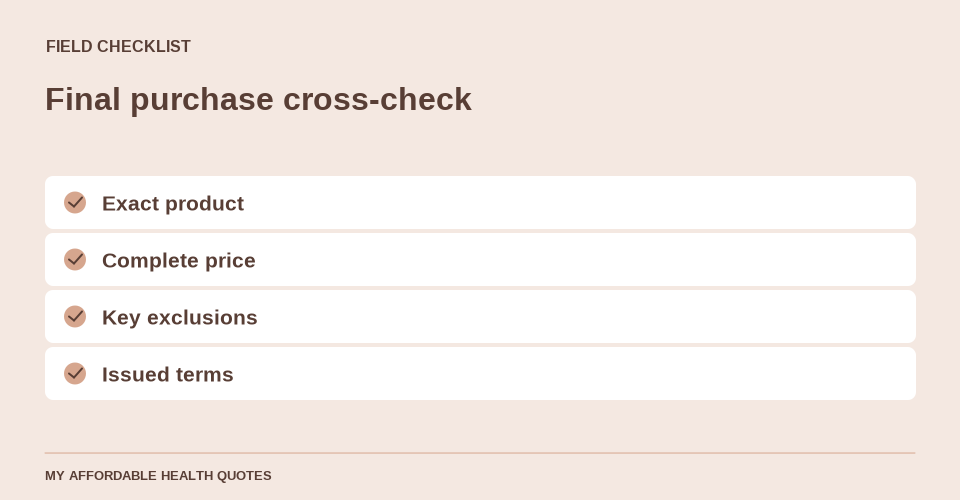
You are ready to decide when the proposal's identity, payment structure, core benefits, important exclusions, and remaining conditions are understandable. A plan can still have limitations and be suitable for a particular purpose, but those limitations should be part of the decision rather than a discovery after care is needed.
Ask My Affordable Health Quotes to walk through the ledger with you when comparing available health policies. The most useful assistance connects each important statement to the actual document and explains any unresolved difference. That produces a purchase you can describe accurately, with a record that remains useful long after the initial quote conversation ends.
Sources and further reading
- NAIC guide to endorsements and riders
- HealthCare.gov rights and protections
- Anthem explanation of medical policies versus benefits
- HealthCare.gov coverage glossary