Ground ambulance coverage deserves its own review when you compare private health insurance. Federal surprise-billing protections generally do not cover ground ambulance services, even though other emergency and air-ambulance protections exist. A Kansas shopper should therefore ask how the exact policy handles ground transport and what additional protections or local arrangements may apply. Do not assume the emergency-room benefit answers the ambulance question.
In a medical emergency, call for help and follow emergency professionals' directions. Cost concerns should not delay necessary emergency care. This guide is for advance plan review, scheduled-transport questions, and understanding a bill afterward. It is not a method for choosing transport during a crisis.
Separate the transport from the hospital encounter
An ambulance service and hospital can submit separate claims. Coverage of the hospital visit does not establish how the transport claim will be processed. Ask the insurer where the ambulance benefit appears in the contract and whether it distinguishes ground, air, emergency, and nonemergency transport.
For each category relevant to you, identify cost sharing, medical-necessity conditions, network rules, and any prior-approval requirements. Do not apply an air-ambulance explanation to a ground trip. The vehicles may serve a similar purpose from the patient's perspective, but the policy and billing protections can treat them differently.
Ask whether the benefit covers transport only or also certain treatment without transport, if that is a question you want resolved. The answer may depend on the contract and service. A general statement that ambulance is covered should be unpacked before you rely on it as a complete description.
Understand the federal protection boundary
CMS states that ground ambulance services generally are not covered by the No Surprises Act's billing protections, while state law may provide different rules. That is a reason to check, not a conclusion that every Kansas ground-ambulance bill is valid or that no other protection could apply.
Ask the insurer and Kansas Insurance Department which rules apply to your exact plan and situation. The type of coverage, provider, and circumstances can matter. If a representative gives a broad answer about federal surprise billing, bring the conversation back to ground transport and ask what contractual or other protections remain relevant.
Keep the source and date of any guidance. Billing law and arrangements can change, and an old online discussion may not reflect the service date. You do not need to become a legal expert before buying a plan, but you should know which institution can resolve the applicability question if a disputed bill arrives.
Ask how the plan calculates payment
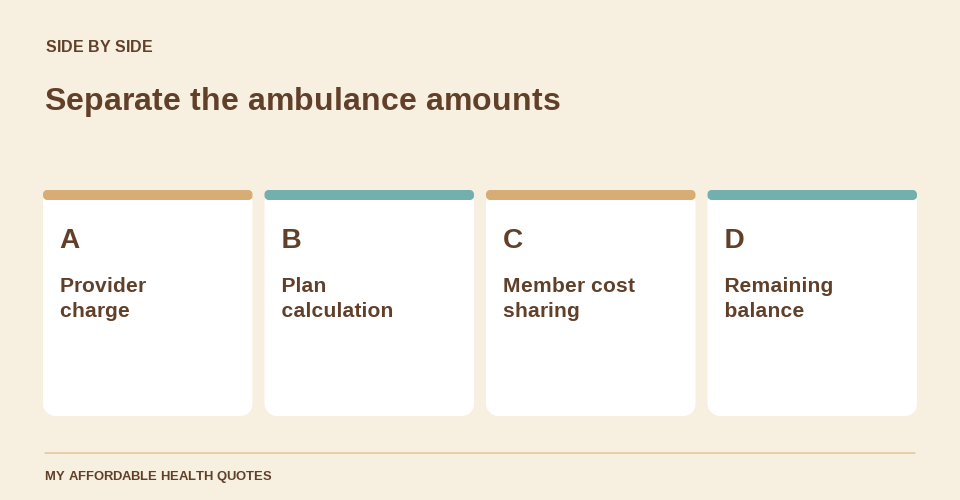
Request the policy's definition of the amount used to calculate ambulance benefits. Ask what happens if the provider's billed charge exceeds that amount. The insurer's payment and your ordinary deductible or coinsurance may not explain the entire balance when an out-of-network provider can bill separately.
Use a hypothetical calculation only to understand the structure. Suppose a provider bills an amount above the insurer's recognized amount. Your share of the recognized amount and any permitted additional provider balance are separate questions. Do not multiply a coinsurance percentage by the entire billed amount unless the policy's calculation actually works that way.
Ask the insurer to illustrate its calculation using clearly labeled sample numbers or a past anonymized example if it offers one. The objective is to understand the formula and possible exposure, not to forecast the cost of an unknown emergency. Record which parts of the illustration are assumptions.
Identify local billing practices without assuming uniformity
If you want advance information, contact the relevant local service's billing office through an official source. Ask whether it bills insurance, how it handles insurer adjustments, and what assistance or payment arrangements are available. Different services can have different practices, so one county's explanation should not be generalized across Kansas.
Johnson County MED-ACT, for example, describes its billing process and says ability to pay should not prevent calling emergency services. Its published information can help residents understand that service's process, but it is not a statewide benefit rule or a substitute for your insurer's contract.
If a membership or subscription is offered locally, request its written terms. Ask which provider and trips it covers, what it excludes, and whether it depends on insurance payment. Do not treat a membership as comprehensive insurance or assume it follows you whenever another service responds.
Scheduled transport requires an advance conversation
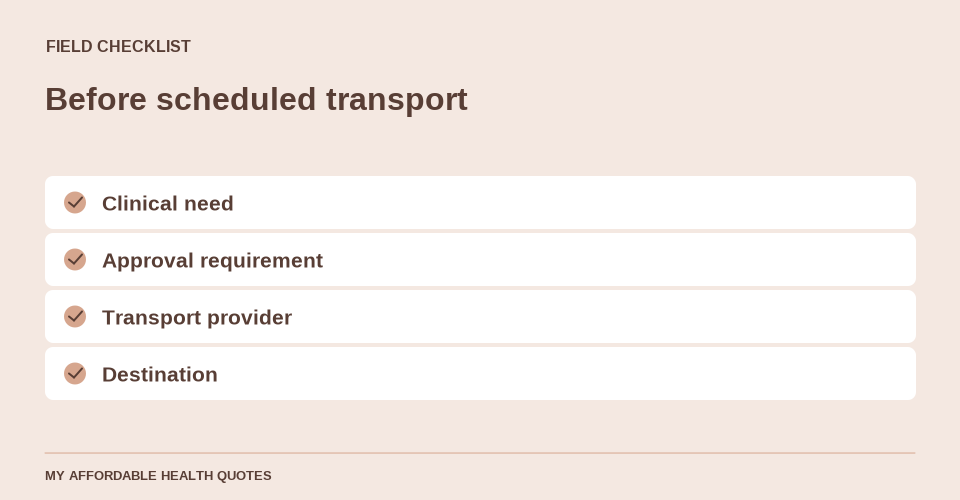
For a planned transfer or recurring nonemergency trip, ask the treating team why ambulance-level transport is needed and what documentation the insurer requires. The clinician should address the medical circumstances. Your administrative task is to identify approval, destination, and provider requirements before scheduling when possible.
Ask whether a facility is arranging the transport and who has verified benefits. A discharge coordinator's scheduling role does not automatically establish insurance approval. Request the name of the transport provider and ask the insurer about that specific arrangement rather than a hypothetical ambulance benefit.
If the insurer questions the setting or transport level, have the clinical team explain the need. Do not substitute another method without medical guidance. If time-sensitive care is involved, ask about the appropriate urgent review process rather than treating a routine approval timeline as the only option.
Read an ambulance bill in layers
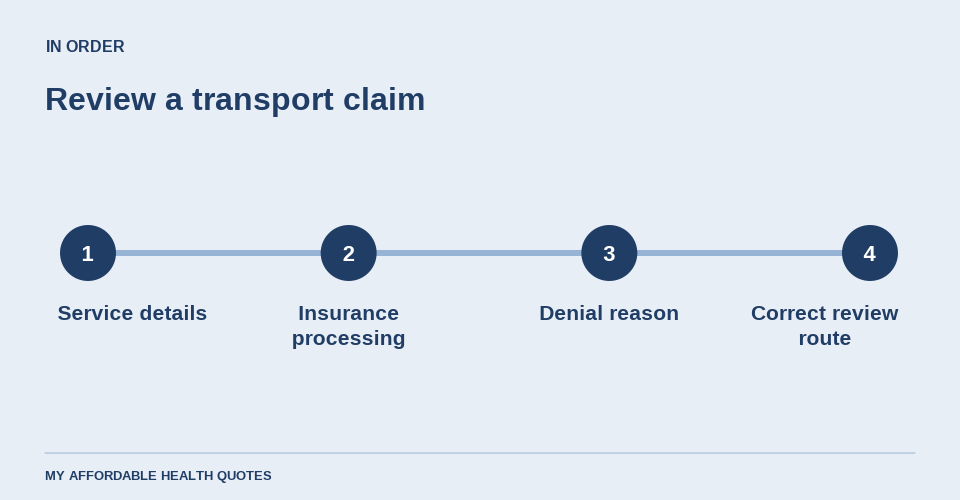
First confirm the patient, date, service provider, pickup and destination information, and insurance details. Request an itemized explanation if the bill is unclear. A transport bill may include a base component and mileage or other charges, but the provider should explain its own billing structure.
Next obtain the explanation of benefits. Determine whether the insurer paid, denied, or is still processing the claim. A provider bill and an insurer statement can arrive at different times. Before paying a disputed amount, ask whether the provider has the final insurance response and whether an updated statement is pending.
Then identify the disagreement: incorrect insurance information, coding or documentation, medical necessity, network payment, or a remaining provider balance. Each issue suggests a different next step. A general request to “fix the ambulance bill” is less effective than identifying the precise mismatch between the claim and policy.
Organize the appeal or correction
If the insurer denied the service, request the written reason and relevant policy provision. Ask the provider whether additional medical documentation or a corrected claim is needed. If the insurer made a clinical determination you dispute, follow the appeal instructions and involve the treating team as appropriate.
A provider's willingness to resubmit does not necessarily preserve your member appeal deadline. Ask what process is underway and whether you need to act separately. Keep the original notice, submission receipts, and follow-up dates. If you authorize a representative, retain that authorization with the file.
If the insurer processed the claim correctly but the remaining provider charge is disputed, ask the provider to explain the balance and any available review. A member appeal to the insurer and a billing discussion with the transport service address different relationships. You may need both rather than assuming one automatically resolves the other.
Keep financial discussions separate from urgent care decisions
Ask a billing office about payment arrangements, assistance, and whether the account can be held while insurance review continues. Get the response in writing when possible. Do not assume an appeal automatically suspends all billing activity, and do not ignore notices because someone informally said the account would be handled.
If you make a payment before processing is final, ask how an overpayment will be refunded. Keep the receipt and compare the final balance after any insurer adjustment. A favorable insurance outcome still needs to be reflected in the provider's account for the issue to be fully resolved.
For a household budget, recognize that an emergency transport cannot be priced precisely in advance. The useful preparation is understanding the benefit structure, identifying assistance contacts, and keeping accurate coverage information available. Avoid relying on an advertised policy feature that omits the ground-transport details.
Use a narrow question when shopping
Ask each candidate insurer the same question: “Under this individual policy, how are emergency and medically necessary scheduled ground ambulance services handled, including out-of-network charges and any remaining balance?” Request the contract sections and a clear explanation of which protections apply. Keep unresolved points visible in the comparison.
If an agent answers only that emergency services are covered, ask for the ambulance-specific response. This is not being difficult; it is testing a separate benefit with potentially different financial rules. A policy comparison should make that distinction explicit rather than hiding it in a broad emergency-care label.
My Affordable Health Quotes can help organize available policy documents and questions. For an existing bill, work with the transport service, insurer, and relevant consumer-assistance authority. The practical aim is to understand who charged what, how insurance processed it, and which specific review could change the result, while keeping emergency medical decisions where they belong: with emergency professionals.
Prepare a compact record for assistance
If you contact a consumer-assistance office, begin with a one-page chronology: transport date, provider, claim submission, insurer response, and current balance. Attach the bill and explanation of benefits rather than an unrelated hospital chart. State whether you are challenging the insurer's determination, the provider's remaining charge, or both. This helps the person assisting you identify which organization needs to respond.
Keep a separate list of unresolved questions, such as whether the service submitted the requested documentation or whether a payment adjustment reached the billing office. Update that list after each response. A clean record reduces the chance that you will repeatedly explain the emergency itself while the actual administrative issue remains unidentified.
Sources and further reading
- CMS ground ambulance billing action plan
- CMS medical bill rights when using insurance
- Johnson County MED-ACT billing process
- Kansas Insurance Department