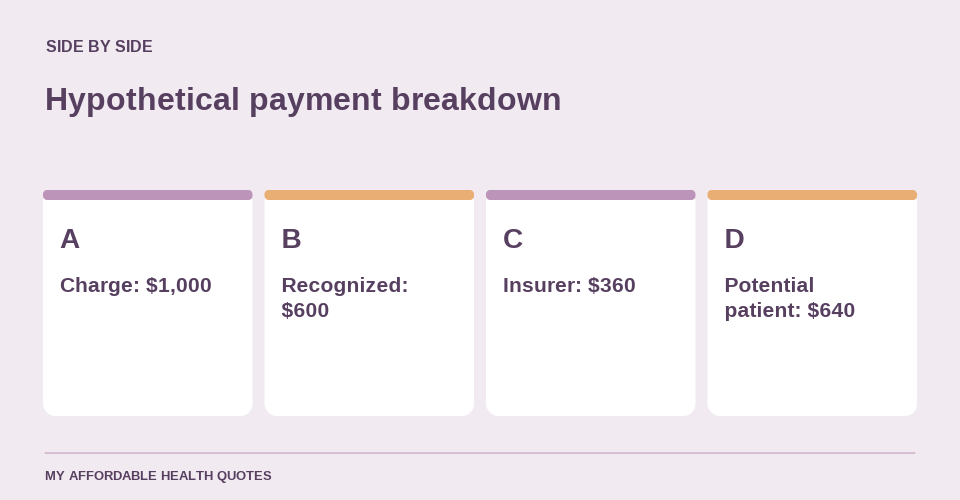
A policy that pays a percentage of out-of-network care does not necessarily pay that percentage of the provider's entire bill. The insurer may calculate benefits using its own recognized or allowed amount, while a provider may seek an additional balance where permitted. Before choosing a Kansas private plan for a preferred out-of-network clinician, understand both parts of the calculation.
This guide focuses on planned nonemergency care where ordinary out-of-network terms may apply. Federal and state protections can change the result in certain circumstances. Do not use the example below to calculate a protected emergency or surprise-billing claim without checking the applicable rules. The purpose is to expose the assumptions hidden inside a percentage-based quote.
Start with four separate amounts
Write down the provider's charge, the plan's recognized amount, the insurer payment, and the patient's responsibility. These are different figures. A conversation that uses the word cost for all four can create a misleading impression even when nobody intends to mislead.
HealthCare.gov's glossary explains allowed amounts, coinsurance, and balance billing as separate concepts. Your actual policy may use terms such as eligible expense or payment allowance. Locate its definition and ask how the amount is determined for the specific out-of-network service you are considering.
The provider can tell you its charge, but it may not know the final amount the insurer recognizes. The insurer can explain its method, but a pre-service estimate may remain conditional on the actual claim. Record those limits instead of treating either estimate as a guaranteed final bill.
A deliberately simple worked example
Assume, only for illustration, that a provider charges $1,000, the plan recognizes $600, the relevant deductible has already been met, and the plan pays 60 percent of that recognized amount. The insurer payment would be $360. The patient's ordinary share of the recognized amount would be $240.
If the provider is legally and contractually permitted to bill the additional $400 above the recognized amount, the patient's total could be $640: the $240 cost-sharing amount plus the $400 balance. These are hypothetical numbers, not a quote, typical rate, or description of a particular Kansas policy.
Notice why “the plan pays 60 percent” is incomplete. In this example, it pays 60 percent of $600, not 60 percent of the $1,000 charge. The denominator matters. A larger reimbursement percentage applied to a lower recognized amount can produce a different result from what a shopper expects.
Add the deductible only after understanding the base
If an out-of-network deductible remains, the calculation may change. Ask the insurer to illustrate the sequence for your policy rather than subtracting a deductible from whichever number seems convenient. The contract determines which expenses count and how cost sharing is applied.
Also ask whether the policy has separate in-network and out-of-network deductibles or limits, and whether spending in one category counts toward the other. Do not assume that satisfying the in-network deductible eliminates out-of-network cost sharing. The policy should state the relationship explicitly.
Keep any potential provider balance separate from deductible credit. An amount you pay does not automatically count toward every plan limit. Ask which portions are recognized for the relevant accumulator and which remain outside it. This is essential when comparing the financial risk of repeated visits.
Confirm that an out-of-network benefit exists
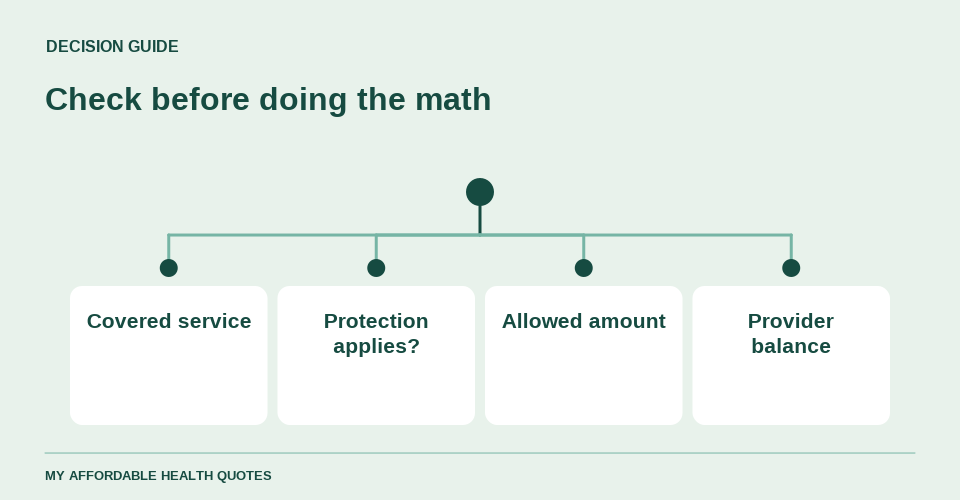
Some policies provide limited or no routine out-of-network benefits except where law or special arrangements require otherwise. Before doing percentage arithmetic, establish that the service is eligible under the contract at all. A preferred-provider label or broad carrier brand does not answer the specific policy question.
Ask whether the service itself is covered, whether authorization is required, and whether any referral or designated-provider condition applies. Out-of-network status is only one layer of the review. A service excluded from the benefit cannot be evaluated solely through the out-of-network reimbursement percentage.
If the plan offers a network-gap or single-case exception process, ask how it works and what must be approved in advance. Do not assume a lack of convenient providers automatically produces in-network payment. Obtain the terms of any exception, including whether the provider agrees to the payment arrangement.
Ask the provider about its remaining balance
Request a written estimate and ask whether the provider accepts the insurer's recognized amount as full payment in any circumstance. If it offers a separate negotiated arrangement, get the terms in writing. A verbal statement that it “works with insurance” does not establish a limit on what you owe.
Ask who submits the claim and whether you pay upfront. If you submit the claim yourself, obtain the required documentation and the insurer's filing instructions. Keep the provider's cancellation and refund terms separate from the insurer's benefit explanation; they govern different parts of the transaction.
If the provider offers a cash price, ask whether accepting it changes claim submission or reimbursement. Do not combine a discounted cash charge with an insurance estimate that assumes the provider's full billed charge unless both parties confirm that is the correct calculation.
Check whether surprise-billing rules change the analysis
The No Surprises Act addresses certain emergency services, specified nonemergency services at participating facilities, and covered air-ambulance situations. Planned care with an out-of-network professional in an out-of-network office is not automatically protected simply because the patient did not expect a high bill.
Ask the insurer or an appropriate assistance office whether the exact setting and service fall under a protection. The Department of Labor and CMS explain the scope and exceptions. Keep the facility status, provider identity, and any notice-and-consent documents if they are relevant to the encounter.
Do not sign a document you do not understand on the assumption that it is routine registration. Where a valid waiver is permitted, it can affect billing protections. Some services cannot use that exception. Ask what the document does and retain a copy, while avoiding a blanket claim that every financial consent either waives or preserves every right.
Compare two policies using the same provider scenario
Suppose a Kansas shopper wants to retain a specialist who is outside both candidate networks. Ask both insurers to estimate the same service, provider charge, and expected frequency. Identify each policy's recognized-amount method, deductible, reimbursement share, and relevant limits.
A policy with the more attractive percentage is not necessarily the better financial choice if its recognized amount, premium, or deductible differs. Use the full worksheet rather than ranking the percentages in isolation. Mark any amount the insurer cannot estimate so the remaining uncertainty is visible.
For recurring care, ask the provider whether charges vary by visit type. An initial evaluation and follow-up may not be identical services. Build the expected pattern with separate rows rather than multiplying one convenient estimate across the entire year.
Read the first claim as a test of the estimate
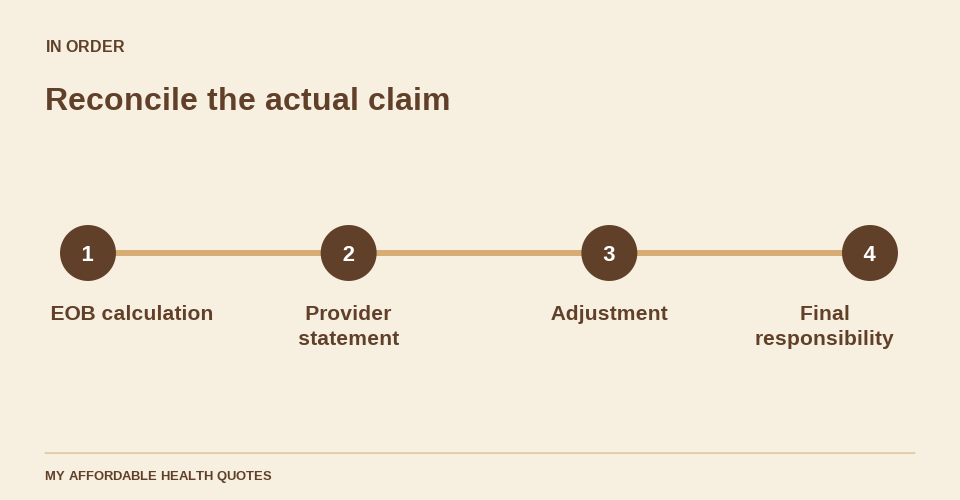
After the service, compare the explanation of benefits with the worksheet. Locate the billed amount, recognized amount, deductible application, insurer payment, and stated patient share. Then compare the provider's bill. If it includes an additional balance, ask the provider to identify that amount and its basis.
An explanation of benefits is not itself a provider bill. Conversely, a provider bill does not prove that the insurer processed the claim correctly. If the two documents disagree, identify whether the issue concerns claim processing, a contractual provider adjustment, or a separate permitted balance.
Ask about corrections before paying an unclear amount, while keeping track of billing deadlines and any account-hold agreement. If you pay while review continues, retain the receipt and ask how a later adjustment or refund will be handled. Do not assume a favorable insurer decision automatically updates every provider account.
Challenge the right part of the calculation
If the insurer used an unexpected recognized amount, ask for the policy provision and calculation method. If the service was coded incorrectly, work with the provider on a correction. If the insurer denied the benefit, obtain the stated reason and appeal instructions. These are different problems even when they produce the same high balance.
If the dispute concerns the provider's additional charge, ask the provider for its financial agreement and any applicable adjustment. If a billing protection may apply, contact the relevant assistance authority with the setting and claim details. Kansas Insurance Department guidance can help identify the appropriate route for regulated coverage.
Keep a concise chronology and the documents supporting the specific issue. A broad statement that the bill is unaffordable may be important for assistance discussions, but a processing appeal needs the facts showing what should be corrected. Distinguish those goals so each conversation is productive.
A better question than the reimbursement percentage
Before buying, ask: “For this provider and service, what amount does the plan recognize, what portion would I pay, and what additional balance could remain?” Request the assumptions and contract references. That question connects the policy to the actual financial decision you are making.
My Affordable Health Quotes can help organize the comparison, but the insurer and provider must supply their respective terms. Keep the worked example as a method, not a forecast. The key lesson is to identify the amount to which the percentage applies and then account separately for any bill beyond that amount.
If the insurer cannot provide a reliable pre-service recognized amount, ask what information would make an estimate possible and whether a formal predetermination is available. Record the remaining uncertainty in the purchase decision. A plan may still be suitable for other reasons, but it should not be selected on the assumption that an unknown reimbursement base will be favorable. Consider how much uncertainty the household can absorb before committing to recurring out-of-network care.
Sources and further reading
- HealthCare.gov allowed amount, coinsurance, and balance billing glossary
- Department of Labor surprise healthcare expense guidance
- Blue Cross and Blue Shield of Kansas federal billing-protection overview
- Kansas Insurance Department