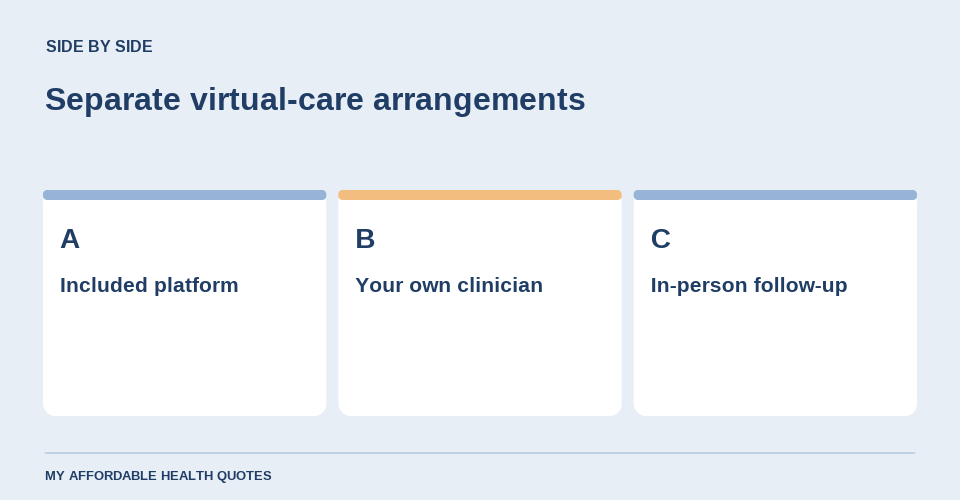
An insurance offer that includes a telehealth app has not necessarily answered how you will receive ongoing care. The app may provide a defined set of virtual services, while visits with your own therapist or specialist follow other network and benefit rules. For an Iowa individual-plan comparison, test the actual care relationship you want rather than treating all video appointments as one benefit.
The most useful review starts with a concrete need: a one-time urgent consultation, recurring psychotherapy, medication management, specialist follow-up, or a mix of virtual and in-person care. These are different service patterns. A feature that works well for one may leave important questions unanswered for another.
What exactly is included with the app?
Ask for the service description and terms. Identify the types of clinicians, conditions or services addressed, appointment format, hours, and any limits. Determine whether the app is an insurance benefit, a separately contracted service, or an optional membership bundled with the proposal. The same marketing phrase can describe different arrangements.
Do not assume that “unlimited visits” means unlimited access to every specialty, a specific clinician, or every treatment. Ask which services the phrase actually covers. If the answer refers to general medical consultations, keep that separate from behavioral health, specialist care, or long-term treatment until those are explicitly confirmed.
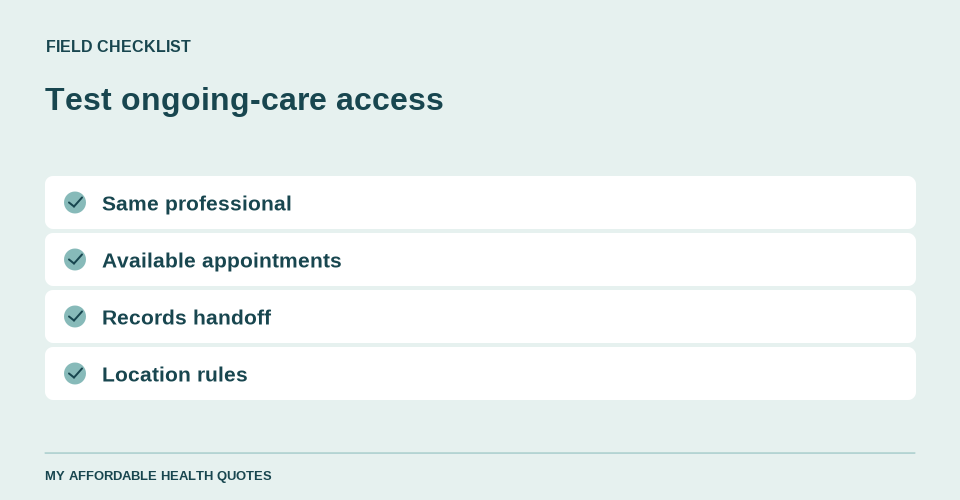
Can you keep seeing the same professional?
If continuity matters, ask whether the service allows recurring appointments with the same clinician and what happens when that person is unavailable. An on-demand consultation model may be useful for one-off needs but different from an established treatment relationship. The service should explain its own scheduling model rather than leaving you to infer it from the app's appearance.
For an existing therapist or specialist, ask that clinician whether they participate with the exact plan and can bill the intended telehealth service. A professional who offers video visits privately may not be part of the insurer's included platform. Conversely, participation in the insurer's general network may involve different cost sharing from the designated app.
Are platform visits and outside-network visits priced differently?
Request a side-by-side explanation for a visit through the designated service and a visit with your own participating clinician. Ask about deductibles, copays, coinsurance, and any separate platform fee. Do not assume a promotional zero-dollar app visit establishes the price of every virtual appointment under the policy.
HHS advises patients to check both insurer and provider coverage before telehealth appointments. Its guidance explains that the cost depends on the provider and insurance arrangement. That practical advice is more useful than assuming a universal telehealth rate from a sales brochure.
Does the service fit the type of behavioral care you need?
Ask whether the offering includes psychotherapy, psychiatric assessment, medication management, or another service. These functions may involve different professionals and scheduling arrangements. A broad mental-health label is not enough to establish that the platform can provide the particular type of care your clinician recommends.
If you need recurring care, ask about appointment availability, visit duration, follow-up, and coordination with existing providers. Let qualified clinicians determine the appropriate treatment and level of care. The benefit review should establish access and payment conditions, not direct you toward a service merely because the app includes it.
What happens if an in-person visit is needed?
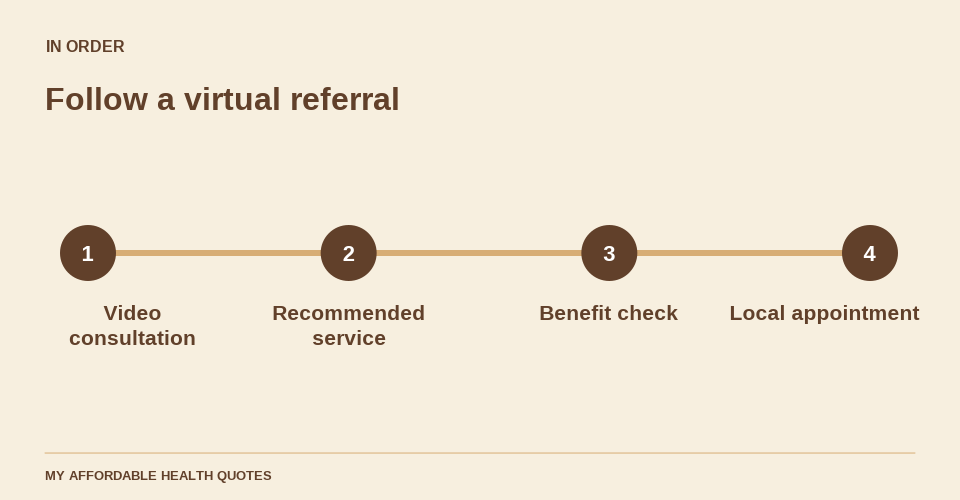
Ask how the service handles a situation that requires examination, testing, or a higher level of care. Does it refer you to a participating local professional, provide records, or leave you to arrange the next step? A virtual consultation is more useful when you understand how it connects to the rest of your healthcare.
Check the in-person benefits separately. An included virtual visit does not establish that a later laboratory test, imaging study, or specialist appointment is included in the same price. Record the expected handoff and the policy provisions for the services that might follow.
Where must you be during the appointment?
Tell the provider if you expect to use telehealth while traveling or staying in another state. Ask whether the clinician can provide the service where you will physically be and whether the insurer covers that arrangement. Do not assume that an app login available nationwide means every clinician can treat you in every location.
For an Iowa resident who spends part of the year elsewhere, this can be a practical continuity issue. Ask before scheduling rather than discovering the limitation when the session begins. The provider should explain any location-related restrictions and help you identify an appropriate alternative when needed.
Are medications and pharmacy costs separate?
Ask what the service can prescribe, what it does not provide, and how it coordinates with your regular clinician. A virtual consultation does not guarantee a prescription, and a prescription does not guarantee payment under your drug benefit. Clinical suitability and insurance coverage remain separate decisions.
If medication is part of your ongoing care, check the exact drug and pharmacy arrangement under the policy. Ask whether a platform fee includes only the visit or also a medication service. Do not interpret a package description as proof that every prescription, dose, or refill is included.
How do referrals and authorization work?
Ask whether the plan requires a referral for the specific clinician or service and whether any prior authorization applies. A telehealth format does not automatically remove administrative requirements that would otherwise apply. Obtain the answer for the exact service rather than a generic statement that video care is available.
If the platform coordinates authorization, ask what the patient still needs to do. If your own clinician handles it, confirm that the office has the correct policy information. Keep the approval details with the appointment record so a later billing question can be matched to the actual arrangement.
Who holds the clinical record?
Ask how to obtain records and share them with your primary care or treating professional. An isolated app visit can be less useful if its findings do not reach the clinician managing ongoing treatment. Use the service's secure portal and authorization procedures rather than sending sensitive information through an ordinary quote request.
HHS provides patient guidance on telehealth privacy and secure communication. In practical terms, choose a private place for the appointment, understand the platform's account settings, and ask how messages are handled. Insurance billing privacy and the app's operational privacy should both be understandable before recurring use.
Is the service suitable for a child or dependent?
If the coverage is for a child, ask about age eligibility, parent or guardian participation, and which clinicians provide pediatric services. A general adult virtual-care offering does not establish that the same service is available to every dependent. Check the actual platform terms and provider capabilities.
For a dependent receiving ongoing therapy, ask how the platform coordinates with existing clinicians and school services where appropriate. Do not assume that virtual availability solves every scheduling or clinical need. The treating team should determine whether the format is suitable, while the insurer explains benefits.
What does a realistic comparison look like?
Consider a hypothetical Iowa shopper, Maren, who wants monthly appointments with an established therapist and occasional general medical consultations. One policy advertises an included app, while another has different outpatient cost sharing. Maren checks the therapist's participation and telehealth billing under both rather than assigning full value to the app's headline.
She discovers that the included service and her therapist are separate arrangements. Her worksheet therefore has one row for ongoing therapy, one for the designated virtual service, and one for in-person follow-up. The example does not predict which policy is cheaper; it shows why the actual service pattern should drive the comparison.
What should be checked after the first visit?
Compare the explanation of benefits and provider statement with the expected cost. Confirm the clinician, date, service category, and patient share. If a platform charged a fee directly, identify whether it was separate from the insurance claim. Do not assume a credit-card charge and an insurer statement describe the same payment.
If processing differs from the pre-visit answer, ask which assumption changed. It may involve the provider, service, network, or billing format. Obtain a specific explanation before scheduling a long series of appointments under the same assumption. An early correction is easier to manage than several months of inconsistent bills.
What if the app is unavailable or the network cannot offer care?
Document the service you sought, appointment availability, and any provider responses. Ask the insurer for access assistance and a concrete alternative. A directory or app invitation is not the same as an available appointment with the needed professional. Keep the question focused on the specific care requirement.
If an insurer denies a benefit, follow the written determination and applicable appeal instructions. Iowa's Insurance Division can direct consumers to relevant assistance and review processes. A technical app problem may instead belong with the service operator, so distinguish access, billing, and coverage issues when asking for help.
How should this influence the purchase decision?
Assign value to a telehealth feature only after confirming that it meets a need you actually have. Compare provider continuity, service scope, in-person connections, medication handling, cost sharing, and practical availability. Avoid counting an included app as a replacement for comprehensive benefits that remain unverified.
Bring your intended care pattern to a My Affordable Health Quotes plan review. The useful question is not whether telehealth exists, but whether this policy supports these visits with these professionals under workable conditions. A short written comparison of those points will tell you more than a prominent virtual-care badge on a sales page.
Keep a copy of the platform terms provided with the quote and compare them with the enrollment materials. If an optional membership is included, identify its renewal and cancellation terms separately. This prevents an app feature from being counted as a permanent insurance benefit when it is actually a distinct service arrangement with its own conditions.
Sources and further reading
- HHS paying for telehealth
- HHS scheduling telehealth
- HHS telehealth privacy guidance
- Iowa Insurance Division external review