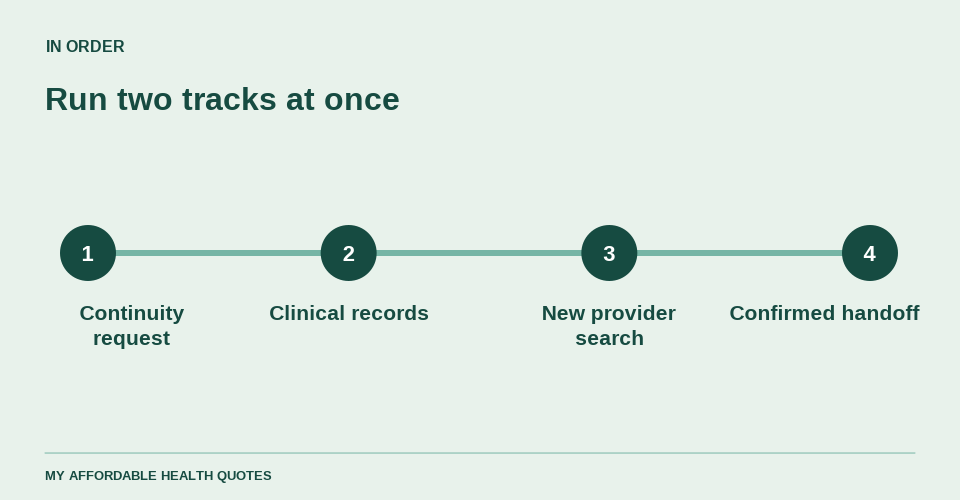
If your doctor or facility is leaving your health plan's network during an ongoing course of treatment, ask about continuity of care before assuming you must immediately change providers or pay ordinary out-of-network rates. Certain patients may qualify for a temporary continuation of in-network treatment terms. The protection has conditions and an endpoint, so the request should begin as soon as you receive the network-change notice.
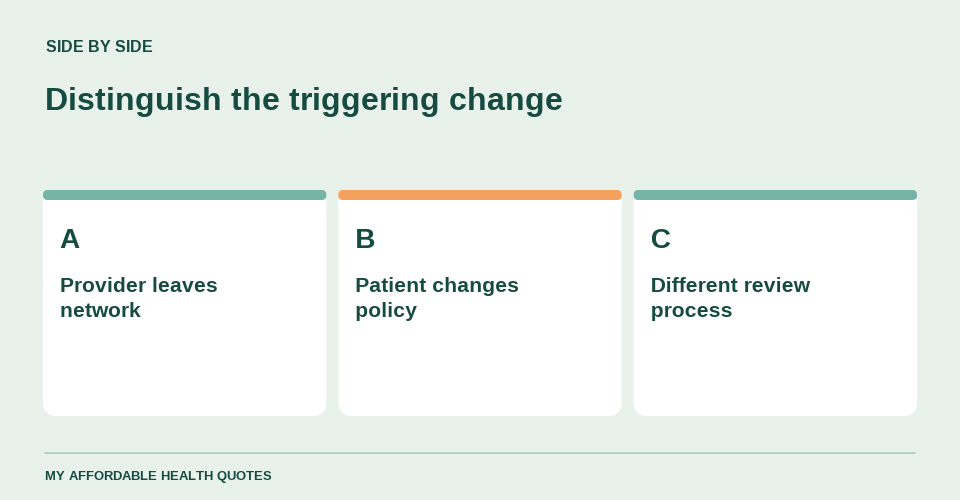
This situation is different from voluntarily buying a new policy that does not include your doctor. A plan change can have its own transition arrangements, but you should not assume it triggers the same rule as a provider's contract ending while you are already receiving care. Start by identifying exactly what changed and which policy remains active.
Day one: confirm the change in writing
Obtain the insurer's and provider's notices if available. Record the affected clinician or facility, network, termination date, and reason stated. A practice may have several locations or billing entities, so identify which one is leaving. A rumor that the entire health system is no longer accepted may be broader than the actual change.
Ask whether negotiations are ongoing, but do not rely on a possible future agreement as your only plan. Continue preparing the continuity request and an alternative care pathway. If the network agreement is restored, you can update the record; if it is not, you have not lost valuable preparation time.
Keep upcoming appointments and planned procedures on a separate calendar. Mark those before and after the announced change. This helps the insurer and treating team understand which services need an immediate answer and which belong to the longer-term transition.
Identify whether you may be a continuing-care patient
CMS explains that certain continuing-care patients may receive care at in-network rates for up to 90 days after qualifying network changes. Its examples include patients receiving treatment for serious and complex illness, institutional or inpatient care, non-elective surgery, pregnancy-related treatment, or terminal illness. Ask your provider and insurer whether your circumstances meet the applicable definition.
The federal statute contains specific conditions, including relevant contractual changes and exceptions. The period can end earlier if the patient no longer qualifies as a continuing-care patient. This is not a universal extra three months with any preferred doctor, and it is not a permanent extension of the provider's network participation.
Ask the insurer to identify the applicable rule and any additional state or contractual protection. The answer may depend on the plan and circumstances. Request the process in writing, including how to elect or request the continuation and what records are needed.
Have the treating team describe the course of care
Ask the clinician to explain the ongoing treatment, its stage, and why an immediate transfer may be disruptive or clinically significant. The provider should supply relevant medical information through the insurer's process. Your role is to coordinate the request and ensure that the correct policy and network-change details are included.
A useful statement identifies the services expected during the transition period rather than simply saying the patient wants to stay. It may describe scheduled treatment, follow-up, or a planned procedure. The exact content should come from the treating professional and reflect the patient's actual circumstances.
Do not send a complete medical history if the process asks for a narrower set of records. Use secure channels and keep copies of what was submitted. A concise, relevant packet is easier to review than unrelated documentation that obscures the ongoing-care question.
Ask which services the temporary arrangement includes
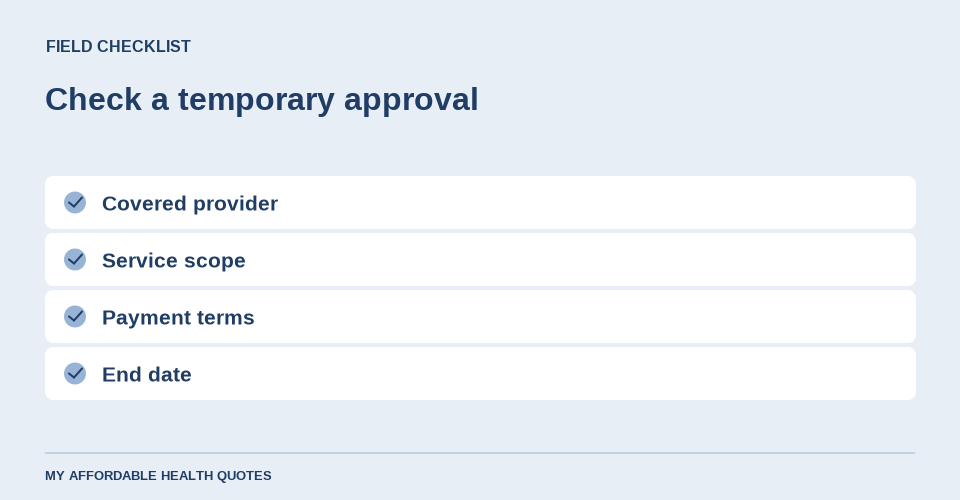
If the request is approved, obtain the provider names, service scope, dates, and payment terms. Ask whether the arrangement includes the facility and other professionals involved in the course of care. Approval for one clinician should not be assumed to settle every related billing entity.
Confirm how existing referrals and authorizations will be handled. A network-continuity arrangement and a service authorization address different conditions. If a procedure was already approved, ask whether the provider's changed status requires an administrative update and who is responsible for it.
Ask the provider's billing office to confirm that it recognizes the arrangement. The clinical team may know about the request while the billing system still treats the patient as ordinary out of network. A shared written record can prevent avoidable statements and scheduling confusion.
Build a parallel handoff plan
Temporary continuation gives time to arrange care; it should not become a reason to postpone all transition work. Ask the current clinician which type of professional is needed next and what records should be transferred. The insurer should help identify participating options, while the clinician guides the clinical handoff.
Call potential practices to confirm that they accept the exact policy, treat the relevant condition, and have appointment availability. A directory listing alone does not establish that a new patient can be seen before the temporary period ends. Record unsuccessful attempts and share the access problem with the insurer.
Ask whether the current and future clinicians need to speak directly. For complex care, a scheduled handoff may be more useful than simply sending a chart. Let the clinical teams determine the appropriate communication, and keep the patient informed about which office is responsible for each upcoming task.
A hypothetical timeline
Imagine that Andre receives a notice that his treating specialist will leave the network next month while a documented treatment course is underway. He contacts the insurer immediately, obtains its continuity form, and asks the specialist to provide the relevant clinical statement. He does not assume the protection is automatic or cancel treatment without medical advice.
While the request is reviewed, Andre asks for participating specialists and begins checking appointments. If temporary continuation is approved, he records its exact endpoint and scope. The transition appointment is scheduled with enough time for records and clinical questions to be addressed before that endpoint.
This example is a workflow, not a promise that Andre or any particular patient qualifies. The useful feature is parallel action: requesting the applicable protection while preparing for the next provider. That is more reliable than waiting for the last week of a temporary arrangement to begin searching.
Track claims during the temporary period
After each visit, compare the explanation of benefits with the approved terms. If a claim processes as ordinary out of network, contact the insurer with the continuity approval and claim identifier. Ask whether reprocessing is needed and whether the provider should update its billing record.
Keep the provider informed if the insurer is correcting a claim. Ask whether the account can be held while the adjustment is processed and obtain the response. Do not assume that a successful continuity request automatically prevents every automated bill from being sent.
If you pay an amount before correction, retain the receipt and ask how any overpayment will be refunded. Close the issue only when both the insurer's processing and provider's account reflect the agreed arrangement. A favorable letter and an unresolved balance are not the same as a completed resolution.
If the insurer says the request does not qualify
Obtain the written reason and the applicable review instructions. Does the insurer dispute continuing-care status, the type of network change, the requested service, or another condition? The response should address that specific issue. A general statement that changing doctors is inconvenient may not resolve a clinical or legal eligibility question.
Ask the treating team to correct any misunderstanding about the ongoing course of care. If records were missing, identify and submit them through the proper process. If the issue is the plan's interpretation of the rule, ask the appropriate consumer-assistance authority for direction.
For time-sensitive treatment, ask the clinician about expedited review and safe care planning. Do not delay emergency care while pursuing an administrative request. The insurer's response process and the clinician's treatment recommendation should be coordinated, but neither should be mistaken for the other.
When the patient changes plans instead
If you are voluntarily selecting a new policy, ask that insurer about its own transition-of-care process before enrolling. Identify the current treatment and provider. Do not cite a provider-contract termination rule as if it automatically requires a new insurer to cover a clinician who was never in its network.
Obtain any prospective transition decision in writing and understand its conditions. A new policy's approval may be limited to specific services or dates. It should not be used to justify a long-term plan choice unless the ongoing network and care arrangement also make sense after the temporary period ends.
Compare the new plan's participating alternatives and appointment access at the same time. If the preferred doctor remains outside the network, ask about ordinary out-of-network benefits and potential balances after any temporary approval. The transition arrangement is only one part of the long-term financial decision.
Finish with a confirmed handoff
Before the temporary period ends, confirm the new clinician's appointment, receipt of records, and responsibility for prescriptions, tests, and pending results. Ask the current team which issues remain open. A provider transfer should not leave an unreviewed result or renewal request between two offices.
Update pharmacies and other relevant care providers with the new clinician and insurance information as needed. Keep prior records and claims documents because services from the old period may still be billed. The clinical handoff and financial cleanup may finish on different schedules.
My Affordable Health Quotes can help organize network questions when comparing policies, but an active continuity request belongs with the insurer and treating team. The practical objective is a documented temporary arrangement where available, a safe clinical transition, and a clear endpoint. Acting early gives all three parts a better chance of being coordinated rather than rushed.
Sources and further reading
- CMS action plan for a doctor leaving the network
- 42 U.S.C. 300gg-113 continuity of care
- CMS medical bill rights and assistance