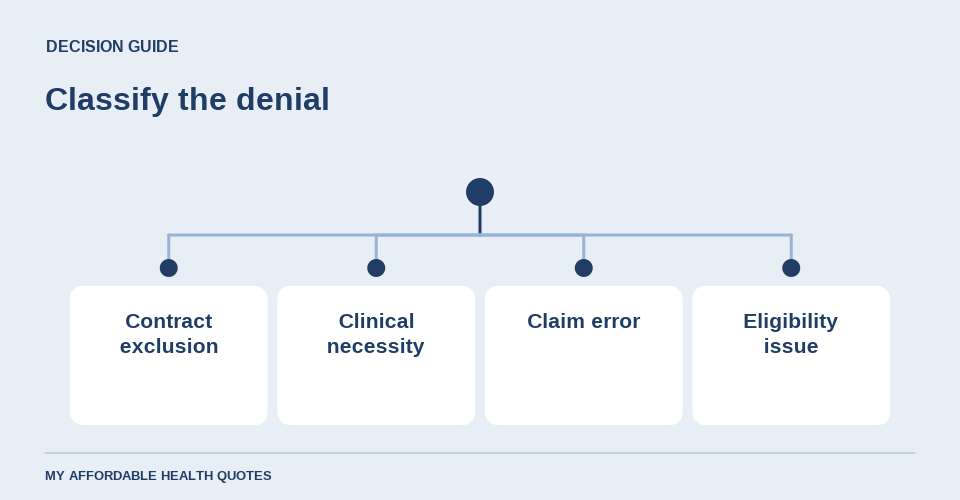
A denial that says a service is excluded raises a different question from a denial that says a covered service was not medically necessary. Before writing an appeal, identify exactly what the insurer decided. In Kansas, the distinction can affect the evidence you need and the availability of external review. A strong response addresses the stated reason instead of sending a general description of why the treatment mattered.
Start by obtaining the complete determination, not just the short message in a provider portal. Ask for the explanation of benefits, denial letter, relevant policy provision, and any clinical criterion relied upon. If a provider relayed the denial verbally, request the insurer's own written notice. This gives you a stable starting point and helps preserve the applicable appeal instructions.
Read the denial as a specific question
Highlight the sentence explaining why payment or approval was refused. Does it say the service is outside the contract, the submitted information did not establish medical necessity, authorization was missing, the provider was out of network, or the patient was not eligible on the service date? Those are not synonyms for one broad “not covered” result.
Next, identify what was denied. It could be one code, one date, a proposed course of treatment, a particular setting, or only part of a claim. A hospital stay can generate multiple determinations from different billing entities. Avoid assuming that a denial of one component establishes the status of every related service.
If the wording contains several reasons, ask whether each is an independent basis for the decision. Overturning one reason may leave another unresolved. Your response should name each issue and the evidence addressing it. This is more useful than submitting the same packet repeatedly without knowing which question remains open.
What a contract exclusion asks you to prove
When an insurer cites an exclusion, obtain its exact language and the policy version effective on the service date. Read definitions and exceptions nearby. Ask whether an endorsement or state requirement changes the cited provision. The key issue is whether the insurer applied the correct contractual rule to the actual service.
A clinician's recommendation can be important, but it does not by itself rewrite an explicit contract exclusion. Conversely, the word “excluded” in a denial does not make the interpretation correct. The service may have been described inaccurately, the wrong policy may have been used, or an exception may have been overlooked. Identify the concrete dispute.
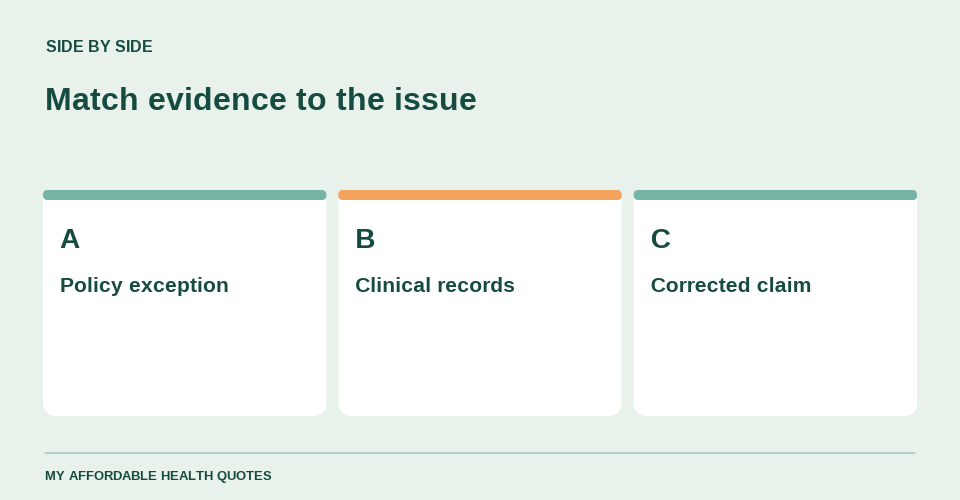
For example, a hypothetical claim is denied under a cosmetic-service exclusion, while the treating provider says the procedure addressed a functional problem. The useful record explains the service, diagnosis, and applicable exception, if any. It does not stop at arguing that the patient strongly wanted the treatment. This example illustrates document alignment rather than predicting a successful appeal.
What a medical-necessity decision asks you to prove
A medical-necessity denial usually calls for clinical information connected to the insurer's criterion. Ask the treating provider to review the stated rationale and identify missing or misunderstood facts. Relevant material may include the treatment history, test results, symptoms, prior approaches, or the reason a particular setting is needed, depending on the actual criterion.
Do not manufacture a clinical argument from internet examples. The provider should explain the patient's circumstances and why the requested care meets the applicable standard or why an exception is warranted. Your contribution can be organizing the notices, dates, and missing documents so the clinical team is answering the right question.
Ask whether the insurer received all the material originally submitted. An incomplete record and a disagreement after reviewing a complete record are different problems. Retain submission confirmations and ask for a list of documents considered. If a key report was absent, clearly identify it in the response rather than burying it in a large undifferentiated packet.
Understand the Kansas external-review boundary
Kansas statutes define an adverse decision for this review process in terms of certain medical-necessity or experimental-treatment determinations involving services that would otherwise be covered. The statute also states that external review does not change the terms of coverage. This is why classifying the denial matters before assuming every dispute belongs in that process.
Use the current determination notice and Kansas Insurance Department guidance to confirm the applicable route, deadline, and eligibility for your plan. Some products and arrangements have different review systems. Do not apply the rules for an individual major-medical policy automatically to a supplemental product, government program, or self-funded employer plan.
If the dispute appears purely contractual, ask the Department which consumer-assistance or complaint route fits. If it concerns clinical necessity, ask about internal appeal and external review requirements. The correct route is not determined by how serious the bill feels; it depends on the plan, decision, and applicable rules.
Separate claim correction from appeal
A wrong member number, missing code, duplicate submission, or incorrect service date may call for a corrected claim. Ask the provider's billing office whether it has identified such an error. Obtain the corrected-claim reference and expected processing steps. Do not assume that a correction request automatically preserves a separate appeal deadline.
Likewise, a provider's informal discussion with an insurer may not be the same as your formal appeal. Ask what process is occurring, whether you must authorize representation, and whether any member action remains necessary. Put the answer in your calendar along with the written deadline rather than relying on an office's general assurance that it is handling everything.
Keep a chronology with the original claim, denial, correction, appeal, and each response. This prevents a new letter from being mistaken for a final decision on a different claim. It also makes a conversation with a regulator or advocate more efficient because the sequence is visible without reconstructing it from emails.
Write a focused appeal packet
Begin with the policy and claim identifiers, service date, decision being challenged, and the outcome requested. Then address each denial reason in a separate paragraph. Refer to attached documents by a clear label. A reviewer should be able to find the relevant policy provision or clinical letter without guessing which page supports your point.
Use a short cover explanation even if the underlying record is lengthy. For a contractual dispute, quote only the necessary policy language and explain the disputed application. For a clinical dispute, point to the provider's supporting statement. Do not mix unsupported accusations with the evidence; they can obscure an otherwise straightforward correction.
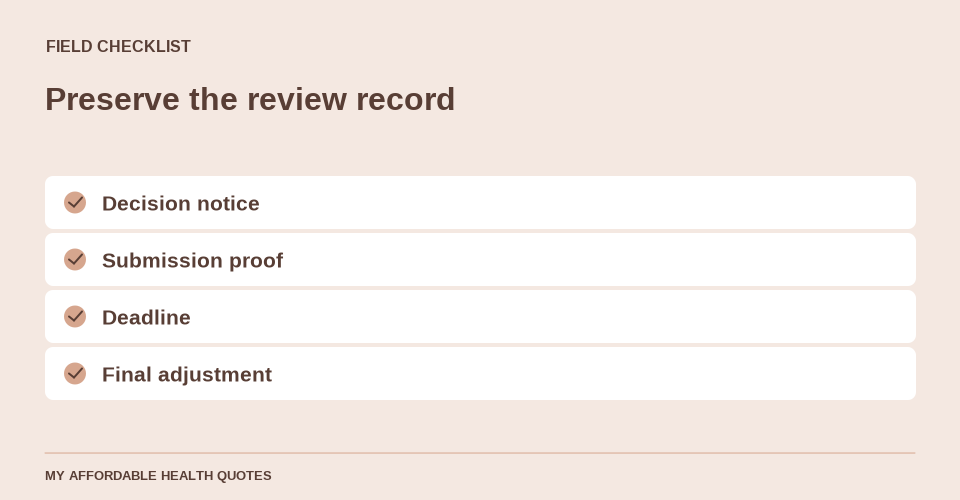
Before sending, check the submission address or portal, format, authorization requirements, and deadline. Keep a complete copy and proof of submission. If you submit electronically, save the confirmation rather than assuming the portal will retain it indefinitely. If a representative submits for you, request the same documentation.
Handle urgency through the proper channel
If waiting could jeopardize health or function, ask the treating clinician whether an expedited process is appropriate. Follow the plan's instructions and identify the medical basis for urgency. A large balance alone does not establish a medical emergency, while a time-sensitive treatment need deserves prompt attention even before a bill exists.
Do not delay needed emergency care to complete an insurance dispute. This article explains administrative preparation, not a recommendation about treatment timing. Your clinician should guide care decisions and help communicate urgent clinical circumstances to the insurer or review organization.
For nonurgent disputes, set realistic follow-up reminders based on the actual process. Repeated daily calls without new information may not improve the review. A scheduled check that confirms receipt, completeness, and the next expected action is more productive and easier to document.
Keep the provider bill in view
If a provider is billing you while the claim is under review, ask whether the account can be placed on hold and obtain the response. An appeal does not automatically mean every collection activity stops. Review payment agreements carefully and ask how a later insurer adjustment would be handled if you pay before the dispute is resolved.
Compare the eventual decision with the provider's updated balance. A successful correction may require the provider to reprocess its account or issue a refund. A continued denial may require a new decision about review options or financial assistance. Do not close your file merely because a letter arrived; verify that the financial records reflect the outcome.
Use the experience when buying the next policy
A denial can reveal a specific benefit question to ask during future plan comparisons. Turn it into a narrow inquiry: this service, this indication, this setting, and this policy provision. Avoid selecting a replacement based on a broad promise that it has better coverage. Ask for the documents that would answer the issue you actually encountered.
My Affordable Health Quotes can help organize policy comparisons, but an existing dispute should be directed through the insurer's and regulator's applicable processes. Keep a clean record of the decision, contract language, evidence, and deadlines. The most effective first step is often simply replacing “they denied my treatment” with an exact statement of what was denied and why.
Ask for a usable explanation of the outcome
When a reviewer responds, check whether the decision answers every issue you raised. If the letter only discusses clinical necessity while your appeal also identified an incorrect policy provision, ask where that issue was addressed. Keep the request narrow and refer to the numbered section of your original submission. This creates a clearer record than restarting the entire account from memory.
If the result is favorable, ask whether the insurer will automatically reprocess the claim or needs another submission from the provider. If the result is unfavorable, read the next-step instructions before the deadline passes. Either way, record the decision date and retain the complete packet; a later billing question may depend on exactly what was approved or denied.
Sources and further reading
- Kansas external review definitions, K.S.A. 40-22a13
- Kansas external review procedures, K.S.A. 40-22a14
- Kansas Insurance Department