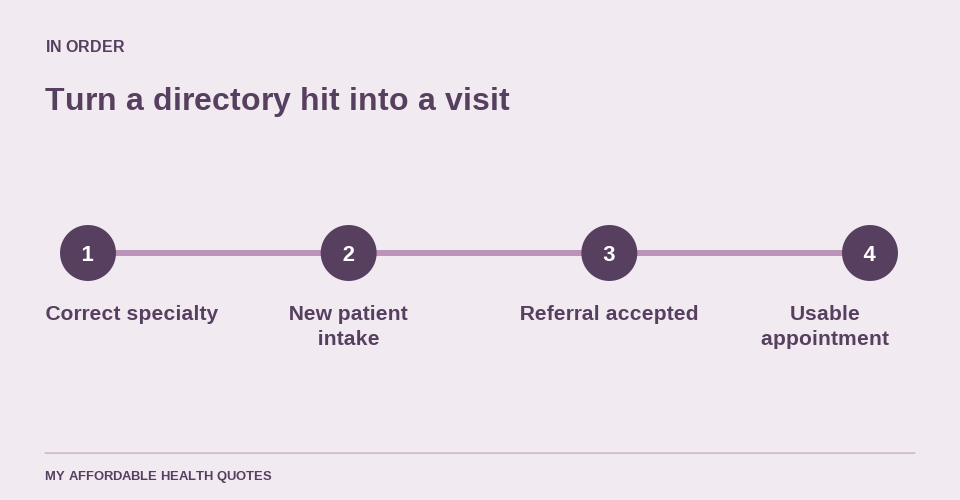
An Oklahoma independent contractor needs an appointment with a specialist. A directory lists six names within driving distance, and the health plan tells the contractor to start calling. One number reaches a retired clinician's former office. Two names belong to doctors who see patients only in a hospital. Another office participates in an employer product with a similar name. The last two have a waiting list. What looked like six choices on a map is now one unresolved question about access. Knowing how to present that question can change the next conversation with the plan.
This example concerns a planned, nonemergency appointment. The referring clinician should say what specialty and timeframe the patient needs and what to do if the appointment cannot be made on time. If the problem changes or becomes urgent, return to the clinical team or seek appropriate urgent or emergency help. An insurer's ordinary directory and grievance procedures are tools for arranging coverage, not guidance on whether someone can safely wait. With that distinction clear, the contractor can investigate why the referral is stuck rather than making the same unproductive calls every week.
Define what would count as an appointment
Before searching, write down the details the referring office can supply. A broad specialty may contain several services, and not every clinician in the category accepts the specific referral. Ask whether the patient needs a particular subspecialty or setting and what records the specialist should review. Ask the clinician to give a meaningful timeframe where medically appropriate. A patient's understandable preference to be seen soon is different from a clinician's recommendation to complete evaluation within a specified interval. Tell the insurer which statement describes the referral and who can document it.
Then establish which constraints are practical rather than clinical. Does the patient have transportation to another county? Could a different time of day work? Would an accessible building or language assistance be needed? Can the patient attend a cancellation appointment on short notice? These facts help the plan distinguish a useful alternative from an unusable name. For a self-employed contractor, closing a job site for a whole day may require paying a qualified substitute. That expense can affect the final comparison, but it does not automatically establish a right to coverage outside the network. Keep the scheduling facts and financial preferences clear.
Check what happened to the original referral
A specialist may say there are no appointments because its intake staff has yet to receive an order, because the practice is at capacity, or because the requested clinician only sees existing patients. The response sounds the same to a worried caller, but the remedy differs. Ask whether the office accepts new referrals for this service, whether it has the required records and what date it would offer if the file were complete. A referral sitting in an intake queue can sometimes be resolved by the referring office. A practice that has closed its panel requires a different route.
The contractor asks the original practice for the date, destination and method it used to send the order. Staff discover it was sent to a central hospital fax rather than the outpatient program. Correcting that destination solves the paperwork issue but does not improve the actual wait time at the intended office. Document both findings. If the plan sees only a complaint that the hospital lost the referral, it might treat an intake correction as the complete answer. If it sees the records have arrived and the earliest offered appointment remains outside the requested interval, it can address the outstanding problem.
Keep an availability log that another person can use
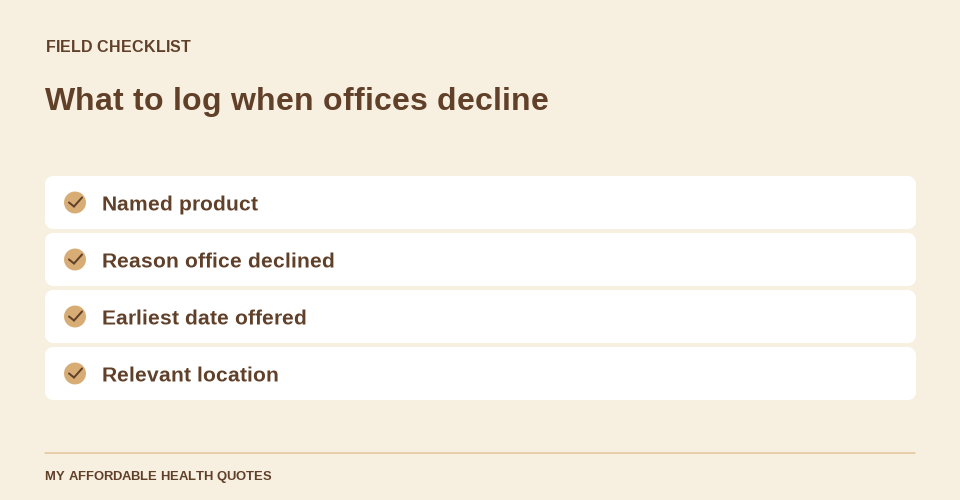
A short log is more persuasive than screenshots of dozens of search results. For each office, record the directory date, precise product, location, identity of the clinician or group, contact date and answer. Capture the earliest appointment actually offered if there is one. Use plain descriptions such as sees inpatients only, needs a complete referral or accepting patients at another office. If an office gives a vague wait estimate, distinguish that estimate from a booked date. Collect only what the plan needs to solve the access question and avoid placing private medical details in unsecured notes.
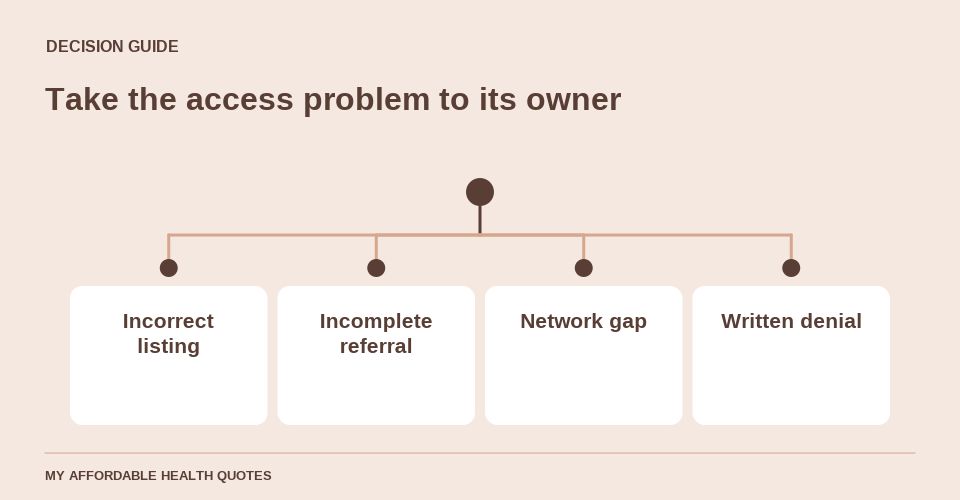
Record why a suggestion did or did not work. In this example one office accepts the insurance but operates at two sites, one of which is no longer open to routine referrals. Another accepts adults only, while the referral in a different family's situation might be for a child. A list of exact reasons keeps a plan representative from reissuing the same unsuitable options and gives the insurer concrete information about an inaccurate directory entry. Take a dated copy of the relevant listing when the office contradicts it, and ask the insurer how it handles reported directory errors.
Ask member services for appointment assistance
Describe the access problem in one short call opening. Identify the plan, referral type, recommended timing, area searched and number of offices you have contacted. Ask the representative to locate a participating clinician who takes this referral and can offer an appointment within the specified window. If possible, ask whether the plan can contact the practice directly or make a joint call. A two-way conversation can surface a mismatch between the plan's billing name and the practice's public-facing name. It may also reveal an intake route unavailable from a public scheduling number.
If the representative suggests a different service, ask the referring clinician whether it is clinically appropriate. A virtual intake, an advanced practice professional or a visit to a larger center may solve the problem for some patients. Equivalence is a judgment for the care team and patient, within the plan's coverage rules. Get the alternative's actual location, visit type, date and next step. A video appointment that only screens patients for a distant in-person clinic can be useful if it advances care. It should be described accurately when comparing it with a direct specialist evaluation.
Investigate an exception before treating it as approved
When a plan cannot identify a suitable participating appointment, ask whether the policy provides a network exception or another process for arranging an outside clinician. Ask who can request review, what supporting documentation is required and when a decision is expected. Give the outside office's billing identity, proposed service and available date. A referring clinician may need to explain why the available alternatives do not meet the clinical need. Submission of that information begins a review. The household should not assume that an open request changes cost sharing or settles what an outside office can charge.
If a request succeeds, confirm the terms with both parties. Which clinician, facility, dates and services does the written decision cover? How is member cost calculated? Has the outside office agreed to the payment terms, and which additional charges could still arise? Is a return visit covered or must someone seek another review? A message that authorizes the first evaluation might be silent about diagnostics or subsequent care. For a contractor taking a day away from a job, knowing what will and will not happen at that first appointment can matter as much as the initial visit charge.
Close the loop on a denial or an offered date
If the insurer denies a requested service or exception, ask for its decision and reasoning in writing and identify the applicable appeal route and deadline. A complaint about a directory entry and an appeal of a coverage decision address different problems. A household may need to pursue both while maintaining contact with the clinician about timing. HealthCare.gov explains the general right to challenge certain plan decisions. The Oklahoma Insurance Department offers consumer assistance for coverage it regulates and can direct an inquiry as appropriate. The actual plan documents identify the processes that apply to the individual case.
When the insurer finds a date, verify that the office has accepted the referral and knows how to process it. A time held provisionally pending records review could disappear if nobody sends the final document. Ask who will call if the date changes and what the patient should do if the initial appointment results in a recommendation for another service. At the next renewal the contractor can use this experience to compare plans by asking about access to a practice that actually accepts the relevant kind of referral. That evidence is more informative than counting nearby icons in a search result.
An availability log has a practical finish line. Stop adding listings when an appropriate appointment is confirmed and the patient knows how to attend it. Keep the dates and responses already collected until coverage questions are settled, particularly if the plan approved special terms. If the first appointment is canceled by the practice, those records let the patient contact the person who arranged the original solution without reconstructing the search from memory. The desired result is an appointment the patient can use, supported by a care team that agrees on the timing and a payer that has explained the financial terms.
If the household is still choosing among quotes, it can carry out a smaller version of the same exercise. Select one likely referral destination and one backup. Ask each how it accepts new patients on the proposed product and whether the named location provides the relevant service. Future appointments cannot be guaranteed from today's openings. The exercise can nevertheless uncover a product mismatch, an obsolete address or an office that never offered the service in question.
Sources and further reading
- HealthCare.gov: Comparing health plans
- HealthCare.gov: Appealing a health plan decision
- Oklahoma Insurance Department: Consumer services
- HealthCare.gov: Summary of Benefits and Coverage