A growing North Carolina business should review its health benefits obligations before a headcount milestone becomes a surprise. The count used for federal employer rules is not necessarily the number on today's payroll roster. Part-time hours, related businesses and the prior year's workforce can matter. At the same time, the insurance market's group classification is a separate question that should be confirmed with the insurer.
The useful response is a structured payroll review, not a rushed purchase based on the statement that the company has reached fifty people. This guide explains how to prepare that review, how to separate the questions and what evidence to keep. It is designed for an owner whose staffing is expanding, fluctuating or spread across related operations.
Give each count a name
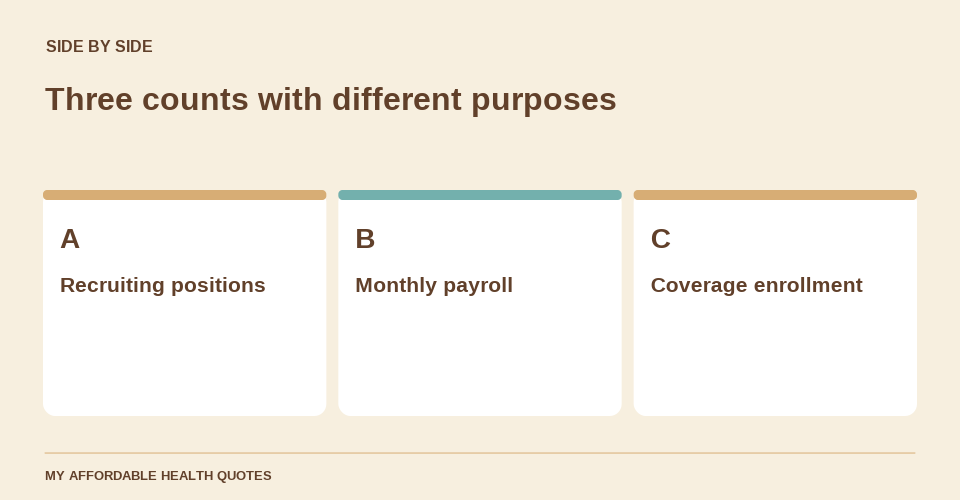
Begin by naming the purpose of every workforce number. A recruiting report may count open positions. Payroll may count everyone paid during a period. An insurer may request a census for group eligibility. A federal tax analysis may require full-time employees and full-time equivalents over a specified period. These numbers can differ without any of them being erroneous.
Ask the accountant and benefits adviser to identify the definitions they are using. Put the definition beside the resulting figure. This prevents a manager from taking a count prepared for one purpose and reusing it as proof of a different requirement.
Keep a separate list of unresolved classification questions. Examples include a worker moved between related entities, a person hired late in a month, an employee on paid leave or someone described as a contractor whose classification is under review. Do not quietly exclude an uncertain person to keep the result below a threshold.
Use the federal method for the federal question
The IRS applicable-large-employer guidance generally bases current-year status on the prior year's average full-time employees plus full-time equivalents. It describes how part-time hours enter that calculation and how businesses under certain common-ownership rules can be combined. A snapshot from one busy week is therefore not enough.
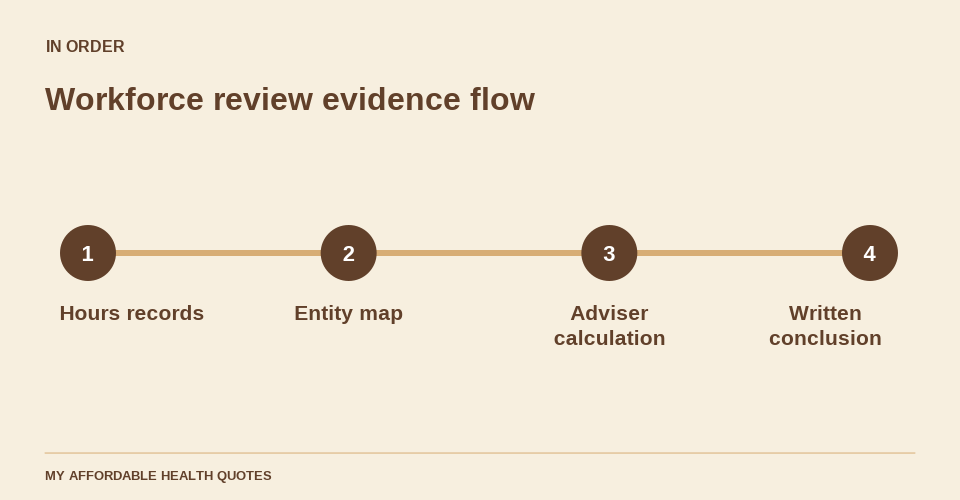
Have a qualified adviser perform or review the calculation using the actual payroll data and applicable exceptions. The purpose of this article is to help you supply complete records, not to replace the detailed rules with a simplified headcount shortcut. Ask for the resulting calculation and a written statement of assumptions.
Separately, the IRS explains that applicable large employers have reporting responsibilities concerning coverage offers. A company can need reliable offer records even when many employees choose coverage elsewhere. Enrollment totals alone do not show who was offered what.
Assemble a monthly evidence file
Request payroll exports that preserve employee identifiers, employing entity, dates of service and the relevant hours information. Keep personally identifying information inside authorized systems. The project team can often work with coded identifiers while payroll retains the matching record.
Gather records of business ownership and related entities for the accountant. A small operating company may be part of a larger ownership structure that changes the analysis. Tell the adviser about businesses that share owners even when they use different payroll providers, brands or locations.
Include acquisitions, closures and transfers that occurred during the year. A simple year-end roster may omit employees who left months earlier. Ask how the adviser wants those events presented, then preserve the underlying records rather than only the final spreadsheet total.
Set a version date on each export. If payroll later corrects hours or employee status, the adviser should know that the data changed. A calculation is only as reliable as the records used, and an unmarked replacement file can make it difficult to explain why two versions produce different answers.
North Carolina insurance classification is another review
The North Carolina Department of Insurance group-coverage resource describes employer group policies and categories. It also explains that employees generally receive a certificate or handbook while the employer holds the master policy. Obtain that master policy or the relevant contract documents when asking how growth affects your arrangement.
Ask the insurer which census and measurement rules it uses for the proposed renewal or new policy. Do not tell it that an IRS calculation has conclusively established the insurance classification. Give the requested facts and obtain the insurer's answer in writing.
Use the department's current insurer information page when checking which companies are marketing the relevant coverage. A listing is a starting point, not proof that a specific product is available for your workforce or service area. Current proposals and underwriting or eligibility requirements still need review.
A growth example with three different numbers
Imagine a hypothetical Charlotte service business whose recruiting dashboard shows sixty positions, payroll shows fifty-six people paid in its busiest month and the benefits administrator reports thirty-eight enrolled employees. The owner asks whether the business is now an applicable large employer. None of those three numbers, standing alone, answers the question.
The accountant requests the prior year's monthly records, part-time hours and information about a related company. The benefits adviser separately asks the insurer about group classification and the next renewal. Human resources builds a record of coverage offers, including employees who declined because they had other insurance.
The result is a coordinated analysis with distinct outputs: the federal status calculation, the insurer's classification response and the operational plan for offers and reporting. The example deliberately does not supply a final status, because the missing facts are exactly what determine it. Guessing from the busiest month's payroll would skip the work that makes the conclusion defensible.
Prepare the benefit budget before a rule forces urgency
Even when no new legal obligation has been established, growth can strain the existing benefits process. Model the cost of the current contribution approach at several realistic enrollment levels. Distinguish employees hired from employees who enroll, and include the effect of dependent elections where the company contributes toward them.
Do not assume the current participation pattern will remain constant. A recruiting push can attract workers with different household needs. Use a range of enrollment assumptions rather than treating the last month's bill as a permanent per-employee forecast.
Include administration in the budget. More employees mean more elections, changes, notices and reconciliation work. If one office manager currently handles benefits between other duties, decide whether the process needs additional support before the next hiring wave.
Create an offer record that payroll can support
Ask the benefits administrator which fields are needed to document offers and elections. A practical record may include the plan offered, employee contribution, eligibility date, offer date and election response, with supporting documents retained securely. The exact compliance requirements should come from the adviser responsible for the plan.
Connect the record to the payroll process. When a new hire becomes eligible, who sends the materials? Who confirms receipt? Who enters the deduction? Who verifies that the insurer accepted enrollment? A company with many employees cannot rely on the owner remembering every conversation.
Keep declined offers distinct from missed communications. An employee who affirmatively declines is different from an employee who never received the enrollment instructions. Establish an escalation process for incomplete elections without pressuring workers to disclose private reasons for their choice.
Schedule the review around business decisions
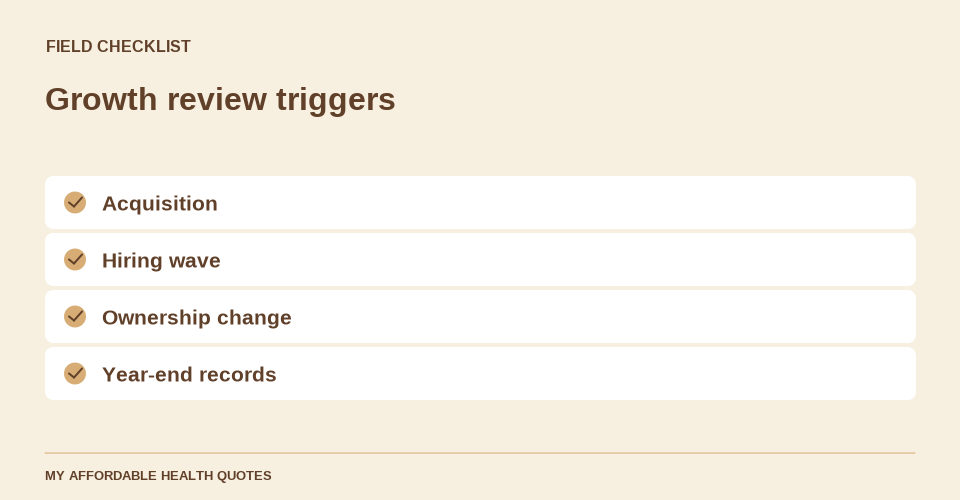
Choose review points that correspond to actual changes: a planned acquisition, a large hiring class, an ownership restructuring or preparation for renewal. The accountant may also need a year-end review when the complete prior-year information is available. Set dates before those events, not after the first problem appears.
At each review, ask what has changed since the last documented conclusion. New entities, corrected hours or a different staffing model may justify a fresh calculation. An unchanged business may only need routine confirmation rather than a full restart.
Maintain a short decision log. Record the date, adviser, source records, conclusion and next review trigger. This is especially useful if the owner changes accountants or payroll vendors. A new professional should not have to reconstruct the company's reasoning from scattered email messages.
Test a data transfer before changing payroll vendors
If growth prompts a new payroll system, export the historical records before the old account closes. Ask the accountant to confirm that the export contains the fields used in the workforce calculation. A summary of total wages may not preserve the hours and dates needed for the review.
Have the incoming vendor explain how it will retain prior coverage elections and deductions. Run a sample employee through both systems and compare the record. Resolve differences while the former vendor can still answer questions. A benefits review becomes much harder when the business has only a PDF total and no usable underlying history.
Prepare questions for the adviser meeting
Bring specific questions: Which workers and entities are included? What period determines the result? Which exceptions were considered? What reporting or offer processes follow from the conclusion? Which insurance-market questions remain for the carrier? Ask for the answers in language that the people running payroll can implement.
Do not let a meeting end with “we should probably be fine.” Request the next action, responsible person and completion date for every unresolved item. Where legal or tax interpretation is required, identify the professional who owns that decision.
If the review leads to a coverage comparison, ask for options based on the verified census and intended effective date. A quote prepared from a guessed headcount can create a false sense of readiness. Request licensed help reviewing available health coverage once the underlying workforce facts are organized.
The owner does not need to memorize every counting rule. The owner's job is to make sure the right data reaches the right adviser and that the resulting instructions become a repeatable process. That is how a growing North Carolina company keeps benefits decisions aligned with its actual workforce.
Sources and further reading
- IRS: Determining applicable large employer status
- IRS: Employer coverage reporting
- North Carolina DOI: Group health insurance
- North Carolina DOI: Insurer information