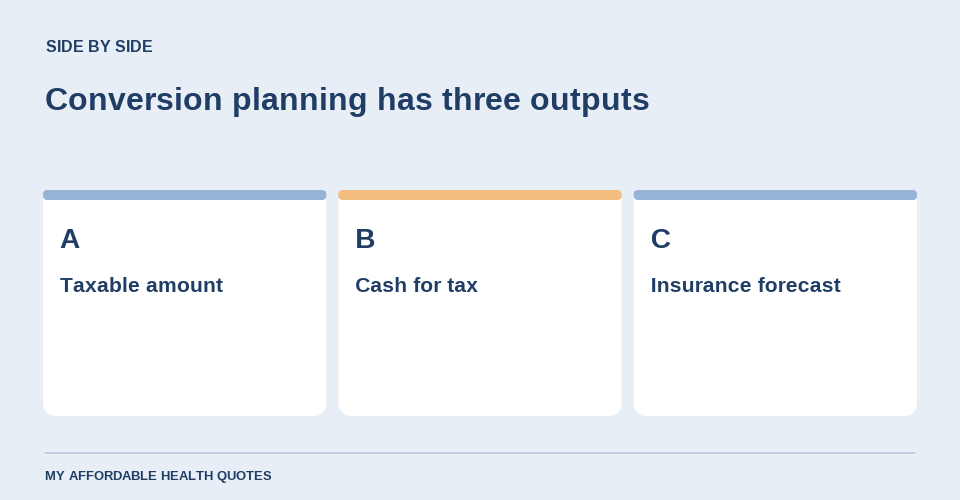
A Roth conversion can affect the income estimate behind private health insurance even when it does not produce spending money for the household. That makes it different from the everyday picture of income as a paycheck or bank deposit. Nevada residents using individual coverage should include the insurance consequences in a broader tax-planning discussion before executing a conversion. The coverage review does not decide whether the conversion is appropriate; it helps ensure that the decision is evaluated with a complete set of costs and assumptions.
The first question is what portion of the proposed transaction the tax adviser expects to be included in income. The second is whether that changes any financial assistance or the household's insurance budget. The third is how the application will be updated if the transaction occurs. Keeping those questions separate avoids a common mistake: assuming that moving money between retirement accounts cannot matter because no cash was withdrawn for living expenses.
Ask for a transaction-specific estimate
The IRS explains conversion treatment in Publication 590-A. Some or all of a traditional-to-Roth conversion may be included in gross income, depending on the facts. Do not assume that the entire account balance is taxable, or that none is taxable, without reviewing basis and the applicable rules. The insurance worksheet should use the tax professional's estimate rather than trying to reconstruct a retirement-account calculation from a custodian's marketing page.
Provide the adviser with information about relevant accounts and prior nondeductible contributions. A record missing from the current custodian's portal can still matter to the calculation. If the household has already taken another retirement distribution during the year, disclose it. Ask for a short written summary of the proposed transaction's expected income effect and the assumptions behind it. That summary is easier to use in an insurance review than a broad statement that conversions are taxable.
Build a baseline before adding the conversion
Start with the household's annual forecast without the proposed transaction. Include wages already earned, expected remaining work, relevant investment income, and other retirement distributions. Then add a separate scenario showing the proposed conversion's effect. Keep the two versions dated and clearly labeled. The baseline helps everyone see which change comes from the conversion and which change was already expected from a job transition or another event.
For example, a hypothetical Nevada couple may have stopped full-time work but still expect consulting income and dividends. Describing the year as a low-income year without those items would distort the comparison. The adviser should review the entire picture before discussing the conversion amount. The insurance analysis then uses the same picture, rather than a different number selected because it produces a more appealing plan quote.
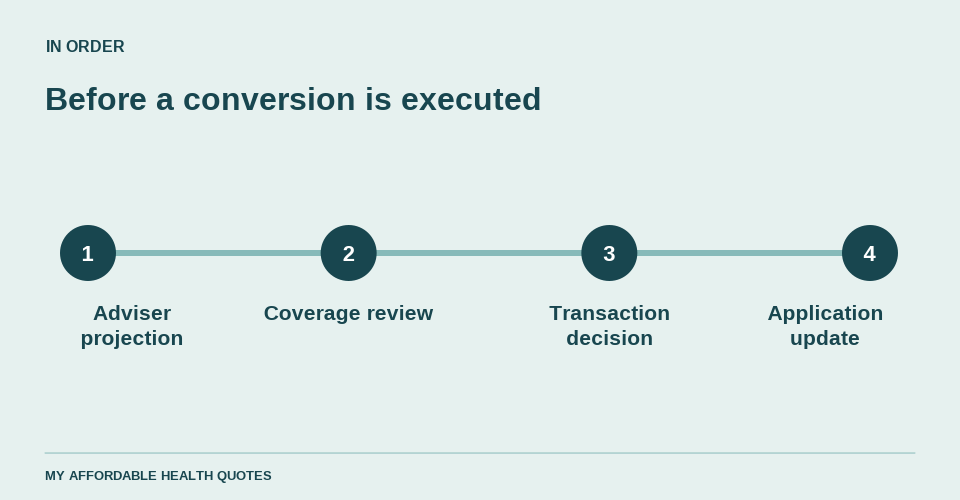
A planning example without a promised tax result
Imagine a household considering a conversion late in the year while enrolled through Nevada Health Link. Its current application was based on a forecast prepared months earlier. The couple asks its tax adviser to compare a no-conversion scenario with the contemplated transaction. The adviser identifies the expected taxable amount and asks the household to obtain an updated insurance-assistance estimate. Neither adviser assumes that the current net premium will remain unchanged.
The household also checks how it would pay any associated tax and ongoing premiums. A conversion may move assets into a different account without creating liquid cash outside retirement accounts. The example therefore has two financial effects to examine: recognized income and available funds. It does not recommend converting, delaying, or choosing a particular amount. It shows the information needed before a personalized recommendation can be evaluated responsibly.
Use Nevada Health Link for the application change
Nevada Health Link's income-reporting guidance identifies retirement income among the sources considered in an application. Follow the current questions and any supporting-document request. If the transaction is unusual, ask how to report the adviser-supported estimate rather than forcing it into an unrelated wage category. Keep the final submission confirmation and any revised eligibility notice with the tax planning records.
An insurer's billing department does not necessarily control the exchange's income information. Telling the carrier that finances changed is not a substitute for updating the application through the correct channel. At the same time, a new exchange notice may require checking the next carrier bill to confirm the expected premium. The household should close the loop between the application record and the amount actually being collected.
Compare the full premium as well as the net premium
Retain the policy's full monthly premium in the planning worksheet even if the household currently receives assistance. Show any assistance separately. This makes it easier to see the coverage commitment under different eligibility outcomes and avoids treating a current net amount as a permanent price. A conversion decision should not be based on an insurance number that no one has checked against the revised annual forecast.
Also preserve the policy's benefit features. A change in financial assistance does not mean a different plan automatically becomes available immediately, nor does it establish that changing plans is wise. Network access, prescription coverage, deductible progress, and enrollment rules still matter. If the household considers switching, ask whether it has an enrollment opportunity and what the transition would mean for expected care. Do not assume that a financial-planning transaction itself creates permission to change coverage.
Avoid double counting retirement transactions
A retirement account can generate multiple records for one movement of funds. A transfer confirmation, distribution statement, and conversion confirmation may all describe parts of the same event. List the transaction once in the forecast using the amount and classification the tax adviser determines. Adding every document total can produce an inflated estimate. Conversely, overlooking the transaction because the funds never reached checking can leave the forecast too low.
Keep a transaction identifier, date, originating account, receiving account, and adviser-reviewed income amount. This does not require sharing account numbers with an insurance agent. A redacted summary can explain the relevant facts while detailed statements remain in a secure tax file. The aim is traceability: someone reviewing the estimate later should understand which event produced the number without exposing unnecessary financial information.
Distinguish a conversion from a qualified Roth withdrawal
A conversion and a later withdrawal from a Roth account are not the same transaction. Their tax treatment depends on different facts. Publication 590-B explains distribution rules, including distinctions relevant to Roth accounts. Do not use a statement about one transaction to classify another. A household that says all retirement money is tax-free or all retirement money is taxable may miss important details.
When preparing the coverage forecast, ask the tax adviser to label each expected retirement event separately. If a withdrawal is planned for living expenses and a conversion is planned for long-term reasons, identify both. Then check whether the insurance estimate includes the correct taxable amounts without counting the same dollars twice. This is a classification task, not a reason to change the household's investment strategy without professional review.
Look beyond the current coverage year
A conversion can be part of a multi-year plan, but the health insurance application concerns a particular coverage year. Prepare each year's forecast separately. Do not carry a one-time conversion into the following year's estimate merely because it appears on the most recent tax return. Likewise, do not omit a future conversion that is reasonably expected simply because it has not occurred yet. The forecast should reflect the current plan and be revised when the plan changes.
If one spouse will later become eligible for a different coverage program, ask the appropriate professional to evaluate that transition separately. Do not apply Marketplace assumptions to every future insurance cost. A long-term planning meeting may need different rules for different years. Labeling the coverage type and year beside every cost estimate keeps the analysis from mixing figures that belong to different programs or stages of life.
Make the decision before the transaction, then verify it afterward
Before execution, ask the financial and tax advisers whether the proposed conversion still fits the household's objectives after incorporating insurance costs. Ask what conditions would change their recommendation. This creates a review point while the transaction is still a proposal. Avoid assuming that a completed conversion can simply be reversed if a later insurance calculation is less favorable. The available correction options depend on the actual transaction and current rules.
After execution, compare the actual amount and date with the forecast. Obtain the custodian's confirmation and ask whether the tax estimate needs revision. Update the application when appropriate and save the revised notice. A plan discussed in a meeting is not the same as a transaction completed at a different value or date. Verification prevents a sensible planning process from becoming inaccurate at the last administrative step.
Bring an organized question to the coverage conversation
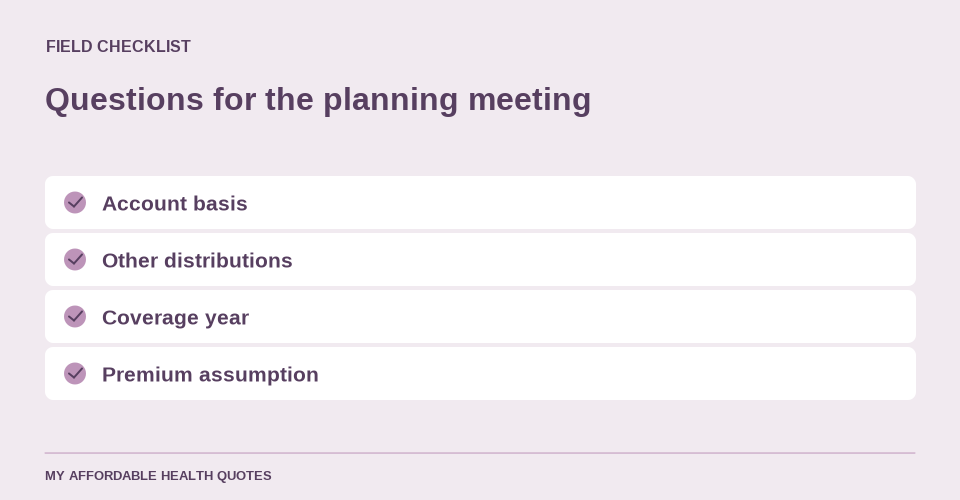
A useful request is specific: the household has this coverage year, this current estimate, and an adviser-reviewed proposed income change; what happens to the insurance comparison and any assistance determination? That question is more productive than asking whether Roth conversions are good for health insurance. It directs the conversation toward the facts an insurance professional can help evaluate while leaving tax and investment recommendations with the responsible advisers.
For a Nevada private-plan review, request help from My Affordable Health Quotes using the current household facts and care requirements. Keep the conversion worksheet available for the relevant eligibility discussion. The desired result is not a transaction selected to chase one premium figure, but a coordinated decision in which retirement planning, cash needs, and health coverage are evaluated together using consistent and documented assumptions.