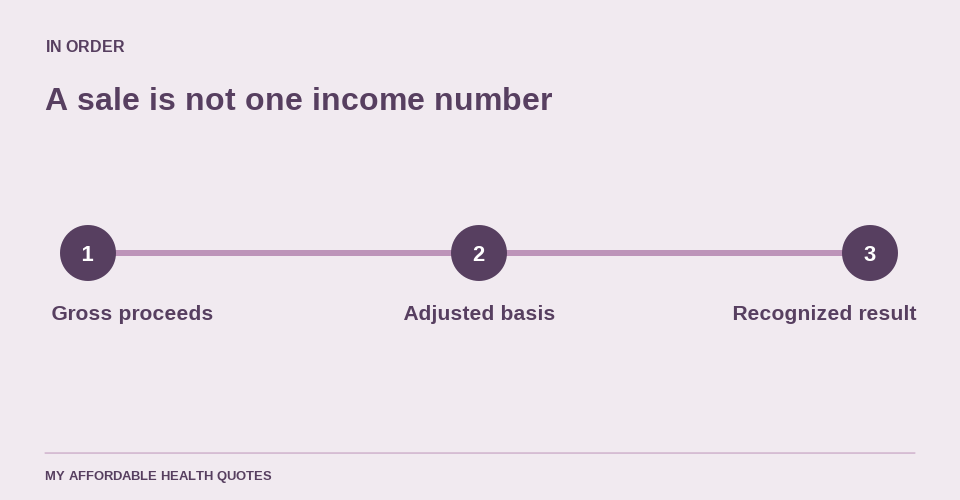
Selling an investment can change the financial information used for a health insurance application even when your salary has not changed. For a Nevada household buying individual coverage, the first task is to distinguish money received from income recognized. Sale proceeds, investment gains, and cash left after a transaction are not interchangeable figures. A careful comparison keeps the investment decision separate from the insurance decision while ensuring that both use the same current household facts.
This is especially useful during a transition from employment to consulting, a sabbatical, or another period without employer coverage. A household may have few paychecks but substantial portfolio activity. It should not describe the year as having no income simply because wages stopped. At the same time, it should not enter the entire value of every investment sold as income without considering basis and the applicable tax treatment. A qualified tax professional can establish the amount that belongs in the annual forecast.
Identify what the transaction actually was
Begin with a simple description of the asset, account, owner, and transaction date. A sale in a taxable brokerage account is different from a transaction inside a retirement account. A transfer between accounts is different from selling an investment. A distribution from an account is different from the gain on a security held within it. Those distinctions should be clear before anyone tries to connect a bank deposit to Marketplace income.
The IRS explains investment gains, losses, and basis in Publication 550. Ask the tax preparer for a forecast that reflects the actual transactions and any relevant adjustments. Do not subtract an assumed purchase price from sale proceeds when the history is incomplete. Reinvested distributions, inherited holdings, transferred accounts, and prior corporate actions can make the correct basis less obvious than the number on a current screen. The insurance application should use a supported estimate, not an improvised tax return.
A worked recordkeeping example
Imagine a Nevada couple sells an investment for a hypothetical $90,000. They intend to use part of the money for living expenses while one spouse starts a business. Their initial worksheet lists $90,000 as new income. The tax adviser explains that the sale result must be determined using the investment's basis and other relevant facts. The couple replaces the unsupported entry with the adviser's estimate and retains the calculation in their records. No specific gain is assumed here because the basis has not been provided.
The example illustrates a practical discipline: each income line needs a reason. The bank statement establishes that cash arrived; the brokerage confirmation establishes the transaction; the tax work establishes its income consequences. None of these documents should be forced to answer every question. When the household later explains the estimate to an enrollment assister, it can point to the relevant record rather than trying to reverse-engineer its own total from memory.
Nevada's enrollment channel matters
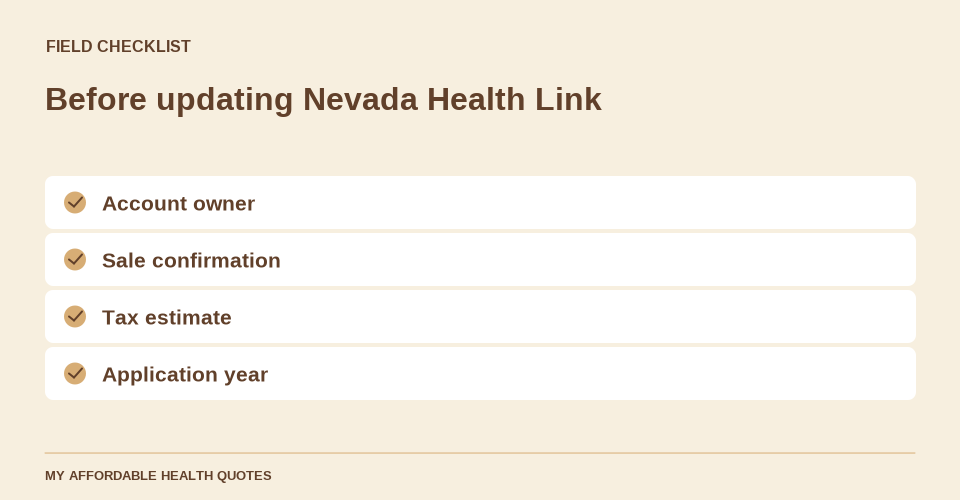
Nevada residents seeking Marketplace coverage use Nevada Health Link. Its income reporting guidance identifies investment and capital-gain income as categories to consider and explains that separate sources should be reported appropriately. Follow the current application instructions and any request for evidence. Do not assume a carrier's billing office can update the Marketplace's household income record merely because the carrier receives your monthly premium.
Keep a record of where each change was made. A brokerage address update, a Marketplace income revision, and an insurer contact-information change are different tasks. If the household also moved within Nevada, review that separately because a new location can affect available plans. The investment sale does not itself establish a qualifying enrollment event. Ask the exchange to determine whether any coverage change is permitted rather than treating a financial transaction as automatic permission to switch policies.
Look at the entire coverage year
An annual estimate should reflect what has already occurred and what is reasonably expected for the rest of the year. A sale in the final quarter can matter even if the household enrolled many months earlier. Conversely, a large gain from a prior year should not be carried into the new estimate simply because it appears on the latest completed tax return. Mark one-time items clearly so they do not become accidental recurring income in a renewal application.
Use a table with separate columns for actual year-to-date amounts, expected remaining amounts, and the source supporting each number. Add a notes column for transactions that are being considered but have not occurred. That last column is a planning aid, not permission to omit a transaction once it becomes reasonably expected or completed. Review the forecast when investment plans become definite and again when the records arrive.
Understand the insurance consequence without making it the investment strategy
The IRS premium tax credit overview explains the income-related conditions for the federal credit. A change in recognized income can affect assistance, but the actual result depends on the household and coverage year. Have the insurance and tax advisers evaluate the relevant facts. Avoid relying on an old calculator or a prior year's eligibility notice as though it guarantees the same outcome after a significant sale.
The investment decision should still consider diversification, liquidity, risk, taxes, and the household's objectives. It is rarely useful to describe a sale as good or bad solely because of its effect on one monthly premium. Ask for a comparison of the complete consequences instead. That discussion may show that a transaction remains appropriate despite higher insurance costs, or that the timing deserves further review. The purpose of the insurance worksheet is to inform that discussion, not to dictate it.
Compare policies at their full price
When income is uncertain, retain a comparison showing the full premium before any assistance. This gives the household a clearer view of the ongoing commitment if its financial eligibility changes. Then record any assistance determination as a separate line. A displayed net premium can be useful, but it should not hide the underlying price or make two policies appear equivalent when their networks and benefits differ.
Compare the deductible, out-of-pocket limit, prescription coverage, and access to the providers you expect to use. Ask whether the exact plan has routine coverage where you spend time, particularly if the household travels between Nevada and another state. Do not assume a high premium buys nationwide routine access. A PPO label describes a network arrangement, not a guarantee that every physician participates or that all out-of-network bills will be paid.
Keep a tax reserve distinct from a healthcare reserve
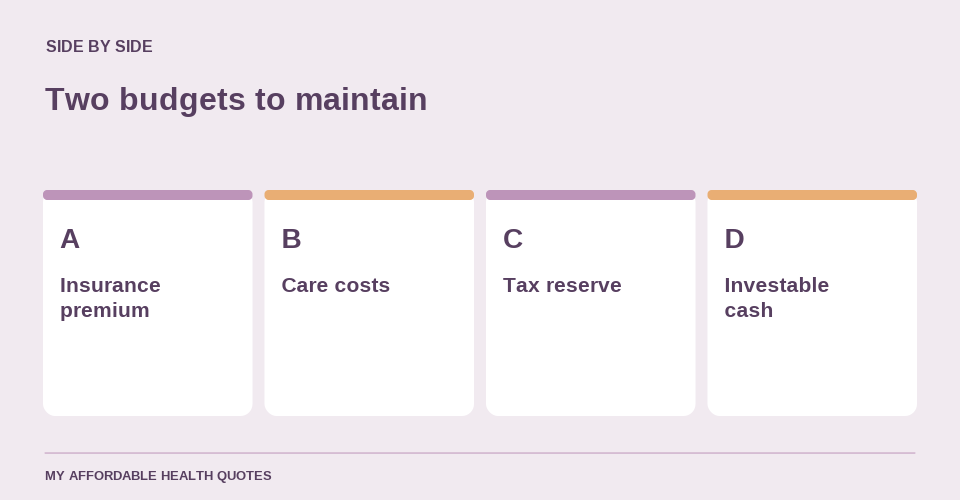
The cash from an investment sale may serve several purposes. One portion may be reserved for taxes, another for living expenses, and another for medical bills or premiums. Label these uses explicitly. A household can appear liquid on the day proceeds arrive while already having obligations against most of that cash. Treating the entire deposit as available to fund a high deductible can create a budgeting problem later.
A practical exercise is to write down the premium obligation for the planned coverage period and a separate amount available for care. Then ask the tax adviser what reserve is appropriate for the transaction. These are planning figures, not insurance benefits or tax guarantees. The exercise is valuable because it makes competing uses visible before the household commits money elsewhere. Revisit it if the sale price or tax estimate changes materially.
Handle losses and corrections carefully
A brokerage account can contain both gains and losses. Their tax treatment may depend on rules that are not captured by simply subtracting every red number from every green number. Ask the tax preparer to evaluate the applicable treatment rather than assuming that a large unrealized decline cancels a realized gain. Likewise, a corrected tax statement can change the forecast after an initial estimate was made. Keep the correction and the explanation together.
If an application was updated using a preliminary number, review whether another update is needed when better information becomes available. Record the date, old estimate, new estimate, and reason. That history is not an admission that forecasting was improper; it shows that the household responded to new facts. The objective is a reasonable, maintained estimate rather than a prediction that never changes despite changing circumstances.
Finish with one consistent set of numbers
Before requesting a plan comparison, prepare the household's current annual estimate, the intended coverage dates, and a list of essential providers and medicines. You do not need to share every brokerage holding with an insurance agent to explain that investment income is part of the picture. Provide the information needed for the application and keep detailed tax calculations with the professional responsible for them.
For help reviewing private coverage in Nevada, contact My Affordable Health Quotes with the current estimate and your care requirements. After enrollment, maintain the income record as transactions occur and confirm any resulting notices or premium changes. A successful process leaves the household with both a suitable policy and a clear explanation of the financial information behind its application, rather than a premium based on a number no one can later reproduce.
If you sell investments in several installments, keep one running total for the year. Record the sale date, proceeds and estimated gain on separate lines, then flag any figures your tax preparer still needs to confirm. This makes it easier to explain why a large deposit in your bank account led to a much smaller change in your household income estimate.
Sources and further reading
- IRS: Investment Income and Expenses
- Nevada Health Link: Reporting Income
- IRS: Premium Tax Credit Overview