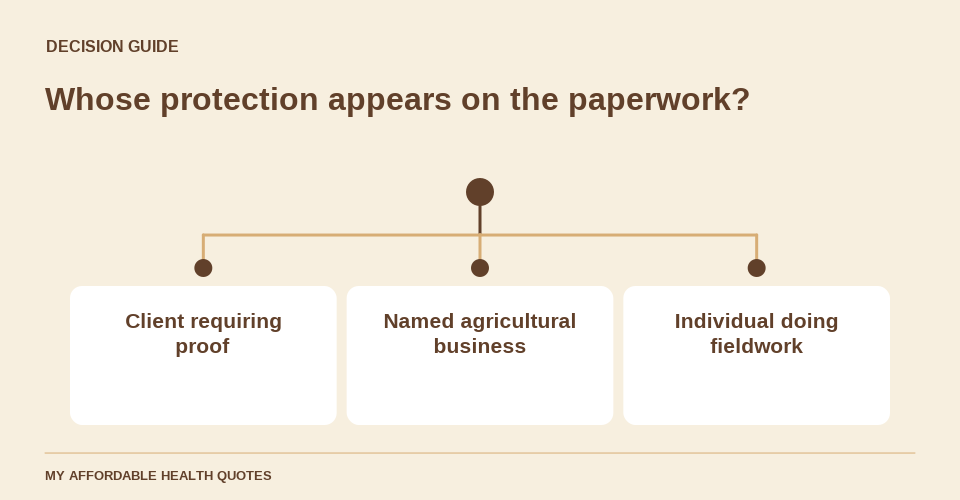
An independent agronomist in Nebraska may spend planting season inspecting equipment and the winter behind a screen interpreting yield data. When a new client requests a certificate of insurance, the easy response is to send the request to a business agent and move on. The harder question is personal. If the agronomist gets hurt walking between two test plots, which policy will handle the medical bills? The certificate, a household health insurance card and a signed consulting agreement each supply part of the picture. A buyer can spend quite a bit of money on all three arrangements and still need an answer about their own treatment.
Start with the person who will actually do the work
Picture Dana, a hypothetical owner who signs farm consulting agreements through a limited liability company. Dana’s spouse helps with bookkeeping, and an assistant collects soil samples during the busiest weeks. When the client asks whether the company has insurance, Dana hears a question about her own safety. The client may be thinking about an assistant’s accident, property damage caused by a truck, or advice that costs the farm money. Ask the client which contract clause triggered the request and who must furnish the certificate. Give that wording to a commercial insurance professional who knows the company’s operations.
Next ask for a separate written answer about Dana as a person. The insured business may have protection for a category of workers while an owner has a different status. Find the document showing who is included, the effective date, and which activity the insurer understood the business to perform. A filing showing an entity was organized, a year-end tax form or a badge that labels someone a contractor serves a different purpose. Nebraska’s Workers’ Compensation Court provides an overview of the employee and independent contractor distinction. When facts are disputed, a private label cannot settle the question for everyone involved.
Read the purchasing decision from both directions
On the commercial side, describe the workday in ordinary language. Include riding with clients, inspecting bins from ground level, taking calls from home and traveling to a second farm before returning to the office. Describe whether someone else sets routes or directs the specific work. Ask the agent about any owner election, inclusion, exclusion or reporting step that affects the arrangement, and request the supporting endorsement where one applies. A contractor who previously worked alone should give the agent the current staffing picture. Hiring a seasonal helper changes the questions that need answering even when the firm’s legal name stays the same.
On the personal side, request the specimen policy for the private health plan being considered. Search the document for work injuries, occupational injuries, workers’ compensation, other coverage, third parties and recovery of benefits. Read the complete paragraph surrounding a match. Some provisions turn on entitlement to another benefit. Others refer to amounts paid or payable. A marketing summary that mentions outpatient surgery does little to resolve those details. Give the insurer the owner’s actual commercial coverage facts and ask which passage would govern a claim arising from the described activity. A general answer on network coverage leaves that question open.
Distinguish a treatment bill from the cost of stopping work
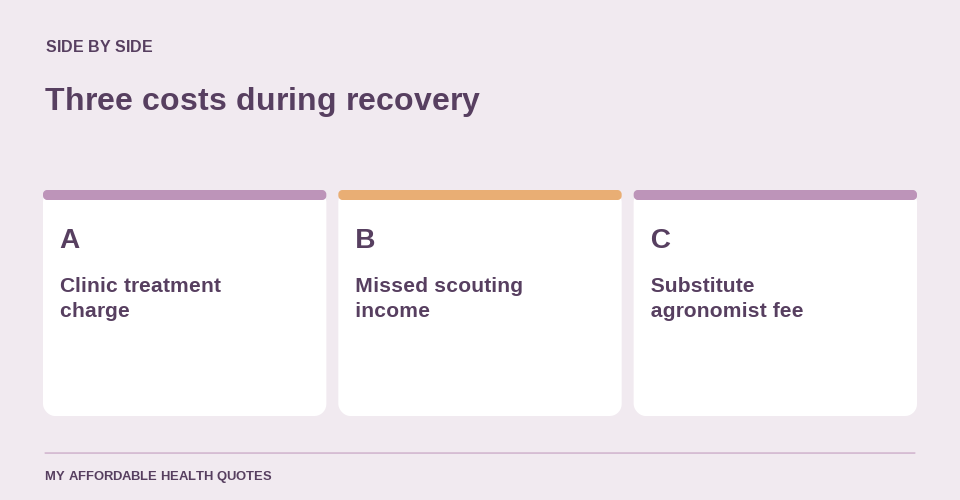
Consider three different invoices after an injured owner has to sit out the remainder of a scouting round. An urgent care center charges for the visit. A neighboring consultant invoices for two days spent finishing crop inspections. Meanwhile, a client withholds payment until the maps are delivered. Household medical insurance can be evaluated for the first expense under its terms. Buying a stronger deductible or a larger provider network does not add a contract completion benefit. The substitute’s invoice and the delayed client payment belong in a separate cash-flow calculation when deciding how much financial exposure the household can absorb.
Use imaginary numbers to see the distinction. A family with six thousand dollars reserved for health expenses may feel comfortable with its personal plan. Suppose it also needs twenty hours of substitute fieldwork at seventy dollars per hour while waiting for a four-thousand-dollar receivable. Fourteen hundred dollars goes to the substitute. The receivable creates a temporary cash requirement and may still arrive in full. Combining the two as a permanent loss would exaggerate the business expense. Ignoring both would overstate the cash available to pay for care. Write down when each payment is due, particularly during a compressed growing season.
Ask the questions before the first work order
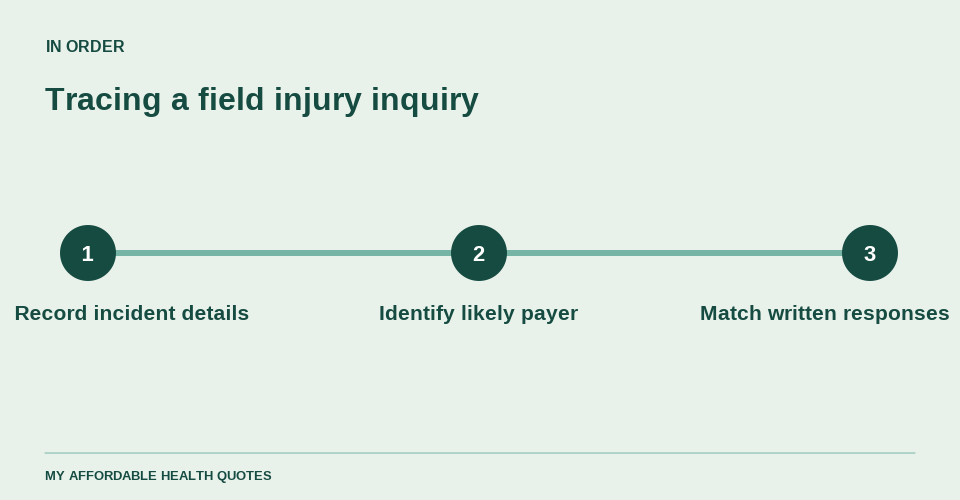
Prepare a short account of a plausible incident and use identical facts when speaking with each insurer. For instance, the owner steps in an irrigation rut during a paid field visit, receives outpatient imaging and later needs follow-up close to home. Ask the commercial contact whether this particular owner is included, which office receives incident reports, and what the owner should give the treating facility. Ask the health carrier how its policy treats a work-related claim if the other insurer is investigating or issues a denial. Save the response alongside the version of the policy used to answer.
One helpful follow-up concerns evidence. Does the health carrier request the other insurer’s written disposition, an employer questionnaire, the commercial policy declaration or some other document? Where should it be sent and how should the member identify the pending claim? A caller who asks these questions at enrollment can include responsiveness in the buying decision. A prompt, specific answer is worth recording. An unresolved issue can also be entered on the comparison sheet as an open item. There is no sound way to convert silence into an assumption that a household policy will automatically become the primary payer.
Keep the client’s certificate in perspective
Ask the commercial agent to explain every box the client wants completed. Identify who issues the certificate and which listed policy would answer a question about an injured worker. Check dates against the first and last field visits, including later sampling trips under the same project. If the client asks for a special endorsement, have the insurer describe its effect on the client and on the consulting firm. The fact that the client accepted a document establishes that its purchasing department accepted that submission. It gives the owner limited information about how an individual medical claim would be decided.
Take particular care when a subcontractor enters the picture. Suppose the usual soil sampler sends a replacement without telling Dana. Write down whose employee or contractor was expected, what the consulting agreement allows and what proof the commercial professional wants before work begins. One business cannot reliably answer for another’s entire coverage by forwarding last year’s certificate. Avoid taking shortcuts with personal health information to satisfy a commercial request. A farm manager handling contractor onboarding generally needs the agreed business documentation. A medical claim, with its details of care, belongs with the parties processing that claim.
When two offices each ask about the other
After an injury, obtain appropriate care and answer questions about how it happened accurately. Preserve dates, location, the task underway and the company for which it was performed. Use the reporting process and timing provided for the situation. Keep copies of anything sent and identify who received it. If the health insurer sends an accident questionnaire, answer it with known facts. A misleading description that reclassifies paid work as an afternoon walk can interfere with the review and create discrepancies with the clinician’s record. If the facts are uncertain, identify the uncertainty and ask how to supplement the response.
Separate a request for information from a final coverage decision. An explanation of benefits may show nothing paid because an insurer is waiting for another payer’s response. Ask for the exact outstanding item, any deadline, and the procedure to reopen or complete the claim. Call the billing office with the reference number and ask what happens to the account while review is underway. Do not presume all collection activity will pause. If a denial arrives, read the reason, appeal instructions and filing period before deciding what to submit. Preserve evidence that a document arrived at the address the reviewer specified.
Revisit the purchase when the farm calendar changes
A small consulting practice can change its exposure without changing its name. A desk-based advisor starts conducting on-site inspections. An owner who worked entirely in Nebraska accepts recurring work across a state line. A spouse becomes an employee and starts driving to client locations. An assistant moves from the office into the field. Each is a reason to give the commercial agent updated facts and ask the health insurer whether the existing explanation still applies. A quick conversation during renewal is easier to arrange when the owner has kept a plain description of duties and last year’s written answers.
When requesting personal health quotes, supply the household’s service area, preferred clinics and budget in addition to the outstanding occupational-coverage question. Consider ordinary illness, ongoing prescriptions and access to a local hospital even if client paperwork prompted the shopping trip. A comparison that focuses only on getting injured at work can overlook the services a household actually uses throughout the year. A commercial professional can address the business arrangement while the individual health advisor identifies which plan documents deserve closer attention. The owner can then choose knowing which questions each professional answered and where a material exposure still requires attention.
Keep the two renewal dates visible in the same calendar. When the business policy renews in March and the family chooses its next health plan in the fall, the decision made for one contract can quietly age out of the other comparison. Record the date of the last written explanation, who provided it and the policy year it concerned. Future Dana will know which answer to refresh before signing the next season’s field contract.
Sources and further reading
- Nebraska Workers' Compensation Court, employer questions
- Nebraska Workers' Compensation Court, independent contractor or employee