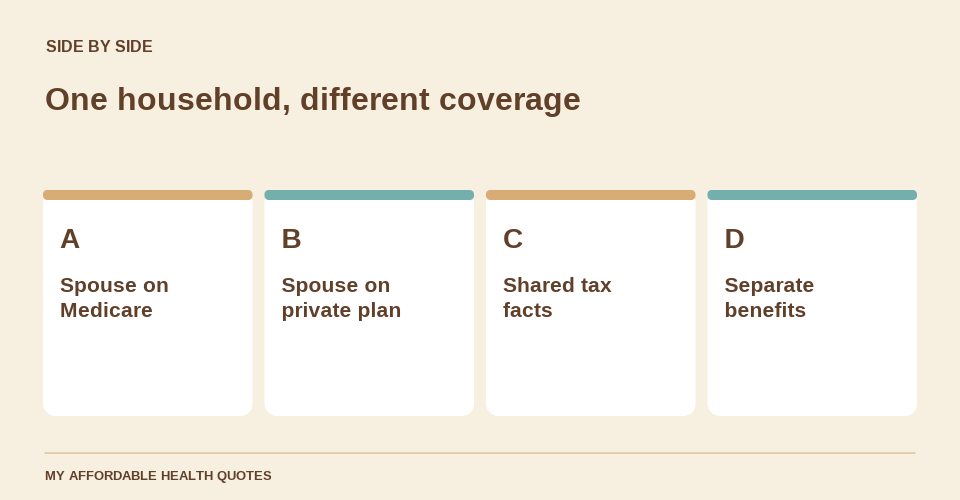
When one spouse starts Medicare and the other continues to need individual health insurance, the household should update coverage person by person. The spouse leaving a Marketplace policy may still belong in the household information used for the remaining spouse's application. Relevant income does not disappear merely because that person no longer needs private coverage. For Montana couples, this is a practical transition involving separate benefits, shared financial facts, and careful attention to effective dates.
This guide focuses on the spouse who continues to use private individual insurance. It does not select Medicare coverage or explain every Medicare enrollment rule. The spouse approaching Medicare should obtain guidance from Medicare or an appropriately qualified adviser. The household then needs to coordinate that confirmed start date with the existing policy and the remaining spouse's application. Treating the transition as two connected projects helps avoid accidental cancellation or an incomplete income estimate.
Start with confirmed dates for each person
Write down when the new Medicare coverage begins and when the individual's Marketplace coverage should end. Do not assume one system automatically informs the other. HealthCare.gov states that Marketplace coverage does not automatically end when Medicare starts and explains the need to update coverage for the person making that transition. Follow the applicable instructions and verify the result.
The remaining spouse may need continuous private coverage with no change to the effective date. Make that intention explicit when requesting an update. If children or other dependents are enrolled, identify them as well. A request to cancel the family plan can produce a different result from a request to end one person's coverage. Read the confirmation carefully and ask the insurer or exchange to correct any mismatch before assuming the transition is complete.
Separate enrollment from household membership
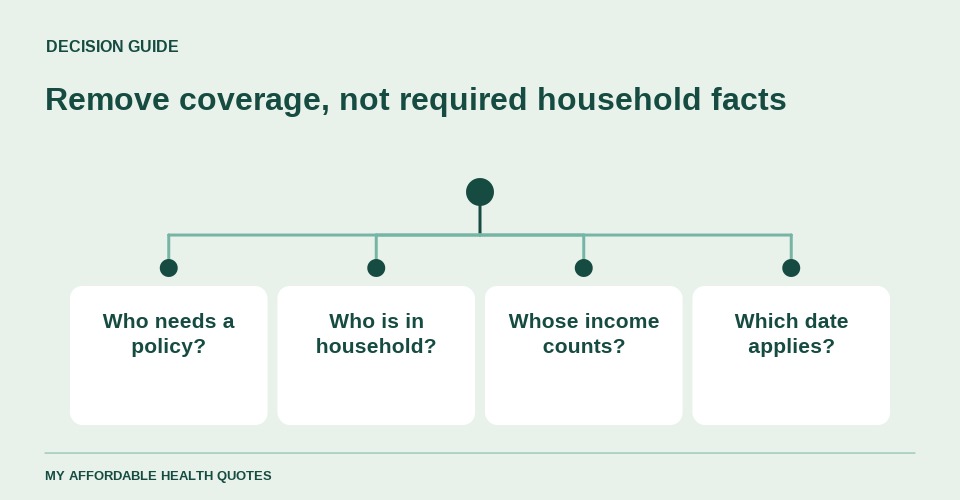
The people enrolled in a particular policy are not necessarily identical to the people included in the Marketplace household. HealthCare.gov explains that household members with other coverage may still need to be listed with their expected income. Follow those instructions rather than deleting the Medicare spouse from every part of the application. The screen should accurately represent who needs coverage and the relevant household facts.
If the tax household itself has changed for another reason, address that separately. A spouse's move to Medicare is not the same as divorce, legal separation, or a change in dependency. Keep the application changes tied to the actual event. If a question is unclear, ask an authorized assister to explain it before submitting a broad change that alters more than intended.
Rebuild the income forecast for the transition year
The year may contain wages earned before retirement, pension payments, retirement-account distributions, investment income, and Social Security. A household should not use only the remaining spouse's current paycheck as its annual estimate. Ask the tax adviser to identify the relevant sources and amounts for the actual coverage year. If employment ends partway through the year, preserve wages already earned rather than treating the year as though retirement began in January.
HealthCare.gov's income guidance identifies the treatment of common sources, including Social Security and retirement income. It distinguishes Social Security benefits from Supplemental Security Income, so do not classify both simply as government payments. Use the source documents and current instructions. The tax adviser can resolve questions about taxable distributions and the household's broader calculation without asking the insurance agent to interpret retirement-account history.
A hypothetical Montana couple
Imagine a Montana couple who have been insured together through an individual plan. One spouse reaches Medicare eligibility while the other remains several years away. The older spouse also reduces consulting work and begins receiving retirement income. The couple initially plans to remove that spouse entirely from the Marketplace application and report only the younger spouse's earnings. An application review identifies that coverage enrollment and household reporting need separate treatment.
The couple confirms the Medicare start date, updates who needs the private policy, and prepares a new household forecast that reflects the actual income transition. They then review the remaining spouse's premium and care access. This example does not assume eligibility for financial assistance or a particular premium. It illustrates the administrative distinction that prevents a smaller policy from being mistaken for a smaller tax household.
Compare the remaining policy as a new arrangement
Even if the younger spouse keeps the same product, the household's cost structure may change when one person leaves it. Ask the insurer to explain the applicable deductible and out-of-pocket limits and how accumulated spending is treated. Do not assume that a family policy automatically becomes a single-person policy with every prior amount transferred in the way you expect. Obtain plan-specific confirmation.
Review the premium using the updated enrollment and any eligibility determination. Keep the full premium separate from financial assistance. A lower number of covered people does not guarantee that the household's net insurance expense falls by a simple fraction. The Medicare spouse has separate coverage costs, and the private spouse's assistance may be recalculated. A combined household budget should show both systems without merging their benefits or limits.
Keep provider checks specific to the private spouse
The younger spouse's physicians, facilities, and medicines should be checked against the exact individual policy. Do not assume that because the older spouse can use a provider under a Medicare arrangement, the same provider participates in the private network. The two systems can have different contracts and administrative requirements. Give each medical office the correct insurance information for the correct person.
For a Montana resident traveling for specialty care, verify the relevant location and facility as well as the physician. A provider's participation at one office does not necessarily answer every billing question. Ask about routine out-of-area care and planned services explicitly. This review is particularly valuable if the household previously selected its policy around the older spouse's needs and now has an opportunity to reassess the younger spouse's priorities at an appropriate enrollment time.
Do not mix the programs' cost protections
Each spouse's coverage has its own rules and financial structure. Spending under one person's Medicare arrangement does not automatically count toward the other's private-plan deductible or out-of-pocket limit. Keep separate records and ask the relevant insurer to explain how claims are handled. A combined budget is useful for household planning, but it is not a combined insurance contract.
The same principle applies to drug coverage and provider authorizations. A medicine approved under one arrangement does not establish approval under the other. If both spouses use the same pharmacy, confirm that each prescription is billed to the correct coverage after the transition. Administrative familiarity can lead to mistakes when a family has used one card or account for years and suddenly has two distinct sets of information.
Revisit automatic payments and account access
Check the premium withdrawal after one person leaves the private policy. Confirm that the payment amount and enrolled members match the updated notice. Do not cancel an entire automatic payment arrangement merely because one spouse's coverage ended if the other remains insured. If a new account or billing number is issued, verify that the intended payment method follows the active policy.
Review email addresses and authorized contacts as well. A spouse who previously managed the family policy may continue helping, but the insurer's access rules should be followed. Keep a secure record of which organization handles each question. The exchange addresses application and assistance issues, the private insurer confirms its policy and claims, and Medicare-related questions belong with the relevant Medicare channel or adviser.
Prepare a different forecast for the next year
The transition year may contain part-year wages and part-year retirement payments. The following year may have a full year of the new pattern. Build a separate forecast rather than copying the transition year's total. Mark one-time events such as a retirement-account withdrawal or asset sale so they do not repeat automatically. At the same time, include recurring sources that will continue even though employment has stopped.
If the younger spouse continues working or starts consulting, review that source independently. A household can have both retirement income and active business earnings. Ask the tax adviser to prepare the combined estimate and explain any material uncertainty. This gives the insurance renewal a current foundation without assuming that retirement means every financial fact has become stable.
Keep prior coverage records for claims and taxes
Do not discard the former family policy's documents when one spouse moves to Medicare. Claims for care before the transition may still be processed later. Marketplace tax forms and eligibility notices may also be needed for the completed year. Preserve the records by coverage period so the household can identify which policy was responsible on a particular service date.
If a bill arrives after the transition, check the service date before assuming it belongs to the new coverage. Ask the provider and insurer to correct billing errors through the appropriate process. Paying an unfamiliar bill without review or forwarding it to the wrong insurer can prolong the problem. A simple timeline of coverage dates is often the most useful document in that conversation.
Complete a final person-by-person review
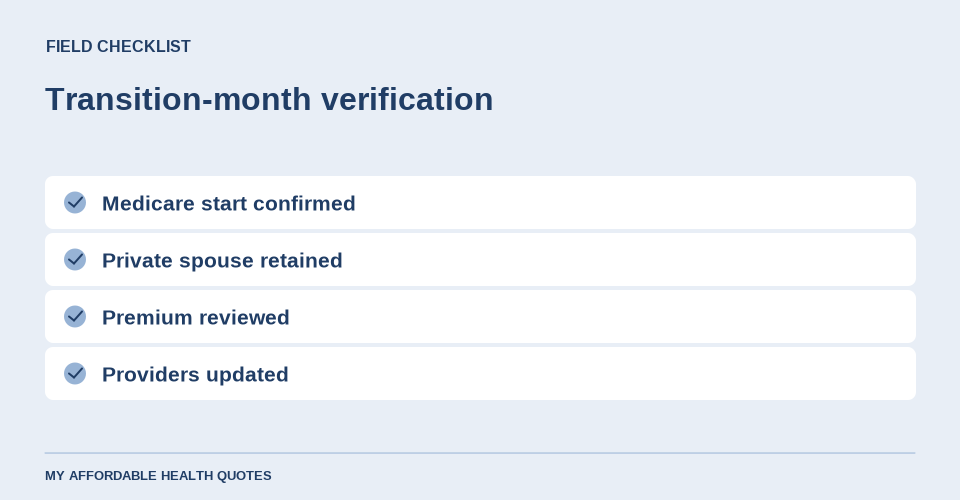
Before considering the handoff finished, verify the Medicare spouse's confirmed coverage, the private spouse's active policy, each premium, and the application's household information. Make sure providers and pharmacies have current details. Save the confirmations together with the income forecast used for the update. This creates a compact record that can be revisited if an unexpected notice or bill appears.
For help comparing the remaining spouse's private health insurance options in Montana, request assistance from My Affordable Health Quotes. Bring the confirmed transition date, care requirements, and current household estimate. The strongest arrangement keeps the two coverage systems distinct while preserving the shared financial facts that the individual application requires.
Schedule a short check after the first full month and another before renewal. The first catches billing or enrollment errors; the second revisits the policy and income assumptions for the next year. These reviews serve different purposes and need not become complicated. They simply ensure that a carefully planned transition continues to work once the household begins using its new arrangement.
Sources and further reading
- HealthCare.gov: Medicare and the Marketplace
- HealthCare.gov: Household Membership
- HealthCare.gov: Income to Include