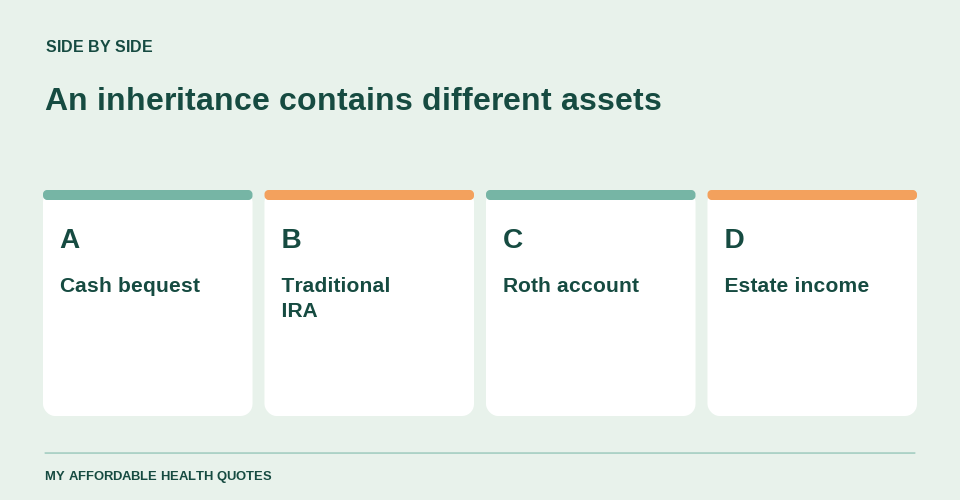
An inherited retirement account can affect a health insurance income estimate differently from a cash inheritance. A Montana household receiving an inherited IRA should identify the account type and the treatment of distributions before assuming that every inherited dollar is excluded from income. The immediate task is to organize the beneficiary records and ask the tax adviser what amounts belong in the coverage-year forecast. The insurance application should reflect that answer without trying to resolve beneficiary rules on its own.
This often happens during an emotionally demanding period. A household may be handling an estate, travel, and family responsibilities while also maintaining private coverage. A short checklist can reduce the administrative burden. It should distinguish the inheritance itself, the account's required distribution rules, and the actual withdrawals planned or made. Those are related issues, but they are not the same transaction or the same professional decision.
Identify the asset before labeling the income
Begin with the custodian's exact account description. An inherited traditional IRA, an inherited Roth IRA, a taxable investment account, and a payment from an estate can require different analysis. The phrase inheritance is too broad to establish the treatment. Ask who the beneficiary is, whether the account has been properly titled, and what records the custodian can provide. Keep those documents separate from a general list of estate assets.
The IRS explains beneficiary considerations on its retirement-beneficiary page. The rules depend on facts such as the account and beneficiary circumstances. Avoid applying a rule remembered from another family's inheritance. A spouse's choices may differ from another beneficiary's, and the date of the original owner's death can matter. The tax adviser needs those facts before establishing the distribution schedule or income forecast.
Separate required timing from an optional withdrawal
An account may have distribution requirements, while the household may also be considering withdrawals for spending or other reasons. Identify which proposed amounts are required and which are discretionary. Do not delay a required action merely because a later year seems more attractive for insurance. Likewise, do not assume that taking the entire account immediately is the only available approach without reviewing the applicable rules. This is a beneficiary-planning decision requiring appropriate professional guidance.
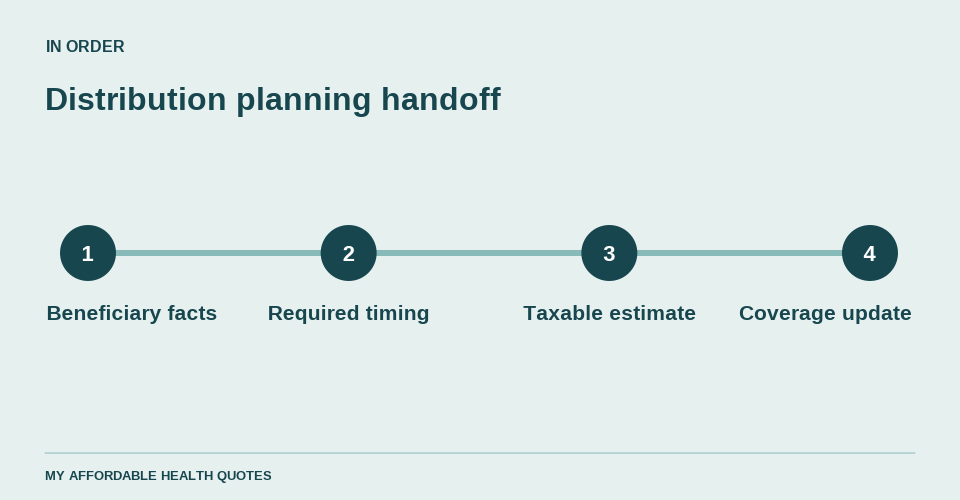
Write the confirmed deadlines on a calendar and identify who will initiate each transaction. A custodian reminder is useful, but it should not be the household's only control. Keep the adviser's explanation of the schedule and revisit it if new facts emerge. The insurance estimate can then use the expected taxable amounts for the relevant year, rather than a guess based on the total inherited balance.
A hypothetical Montana household
Imagine a self-employed Montana resident who inherits a retirement account from a parent. The resident already has private health insurance and has reported a forecast based on business earnings. A family member says inheritances are not income, so the resident initially sees no reason to revisit the application. The tax adviser explains that distributions from this particular account need separate analysis. The household obtains a distribution estimate and reviews whether the coverage-year income forecast should change.
The example does not assume a withdrawal amount or a specific beneficiary deadline. Its purpose is to show the classification problem. The original account balance is not automatically the amount to enter, and the general label inheritance does not automatically exclude every later payment. The household needs the actual account facts and an adviser-supported estimate before deciding what information to report.
Review the taxable amount with the right records
IRS Publication 590-B discusses inherited IRA distributions and their tax treatment. Ask the preparer whether any basis or other account history affects the taxable amount. A custodian may not possess every record needed for the final calculation. Preserve documents received from the estate or prior advisers, and ask how missing information should be resolved rather than assuming the default number on a statement is always complete.
If the household receives several distributions, maintain a running list with dates and amounts. Identify any withholding separately from the gross payment. The money deposited after withholding is not necessarily the income figure. When the year-end form arrives, reconcile it with the list and ask about discrepancies. A clear transaction history makes it easier to update the insurance forecast during the year instead of waiting for the final tax return.
Estate payments need their own classification
The inherited IRA may be only one part of what the household receives. An estate can also distribute cash, property, or income with separate reporting consequences. IRS Publication 559 addresses issues for survivors and estate administration. Do not combine every payment into one inherited-income line. Ask the executor or fiduciary which tax documents are expected and when a reasonable estimate can be provided.
Keep a source label for each payment so an adviser can distinguish an IRA distribution from an estate distribution or a transfer of an existing asset. This is especially important if several deposits arrive close together. A bank statement alone does not establish their character. The household should be able to trace each relevant amount to the custodian, executor, or other source without relying on a memory of who sent the money.
Include the distribution in the full-year picture
An inherited-account payment does not replace the rest of the household forecast. Add the relevant amount to business profit, wages, and other sources using the applicable income rules. Preserve income already earned earlier in the year. If the household has reduced work to handle family matters, update that assumption separately. The resulting estimate should explain both the new account income and any change in ordinary earnings.
Prepare a separate forecast for the next coverage year if the distribution pattern will differ. A large one-time withdrawal should not become an accidental recurring amount at renewal. Conversely, an expected future distribution should not be omitted just because the current year's paperwork is complete. Ask the adviser for the next review point, particularly when account requirements or household plans will create a different pattern over several years.
Keep assistance questions distinct from plan suitability
A revised income estimate may affect financial help, but it does not tell the household whether its current policy is a good fit. Review the network, medicines, and expected services independently. If the household receives care from specialists outside its immediate Montana community, verify those providers under the exact plan. A change in assets does not eliminate the practical importance of access, authorizations, and continuity of care.
Retain the full premium alongside any net amount after assistance. This lets the household understand the coverage commitment if eligibility changes. Do not assume the inherited account makes every premium or deductible affordable; the funds may be restricted by planning needs, taxes, or other obligations. A realistic budget identifies the cash available for healthcare rather than treating the entire account value as a medical reserve.
Avoid changing withdrawals solely from a premium estimate
The tax and financial advisers should evaluate the distribution strategy using the beneficiary rules and the household's broader objectives. Insurance costs are one input. A lower premium in one scenario does not automatically justify a transaction that creates another tax problem or conflicts with a required distribution. Ask for the full comparison and the assumptions behind it. Do not seek an insurance answer that bypasses the account's legal or tax requirements.
If different professionals provide different numbers, ask them to reconcile the source and year rather than choosing the more favorable figure. One may be discussing gross distributions, another taxable income, and another spendable cash. Those numbers can all differ for legitimate reasons. A short written reconciliation helps the household understand the distinction and gives the insurance application a consistent, supportable estimate.
Share sensitive information selectively
An insurance quote request does not need an account number, beneficiary designation, or complete estate file. Provide the information needed for the coverage conversation and use secure channels for any required evidence. Keep detailed documents with the custodian and advisers responsible for them. If an eligibility notice requests proof, read exactly what it asks for and provide accepted documentation that addresses that issue.
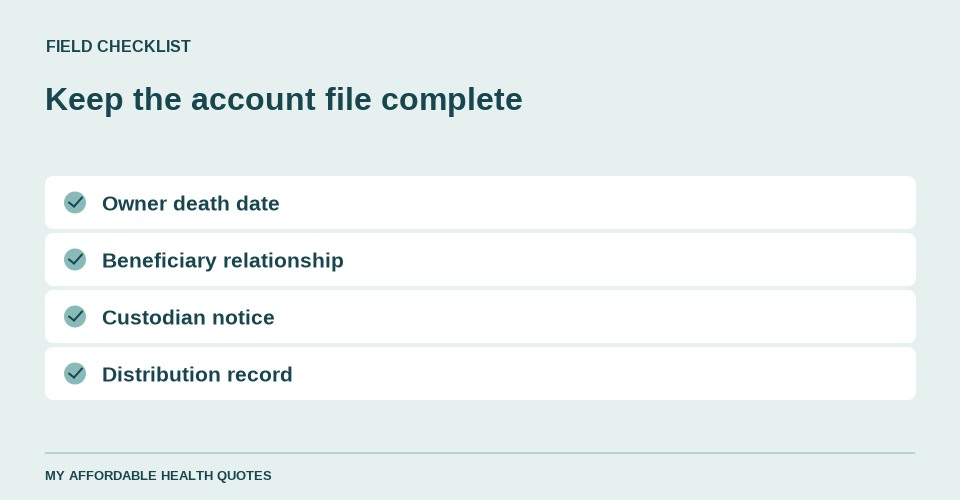
Retain submission confirmations and a copy of the forecast used. During estate administration, several family members may help with paperwork. Assign one person to track the insurance update so the same change is not submitted inconsistently by different helpers. The goal is not to exclude support, but to ensure that everyone works from the same current record and understands which tasks remain unfinished.
Check the result after a distribution occurs
Once a withdrawal is completed, compare the actual date and amount with the forecast. Ask whether a tax estimate or insurance application needs revision. Keep the custodian confirmation and any updated eligibility notice. If the insurer's next bill changes, verify that it matches the expected determination. Do not assume that updating one record automatically completes every related administrative step.
For help reviewing private health coverage in Montana, request assistance from My Affordable Health Quotes with the current household estimate and coverage needs. Bring inherited-account classification questions to a qualified tax professional. A sound process respects the complexity of the inheritance while keeping the insurance work concrete: identify the relevant income, report it accurately, and maintain coverage that fits the household's actual care requirements.
Keep a separate note for questions awaiting an executor or custodian response. Give each question a follow-up date and identify whether it blocks a required account action or only refines an estimate. This helps the household prioritize urgent work during estate administration without losing track of the smaller updates that keep the insurance record accurate.