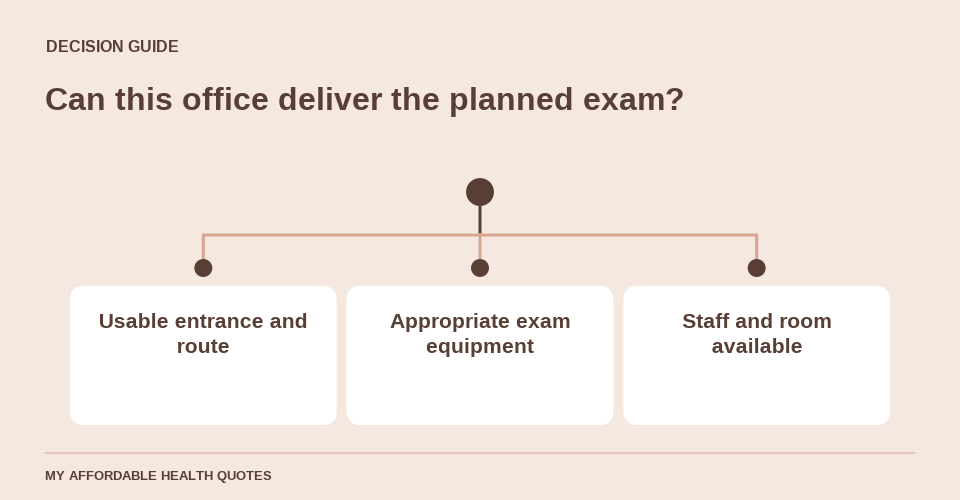
A Missouri accessibility consultant uses a wheelchair and knows how to inspect a public building. Shopping for private health insurance creates a different kind of access problem. The directory lists a primary care office close to home and identifies it as accessible. The visitor entrance may indeed be step-free. But can the consultant get onto the examination table using a preferred transfer method? Is an accessible scale available? Can the scheduler reserve the right room on the day of the appointment? A useful provider network must connect the patient to the actual examination, all the way past the front door.
Describe the appointment from the patient’s point of view
Begin with the person’s preferences for receiving care. Some wheelchair users transfer independently if the height and approach work. Others use equipment or trained staff assistance. Some examinations can appropriately occur while the person remains in the wheelchair, while others require an examination table or different positioning. The clinician and patient decide how the examination can be done appropriately. When shopping, the person can describe the functional feature needed without disclosing a full medical history. An office can usually answer whether it has an adjustable table and how staff arrange access before knowing the diagnosis.
Consider writing a short request in the patient’s own words. For example, the patient can transfer toward one side and needs space for a chair beside a lowered table. Another might need a lift with compatible equipment and staff available to operate it. Use whatever description the individual considers accurate. A generic question about wheelchair access can invite an equally generic answer concerning parking. Asking about the room, table and scheduling process gives the office a chance to connect the caller with someone who has seen and used the equipment.
Confirm the particular door, room and day
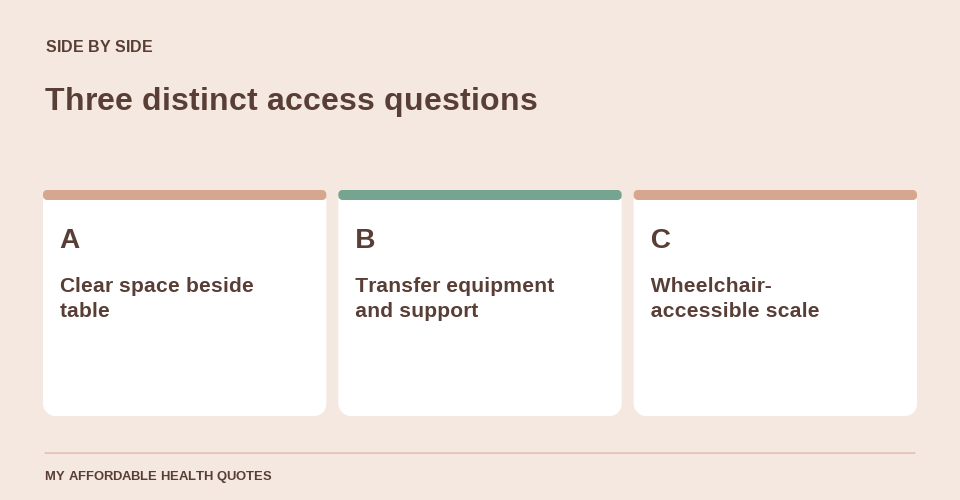
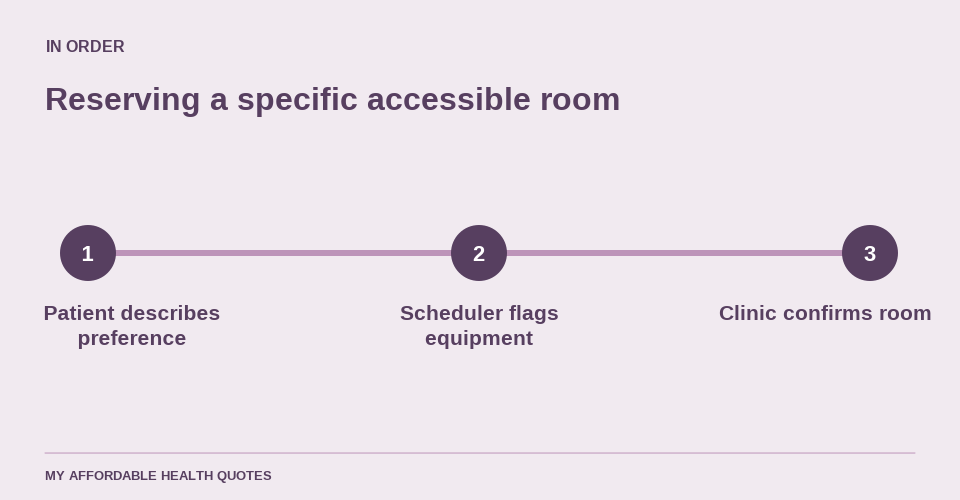
A large practice might occupy several suites, and the clinician who appears in the directory may work in different buildings on different days. Give the scheduling team the specific address and proposed appointment type. Ask which entrance and elevator lead to that department and whether any temporary construction affects the route. Then ask whether the room with the appropriate equipment can be reserved when the appointment is booked. If a single adjustable table serves the entire practice, knowing it exists only starts the conversation. The patient needs a reason to expect it will be available at the relevant time.
Check what happens when the usual room or staff member is unavailable. Can the practice flag the appointment in advance? Will someone confirm the setup before the patient makes the trip? If another site is suggested, identify how far away it is and who will help check participation there. The Department of Justice guidance on medical care for people with mobility disabilities addresses accessible examinations, equipment, transfers and staff assistance. Use it when discussing a barrier with a practice, particularly if a caller is told to bring a family member simply to compensate for missing assistance at the office.
Give weighing and diagnostic equipment their own questions
A patient may be able to use an exam table and still have no practical way to be weighed during the same visit. Ask whether the office has a wheelchair-accessible scale and how staff determine and record the measurement appropriately. Do they need information about the chair? Can the equipment accommodate it? The medical team determines when and how measurements are clinically necessary. The patient wants a clear description of available options, rather than a blanket promise that a historical estimate will always suffice. A practice that can explain its process is easier to evaluate.
If the household expects another service, repeat the question for that department. A primary care suite and an imaging center in the same building may operate with different equipment and scheduling systems. Ask about positioning, transfer support and the exact location of the proposed service. Let the patient communicate preferences directly. A household member can help take notes if invited, but the patient is the best source for the transfer method that works for them. Avoid letting the desire for an easy administrative answer replace an informed conversation with clinical staff about providing a complete examination.
Verify the insurance after the physical details
Once the appropriate office is identified, call the insurance carrier with the physician, billing organization, suite address and exact plan name. A convenient facility that offers the necessary equipment may participate in one network and be outside another sold by the same insurer. Ask whether the visit will be billed as a physician office or a hospital outpatient service and whether that affects cost sharing. When more than one department is involved, identify which organization bills for each. Confirmation of a wheelchair-accessible route is evidence about the building; confirmation of network status comes through the plan and provider.
If the insurer points to a different practice, give it the practical requirements, not the patient’s entire history. Ask which locations in the directory meet the appointment needs and which department can help verify the information. Record whether a suggested site has confirmed its features or merely carries a directory flag. If the person cannot find an appropriate participating provider, ask the carrier about assistance locating care and any applicable exception process. Obtain any decision in writing before relying on a proposed payment arrangement for scheduled services. A verbal suggestion to go elsewhere is incomplete if no one has explained how that visit will be processed.
Compare travel and time with actual figures
Imagine the closest confirmed suitable practice is twenty-five miles away, while a directory entry with uncertain equipment sits five miles from home. For six round trips, that difference represents two hundred forty extra miles over a year. The mileage is a useful measure, but it may capture only part of the burden. Accessible transport may require advance booking or a fixed pickup window. A consultant may be able to work during some waiting periods but may lose a paying appointment if the return trip overruns a client meeting. Estimate the actual cost of the logistics the household uses.
Another plan might include a clinic with verified equipment down the street at a higher monthly premium. A thirty-dollar monthly difference is three hundred sixty dollars annually before care. Compare that fixed expense with the expected transport costs, coverage for the actual clinical service and the person’s preference for a particular practice. Avoid assigning a made-up hourly wage to every minute of travel. Instead, include identifiable expenses and record scheduling freedom as a separate benefit. A professional whose calendar is under their own control can still find that a reliable accessible appointment is worth paying for.
Know which organization can fix which problem
If an office has the correct equipment but it was assigned to someone else on the appointment day, speak with the practice about scheduling a usable room and preventing a repeat. If a directory falsely indicates that a location offers an accessible service, ask the insurer to investigate and correct the listing. If the barrier concerns the quality or equality of access, discuss it with the practice’s designated patient relations or accessibility contact and consult official guidance on available options. A network complaint and a disability access concern may overlap, yet each recipient needs a precise description of the part it can address.
A strong account can be brief. Record the appointment date, exact suite, feature requested, who confirmed it and what happened on arrival. Note whether care was delayed, incomplete or rescheduled and whether a suitable alternative was offered. Protect personal medical details when writing initial enquiries. A clear request such as reserving an identified room or confirming a workable transfer procedure gives the provider something actionable. A request to the insurer might instead ask it to identify a participating practice that can provide the examination and explain member cost sharing for that practice.
Use the first visit to test what renewal will mean
With the patient’s permission, note what worked from arrival through checkout. Was the correct room reserved? Did the team ask how the patient preferred to transfer? Was the equipment available without an avoidable delay? Did the claim use the agreed setting and provider? Update the household’s notes with concrete answers. A successful first visit can support a plan choice at renewal, while repeated scheduling failures can justify looking beyond what appears to be the largest network. An accurate directory is particularly valuable when the patient needs an alternate site unexpectedly.
When requesting a Missouri quote, provide the exact facility that works and the kind of access the person wants to preserve. Ask the advisor to verify the policy’s medical benefits and the facility’s participation while the clinic verifies equipment and staffing. Include a backup for appointments requiring another department. The result is a comparison based on the patient’s real standard for a usable network: being able to reach the room, receive the examination appropriately and understand the financial arrangements before returning to the workday.
One final question can reveal whether the arrangement will survive routine staffing changes. Ask where the office records the patient’s access preference and how the patient can update it before a future appointment. Keeping the information with the booking process can spare the patient from having to negotiate the whole visit again every time a different scheduler answers the phone.
Sources and further reading
- U.S. Department of Justice, medical care for people with mobility disabilities
- Missouri Department of Insurance, health insurance