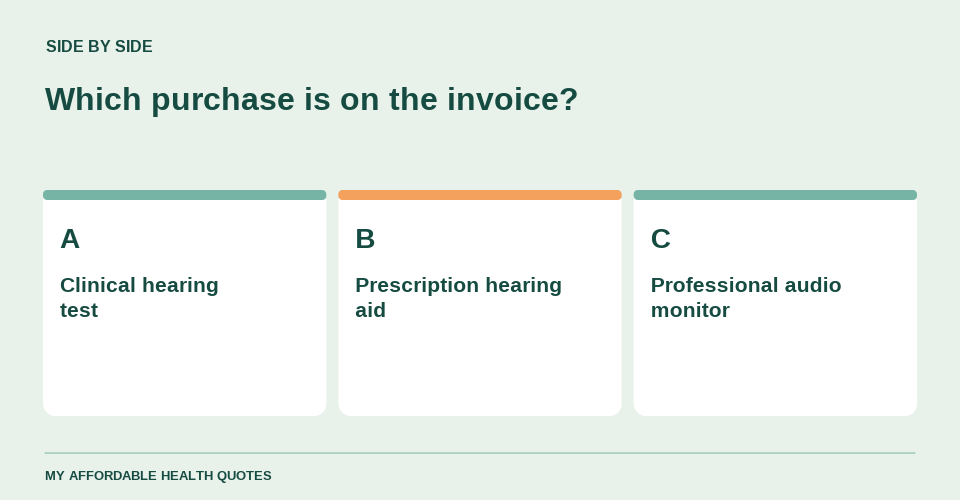
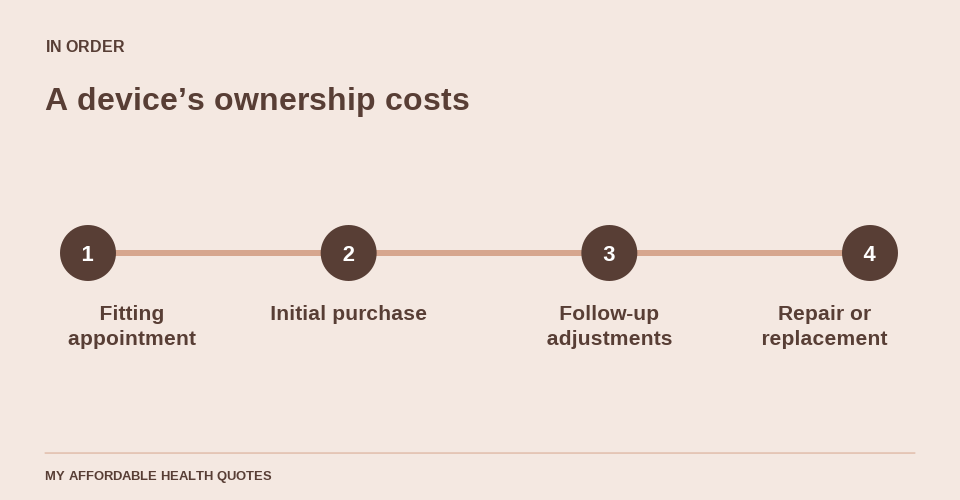
For an independent sound engineer, the ability to hear clearly has obvious economic value. That does not make every hearing-related expense a health insurance benefit. Compare the clinical evaluation, the device, fitting and follow-up, repair or replacement, and any equipment used only for work. Ask which expenses your individual plan covers for an adult and which remain your responsibility. A plan that covers the hearing test might offer a limited device allowance, a discount program, or no applicable hearing aid benefit.
Consider a Missouri engineer who records classical ensembles and also mixes live performances. She has an audiology appointment on her calendar and wants to review health insurance before purchasing a device. A promotional quote advertises “hearing savings.” What she needs to know is how much eligible expenditure the plan will actually pay, where she may buy the device, and what is included in the professional’s quote. She should make clinical decisions with her clinician and equipment decisions with the appropriate supplier. Her job title alone settles neither question.
Put a clinical name on the first appointment
Ask the audiology office what appointment has been scheduled and whether it is a hearing screening, a diagnostic assessment, a hearing aid evaluation or a fitting. These terms can describe different work. Obtain the practice’s contact information for insurance verification, the location, and any proposed service descriptions the office can provide. Then ask the carrier how this particular appointment is treated. Avoid starting with an assumption that a free screening advertised by a retailer is equivalent to a diagnostic appointment ordered by a clinician.
If your primary care clinician has referred you for a symptom, tell the insurer the nature of the service being requested without guessing at a diagnosis. Ask whether the plan requires a referral, whether the professional and facility are in network, and whether the evaluation is subject to a deductible or separate cost sharing. If you have a symptom that needs prompt evaluation, follow clinical guidance. A plan comparison should help you understand payment, not determine how long to wait for care.
An adult hearing aid benefit is a separate inquiry. Marketplace plans cover categories of essential health benefits, but benefit details vary, and words such as “rehabilitative services and devices” do not by themselves tell you what an individual policy pays for a particular hearing device. Ask for the hearing section of the policy issued in your Missouri service area and the exclusions applicable to adults. Hearing benefits for a child on the same family plan cannot simply be copied into your own column.
Distinguish the product from the way it is sold
The FDA distinguishes hearing aids, which are medical devices intended for people with hearing loss, from personal sound amplification products intended for people with normal hearing in certain listening situations. A professional stage system or custom in-ear monitor has its own intended use. Matching the shape of a device to the shape of a hearing aid is not evidence of medical coverage. Ask the seller to describe the product, intended purpose and included services in writing.
Over-the-counter hearing aids are an option for certain adults with perceived mild to moderate hearing loss. FDA materials explain differences between OTC and prescription devices and when to seek professional assistance. The existence of an OTC category answers a regulatory question about access to products. It does not establish that an insurer reimburses a device bought directly from a store. Ask how the carrier defines eligible suppliers, whether a prescription or professional evaluation is required for its benefit, and whether reimbursement can be requested after purchase.
A bundled professional quote can include device hardware, fitting appointments, subsequent adjustments, maintenance or a service period. A lower sticker price may include fewer services. Request an itemized description of what is included and what you would buy separately. If a carrier pays a fixed amount toward hardware but does not pay for the same bundle of services, price the difference using the service arrangement you intend to use. Compare complete options, especially when the plan restricts the supplier.
Follow the allowance through two ears and two years
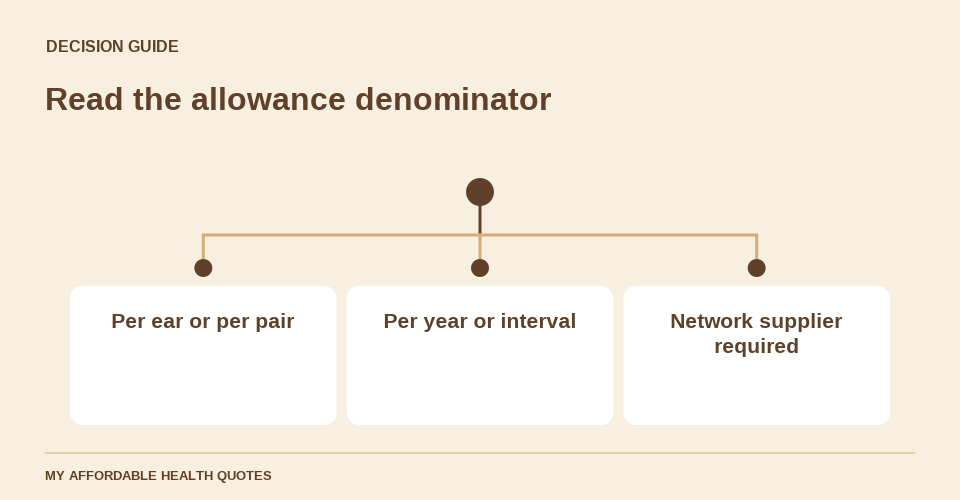
A description such as “up to $800” is missing at least three units. Is that number per ear or per pair, per benefit year or per multi-year interval, and per eligible device or for a larger collection of services? Ask how the interval is measured. It could be based on a prior purchase, a plan year, or another rule. If you are switching insurers, ask the new issuer what records it uses to establish first eligibility under the new policy.
Consider a purely hypothetical pair of arrangements. Option A pays up to $500 per ear toward qualifying devices. Option B pays up to $800 per pair. If a person needs two qualifying devices and all other conditions are satisfied, the ceilings in that example would be $1,000 and $800 respectively. These are maximum potential contributions, not promised payments. The billed amount, allowed amount, deductible, purchasing channel and provider contract can change the calculation. The larger number in a brochure is not necessarily the larger benefit.
Now extend the time horizon to replacement. Ask whether accidental damage, loss, technological obsolescence and ordinary wear are handled differently. Identify who provides the warranty: manufacturer, dispenser or insurer. A device may have a manufacturer’s repair promise even if an insurer has no obligation to buy another device during the interval. Conversely, a policy provision about replacement does not establish what the manufacturer will do when a specific part fails. Keep the certificate and the warranty in separate places on your worksheet.
Price the time cost of service away from home
A Missouri professional who travels for performances may need follow-up while away. Ask whether a provider at another location can adjust the specific device, whether the service is covered by the original bundle and whether remote adjustments are possible when clinically appropriate. If the contract requires return to a particular dispenser, find out how long you can realistically be without the device. Two plans with similar purchase allowances can differ substantially in the practicality of follow-up.
Suppose a touring engineer books a morning appointment between travel days. One supplier offers a fitting locally but sends hardware out for service, while another provides adjustments only at a distant office. The engineer should compare actual travel and service arrangements, not just monthly premiums. An extra commute or canceled booking is a personal or business cost to consider. Do not include that amount as a reimbursable health expense unless the policy provides a specific applicable benefit.
Keep occupational hearing protection outside the medical-device price calculation. Earplugs developed for stage work, sound-level monitoring equipment and audiology services can all contribute to professional hearing conservation. Their roles are different. Ask a qualified professional about appropriate protective practices and what a client or venue supplies. The purpose here is to avoid labeling business equipment as a medical service or assuming that a useful protective purchase must be paid for by an individual health insurer.
Handle “discount” and “covered” as different payment mechanisms
Ask how money moves. In an insurance benefit, determine who submits the claim and how the plan calculates its payment. In a negotiated discount, ask who sets the price, what supplier must be used and whether any money is paid by the insurer. A discount off a high list price can still leave a patient owing more than a lower cash quote from another dispenser. Request the final amount you would pay for comparable services under each option.
Before purchasing, record the exact product description, provider, quoted out-of-pocket price, included follow-up and unresolved insurance questions. Ask how a return or exchange interacts with a claim or allowance and whether you must seek any required approval before the order is placed. Retain the receipt and the written return policy. A carrier’s confirmation that your policy has a hearing benefit should not be treated as a guarantee that it will pay a claim lacking documentation or falling outside the allowed supplier arrangement.
A good insurance shortlist may ultimately be driven by your doctors, prescriptions or family coverage even if hearing is important to your career. State the hearing result honestly: for example, “Plan A makes the clinical evaluation more predictable, but I still need a separate device quote.” That is a more actionable outcome than choosing the plan with the most appealing hearing icon on its marketing sheet. For a quote discussion, bring the itemized audiology estimate and the precise questions about adult devices, purchasing channels and replacement intervals.
One last comparison is worth doing on paper. Suppose one plan would cost another $240 over the next twelve months. List the hearing-related expenses it would change this year and the expenses it would change only in a later replacement year. An allowance that cannot be used until a future date has a different present value from a covered evaluation scheduled for next month. Family plan costs, coverage changes at renewal and uncertain future device needs make distant projections particularly fragile. Use a second column labeled “possible later value” for benefits you cannot actually use this year. You will still see them in the decision without counting the same allowance as a fresh payment every January. That small accounting step can reverse an apparent bargain without requiring a guess about the price of a future device.
Sources and further reading
- FDA — Hearing aids and personal sound amplification products
- FDA — How to get hearing aids
- HealthCare.gov — What Marketplace plans cover