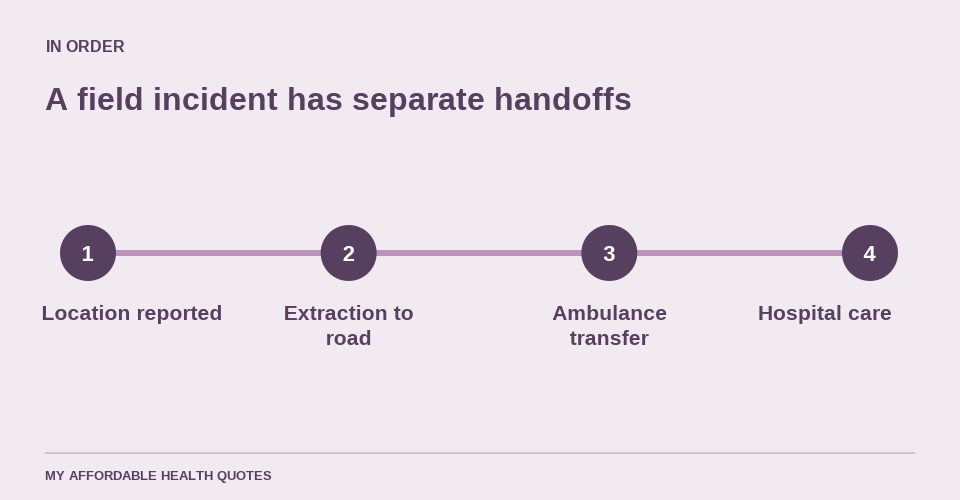
An independent surveyor can buy comprehensive private health insurance and still have unanswered questions about a remote extraction. A team might need to find an injured person, move them from a hillside to a road, arrange a ground ambulance and deliver them to a hospital. Those actions are related, but the organizations doing them and the contracts governing their costs may differ. Read your quote by following the person through those handoffs. Do not start with the assumption that every action before hospital admission is a covered ambulance ride.
Picture a hypothetical West Virginia surveying engagement. One crew member will be working near an access road. Another will spend much of the day beyond ordinary vehicle access. Their assignments have the same client, fee schedule and state. Their practical emergency arrangements need different answers. The location of the handoff matters more than the occupation printed on an insurance application. No coverage discussion should delay calling emergency services when there is danger. The right time to ask about payment is during project planning and insurance shopping.
Separate the physical route from the financial route
Draw the field route on one page without putting any dollar amounts on it. Identify how the crew enters, how it leaves, the nearest agreed access point, and the parts of the trip that change if weather closes a road. For a job near a public recreation area, consult the responsible land manager’s current guidance. A brochure about visiting a park does not establish authorization for commercial work or tell you which responder will come to a particular site.
Then draw the financial route on a second page. Who employs or contracts the field crew? Who chose the field safety arrangement? What insurance does the professional carry individually? Does the client carry a separate occupational policy, and is a contractor actually included? The answers could involve a personal health carrier, a business insurer, a membership organization or no payer at all for a particular service. Keep these possibilities open until someone with authority identifies the applicable provision.
The National Park Service recommends leaving a trip plan with a trusted contact. Apply the underlying idea to your work arrangements by giving the right person the route, return expectations and applicable emergency instructions. The published recreational tool is a planning aid. It cannot substitute for client safety procedures, professional training, required protective measures or directions from local authorities. A coverage limit on a card does nothing to help responders locate a person whose route nobody recorded.
Decide which question belongs to which organization
Contact the health insurer with a specific scenario. Rather than asking about “rescue coverage,” describe a person brought to an access road by one organization and moved to an emergency department by another. Ask how the policy defines medically necessary ambulance services, what documentation it requires, and whether it addresses extraction or search expenses at all. Ask where the written answers appear. Some representatives may be familiar with the medical transportation provision without having any information about search operations.
For the client or land manager, the questions are operational. Who coordinates emergency response at this location? Are there response arrangements specific to this contract? Who should receive an incident report afterward? If someone says that rescue is “included,” find out what that means. It could refer to a staffing arrangement, a commitment to call public responders, reimbursement of eligible charges or simply a statement that help will be sought. Those meanings have different consequences when you receive an invoice.
An assistance membership deserves its own review. Ask which organization provides the benefit and what event qualifies you to use it. A telephone assistance service, a rescue expense reimbursement benefit and transport arranged by a particular provider are different mechanisms. Ask what happens when another operator responds because it is the one available. If dispatch decisions are made by emergency personnel, a policy that requires a particular operator or advance coordination needs especially careful interpretation before you rely on it.
Find the occupational boundary in the paperwork
A personal trip and paid fieldwork are not interchangeable descriptions of the same outing. Give both the health carrier and any separate assistance provider an accurate account of the work. Specify whether travel is on foot, by vehicle or by another method, and describe the type of access. Ask whether an occupational exclusion, workers’ compensation provision, hazardous activity exclusion or geographic limit could apply. Avoid accepting a recreation-specific answer when the actual work is being performed for pay.
Do not assume that being paid on a 1099 settles workers’ compensation status. Your business structure, working relationship and the applicable jurisdiction matter. Consult the relevant state authority or qualified business adviser about your circumstances, then bring the insurance details back to the carrier. Record whether the contract establishes a process for reporting an occupational injury. Medical benefits and employer or client reporting obligations can proceed on different calendars and require different documentation.
In a hypothetical proposal, the prime contractor promises to “maintain insurance for the project.” That phrase gives the surveyor no list of insured people and no categories of covered expense. Request the provision that would apply to an independent surveyor’s injury and ask who can confirm its scope in writing. A general liability certificate or proof of the client’s insurance may satisfy an administrative condition without supplying personal medical benefits to everyone who enters the property.

Read ambulance protections precisely
CMS explains that federal surprise billing protections generally do not apply to ground ambulance services, although other protections may apply. A consumer evaluating a potential ground ambulance bill should check the actual plan and any applicable state rules. The absence of a particular federal billing protection does not mean the plan pays nothing. Separate the insurer’s contractual benefit from any legal restriction on what a provider may bill the patient.
Air transport requires an equally careful description. A covered air ambulance service and a search aircraft working to locate a missing person may both appear in a news report as a helicopter rescue. The legal and insurance analysis depends on the service actually provided and the coverage involved. Ask the insurer about the applicable rules for covered air ambulance services, the standards it uses and which party handles disputes. Do not generalize a healthcare billing protection into a promise about every flight.
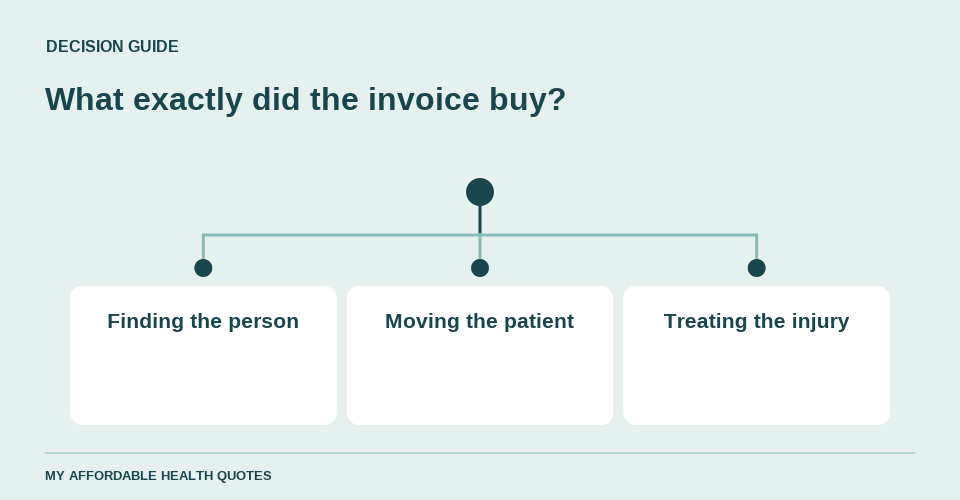
One way to compare two policies is to write down four sample descriptions: search operation, litter extraction, medically necessary ambulance transport and emergency department treatment. Put the wording from each candidate policy under the appropriate description. A blank cell is a question to investigate. It is more honest than entering a zero cost or assuming the maximum benefit attached to the broadest-sounding line. Leave separate space for the carrier’s explanation when a claim involves more than one organization.
Follow up on an itemized bill without reconstructing the emergency
After an incident, preserve the dispatch or incident identifier if one is available, the transport provider’s name, the destination facility and whatever paperwork the responders leave. The patient or a trusted contact may be able to fill in these details later. Emergency staff should be able to concentrate on the emergency. Practical paperwork habits are most helpful when nobody is expected to conduct a financial interview during a rescue.
When an invoice arrives, identify the issuer and the actual service dates. Compare it with the plan’s explanation of benefits if a claim was submitted. Ask the provider whether the bill represents a search operation, a transport charge, clinical services, or a combination. Ask the insurer if it received that provider’s claim and whether it needs more information. If a work claim is pending, ask both relevant parties how they coordinate rather than submitting inconsistent explanations to get a faster answer.
Suppose the initial letter uses the word “transportation” without saying where the journey began. The disputed distance could refer to moving someone to the trailhead or driving from the trailhead to a hospital. Request an itemized description before deciding that the entire amount belongs under the same benefit. A factual correction on the bill may resolve a different problem from an appeal challenging the insurer’s interpretation of medical necessity. Keep the deadlines from the determination letter visible while requesting further information.
Before accepting a remote contract, summarize your open questions in a form the client and your insurance adviser can each address. List the field activity, the access problem, the planned response contacts and the medical transportation provisions you verified. Mark any cost responsibility nobody has yet accepted. That document gives you an informed basis for changing the site plan, negotiating a project expense or choosing an individual health policy with clearer transport terms. Most importantly, it keeps financial planning in the office, where you have time to evaluate it, and emergency decisions in the hands of people responding to the situation.
A useful final rehearsal takes five minutes. Give a colleague the two routes you drew and ask them to point out who takes over at the road, who can identify the relevant policy and who knows the return deadline. If the colleague can find the insurance card but cannot locate the access instructions, the field plan needs work. If the colleague can describe the route but cannot find a contact for a disputed transport charge, the financial plan needs a correction before the next contract.