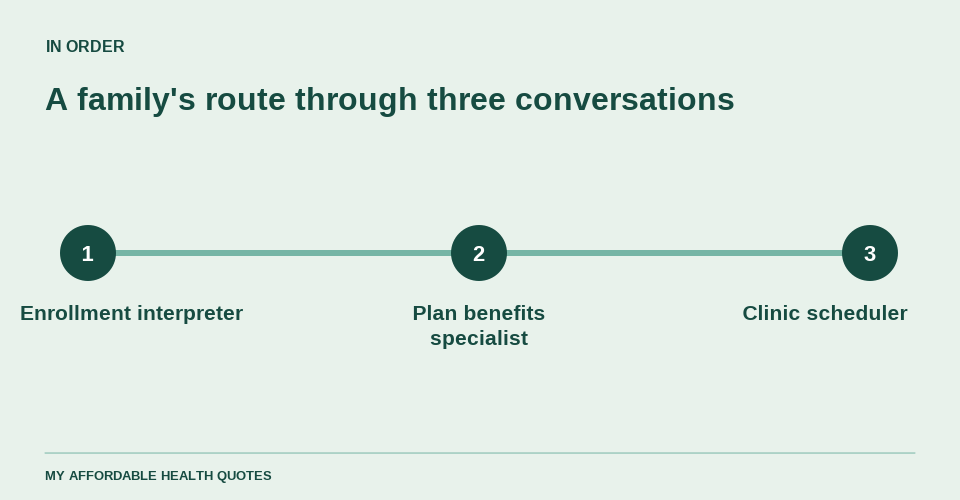
A Maryland marketing consultant negotiates contracts in English every day. Her spouse prefers Spanish for conversations about health, especially when several choices arrive at once. During enrollment the consultant can read a quote aloud over breakfast. Three months later, when a benefits letter arrives while she is at a conference, her spouse needs to understand it independently. Shopping as a bilingual household means testing the entire route from enrollment to using the plan. A beautifully translated sales page provides only a small sample of that experience.
Pick the conversation that has to work without you
Start with a situation the person buying the coverage considers important. Perhaps they want to ask a hospital for an estimate without disclosing a planned procedure to relatives. Perhaps they can discuss a familiar prescription in English but want another language to understand an insurer’s written decision. Speak directly with the person about the language they want to use when speaking, reading or receiving a voicemail. These preferences may differ. The primary subscriber’s fluency says very little about the experience a spouse or adult child wants when handling an account alone.
Turn that preference into a shopping question. For example, the applicant needs to speak privately with the insurer about why a previous authorization is missing. Ask the prospective plan how an enrolled member would reach someone who can support that call. What should the person say at the first prompt? Is there a way to request a callback in the preferred language? Can the interpreter stay while a second department joins? An answer with a telephone route, hours and a fallback gives the household something practical to assess beside the premium.
Hear the enrollment language before accepting the quote
Maryland Health Connection identifies options for free confidential help and offers assistance in multiple languages. Its role concerns Marketplace business, such as the application and selection of an available plan. If using a private advisor to compare additional options, ask how interpretation will work during that advisor’s enrollment process and which organization will hold the resulting account. A translated illustration of benefits is easier to interpret when both people know the plan’s exact product name, the year, and who issued the underlying document. Keep the original beside any translated version.
Give the applicant enough room to ask questions in their own order. A consultant accustomed to running client meetings may feel pressure to explain every pause. An interpreter needs time to convey what was said, and the person choosing coverage may care about a different issue from the one their relative would raise. Invite the applicant to explain, in whatever language feels comfortable, how they would make an appointment and what they would pay at the desk. A misunderstanding about a deductible is far easier to catch in that conversation than after the first bill arrives.
Separate interpretation from authority over the application
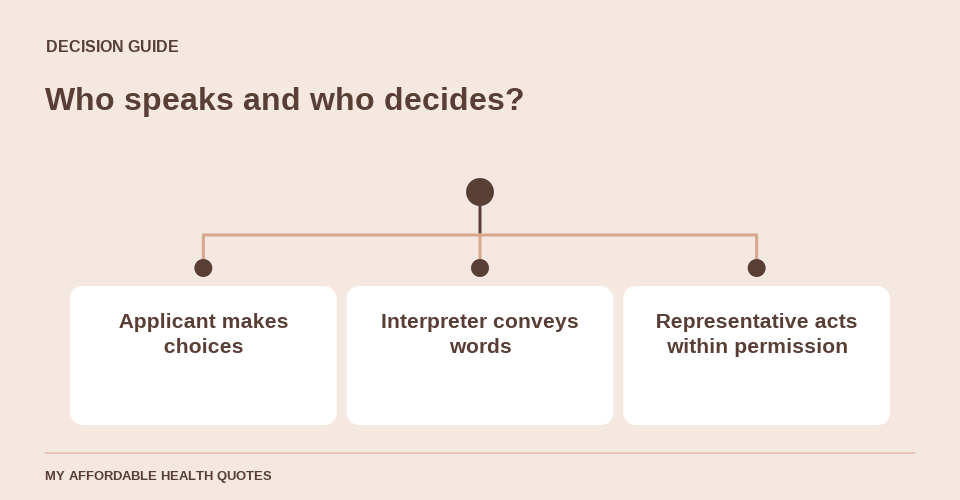
An interpreter communicates meaning between people. Designating someone to act on an application is a different decision. Maryland Health Connection provides a process for naming an authorized representative. Read the current instructions together and decide which actions, if any, the applicant wants another person to handle. A consultant who can translate a phrase may have no reason to receive application correspondence or discuss the person’s household income later. Conversely, a trusted relative who lives elsewhere may be a sensible choice to help manage an application even if that relative speaks only one language.
Keep each permission attached to the organization that requested it. If a Marketplace accepts an authorized representative form, ask the insurer what it requires before discussing an individual claim with someone else. A clinical practice may have its own process for sharing information or adding a portal proxy. Leave account recovery information under the account holder’s control where possible. Sharing passwords among relatives to get a telephone call over with can leave people confused about who submitted a change or who now receives private messages. Ask for the organization’s intended permissions process instead.
Test the provider address as well as the carrier
A directory may list that a physician speaks a certain language. That can be valuable during an appointment. The person who answers scheduling calls, coordinates referrals or prepares discharge instructions may provide language support in a different way. Call the specific office as a prospective patient and describe a routine appointment. Ask whether a language preference can be recorded before booking, what interpretation options exist and whether the process changes for a video visit. An answer from a hospital’s central line may need confirmation by the outpatient location where appointments actually take place.
Consider a hypothetical comparison. One plan lists a bilingual specialist across town whose office offers in-person visits only on the consultant’s busiest client day. Another has a nearby specialist with a remote interpreter available by advance request. The household might prefer either arrangement. Compare the time to the next appointment, the person’s comfort discussing sensitive matters using each option, and whether the exact specialist participates in the quoted network. The most reassuring conversation with an office does not resolve participation in a particular product. Confirm both the address and the product name with the insurer.
Give written notices the attention they deserve
During shopping, ask for a sample explanation of benefits and directions for requesting help reading it. See how the layout distinguishes the amount billed, what the insurer allows, what the insurer paid and what the member may owe. A translated glossary is helpful, but a sentence describing an exception can matter more than any individual word. Ask how to request a translated document or an explanation by a qualified interpreter. HHS explains how language assistance can apply in covered health settings. Use its guidance to identify where questions about access should go when routine customer service cannot resolve them.
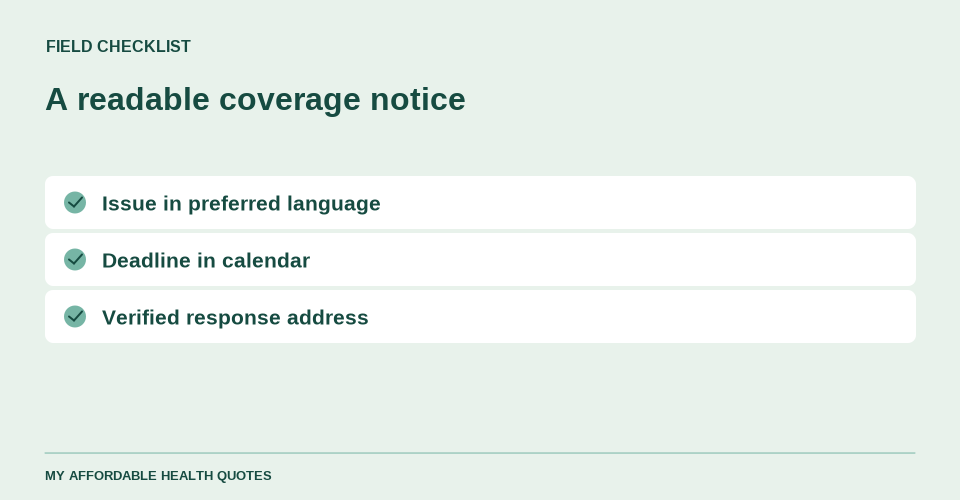
Now test a notice that requires action. Suppose an applicant receives a request for an income document while their consulting income is changing. Ask the issuing organization how to confirm the deadline and the secure submission address in the person’s preferred language. Keep the original notice and its envelope or electronic delivery date. Write the deadline on a calendar the account holder controls. If assistance takes time to arrange, contact the sender about the deadline promptly. Waiting for a relative to return from a business trip is a fragile way to manage any time-sensitive decision.
Compare the whole experience without assigning a fake score
Use three short descriptions for each finalist. Describe what happened when the family tried to obtain enrollment help, reach member services and schedule with a preferred provider. Write down whether a person actually reached the intended team or simply received a promise that someone else would help. Include the time of day of the call. A consultant who can wait on hold on a Friday morning may still find that a spouse with evening availability needs another route. Where the carrier only permits access to a member portal after enrollment, mark that part as untested.
Add the ordinary insurance figures on a separate line. Compare premiums over the same time period and look at costs for the care the household expects to use. If two plans differ by thirty dollars a month, that is three hundred sixty dollars over twelve months before any care. The household can decide what convenience or access is worth in that context. Avoid assigning a dollar value to an interpreter the applicant is entitled to receive without charge. The meaningful comparison is whether the person can reach the right service in time and understand their own options.
Put the instructions where the member can actually use them
Before filing the insurance cards away, have the account holder place a test call if they want to. Save the carrier’s verified contact, the Marketplace contact if relevant, and the clinic’s scheduling instructions under distinct names in the phone. Put a paper copy at home if that is the easier format. Record how to request an interpreter in the other language and how to reconnect if a call drops. Each adult should be able to find their own membership details without asking the family member who usually organizes the finances.
When asking for a quote, a simple instruction can improve the first conversation. For example, ask the advisor to address the applicant directly, arrange support in the chosen spoken language and provide the plan documents in the available preferred format. No one needs to disclose a diagnosis to explain those preferences. After enrollment, check what language the insurer actually recorded for each person and which communications the selection covers. The household can then evaluate the result by a concrete measure. When a question about care arrives during the consultant’s next conference, can the person who received it act on it with confidence?
If the answer turns out to be no, keep the specific example. Record which office was called, the time, the language requested and how the failure affected access. Ask the organization to fix the individual issue and identify its language access or consumer relations contact. For questions about civil rights obligations, HHS provides a separate route for information. A clear account of one failed handoff is easier to address than a general complaint about translation. It also gives the household practical evidence to use when reviewing the coverage at its next renewal. A dated example also lets the next representative see exactly where the original request stopped.
Sources and further reading
- Maryland Health Connection, free confidential help
- Maryland Health Connection, authorized representative
- HHS Office for Civil Rights, limited English proficiency