A consulting agreement can name a hotel, specify a per diem and reimburse a business-class flight while saying almost nothing about who pays if you need a hospital abroad. Before accepting an overseas engagement, establish three things in writing: what your domestic health insurance covers at the destination, whether you could be asked to advance the bill, and who decides where you go if the local facility cannot provide appropriate care. Those answers can come from three different organizations. A client’s promise to cover travel expenses answers none of them by itself.
Consider a hypothetical engineer based in Rockville who spends five weeks at a client’s facility overseas. Her spouse and children stay in Maryland. Dropping the family policy for a travel policy would undo a perfectly useful arrangement at home. The decision is much narrower. Can she keep that coverage in place and fill specific holes for the business trip? The answer depends on her contracts, destination, work duties and travel dates. It cannot be inferred from her earnings or the word “international” on a brochure.
Draw the actual itinerary, including the days nobody invoices
Start with a calendar rather than an insurance application. Mark the day you leave home, every country where you expect to work, any overnight transit stops, the date your partner joins you for personal travel, and the date you expect to be back. Record the most plausible extension. A project manager might describe this as one month overseas even though the flights, weekend excursions and final handover span forty days. A certificate covering the working weeks may leave an inconvenient gap on the trip home.
Next to each location, describe the work in plain terms. Consulting in a conference room is different from climbing a platform to inspect equipment. A professional title on a badge is a poor description of what you do in a normal afternoon. Ask whether business travel, site visits and the particular duties are within the policy’s definition of eligible travel. Disclose what the application requests accurately. Have the issuer identify any exclusion the work could trigger instead of relying on a salesperson’s description of typical business travelers.
If another person will travel with you, make a separate line for that person. A spouse who joins for ten days may have a different departure city and return flight. One medical event might create expenses for both people, yet their status under a policy can differ. Verify who is named, what proof of travel is required and whether a family member’s accommodation or transportation has a benefit of its own. An attractive family price has little meaning without a list of covered people.
Ask the domestic carrier about two encounters
A broad question such as “Am I covered overseas?” invites an answer that leaves the real decision unresolved. Describe two possible encounters without providing unnecessary personal medical information. First, suppose an acute problem requires an unplanned admission abroad. Second, suppose you need a routine outpatient follow-up during the assignment. Ask the carrier to explain how each would be handled under the exact Maryland plan you are buying. The State Department recommends checking both emergency and routine coverage with your U.S. insurer before departure.
For each answer, ask what happens after the first visit. A policy might treat emergency stabilization differently from a follow-up appointment, a replacement prescription, or transportation to another facility. Ask about a notification requirement, any deadline, and the number you can call from overseas. Obtain instructions for situations where it is initially impossible to call. Store the instructions where a trusted companion could find them. An emergency is a poor time to discover that the number on the card only accepts calls placed within the United States.
The financial questions are separate. Is the hospital likely to bill the plan directly? If you pay first, what currency, exchange rate or documentation does the insurer use when it calculates reimbursement? Does the spending count toward any domestic deductible or out-of-pocket limit? Ask for answers tied to the applicable policy section. Even an affirmative answer about emergency benefits leaves open the possibility that the hospital requests a deposit or that the reimbursable amount falls below the bill.
Compare access to money with eventual reimbursement
Imagine a foreign hospital asks for a deposit equivalent to $3,000. In this hypothetical, the consultant has the funds but needs to choose what to do in the next hour. A reimbursement promise for eligible charges does not authorize the hospital to release her card hold. A travel assistance line that can contact the hospital is different again from an insurer committing to pay it. Ask which party can actually issue a payment guarantee, when it is available, and what happens if the facility declines the arrangement.
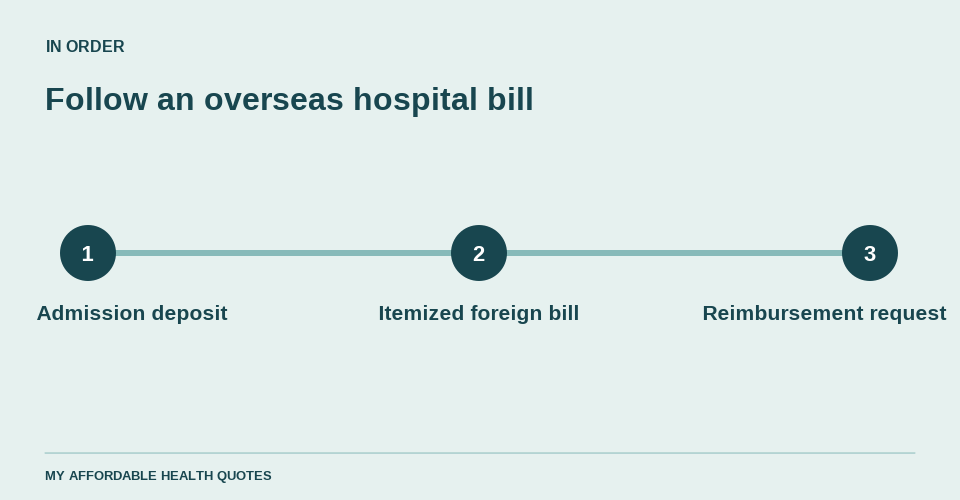
Build the comparison around the time money changes hands. In the first column put what a traveler might have to pay at admission. In the second put what the traveler must obtain at discharge. In the third put who adjudicates the claim later. You may discover that your domestic plan and a travel plan both request the same original itemized receipt. Ask whether a legible copy will satisfy either organization and whether one payer needs the other payer’s written determination first.
An internationally experienced practice can still give you a receipt that a domestic claims department cannot interpret. Ask before traveling what must appear on a medical invoice, whether a translation is needed, and whether proof of payment must be separate from the invoice. A card statement can show that you paid a hospital without identifying the service. An invoice can describe the treatment without proving you paid. Keep copies in a secure location, separate from the work documents you turn over to the client.
Read the transport destination sentence twice
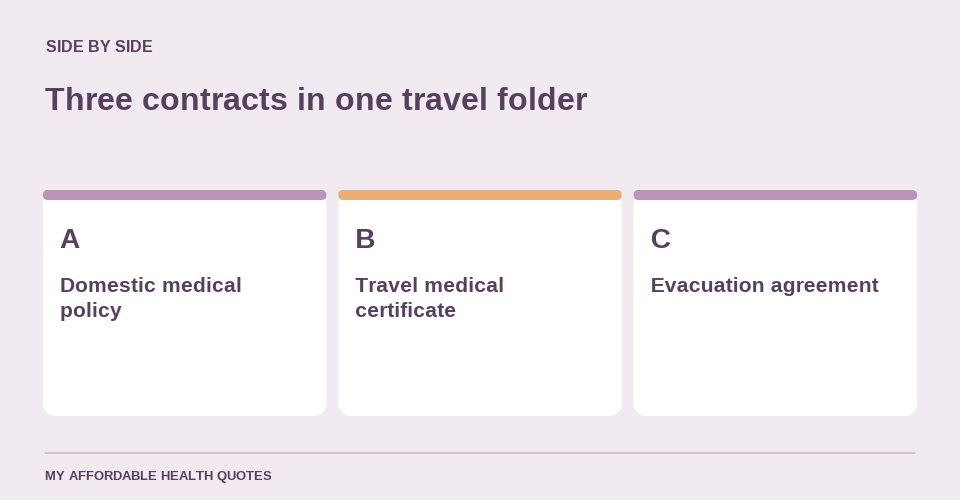
A medical evacuation arrangement addresses a different problem from paying a hospital invoice. Read the sentence describing the destination. “Nearest appropriate facility” and “hospital near your home” describe quite different journeys. Find out who makes the medical and logistical decision, whether the insurer must arrange the transportation, and what happens when conditions make a preferred route unavailable. Ask for an example based on the actual overseas facility you will visit. The State Department specifically recommends considering medical evacuation coverage where access to care is limited.
Work out what would count as reaching an appropriate facility in your example. The consultant might prefer to receive follow-up care near her family in Maryland even after she has been transferred to a capable city hospital overseas. That preference may be understandable and still fall outside the transport promise. If bringing someone home is a deciding factor, ask for the exact provision governing that journey and the conditions that must exist. Compare those conditions before comparing benefit limits printed on the first page.
A trip cancellation benefit deals with money you could lose if a trip changes. It should have its own line on your comparison sheet. Ask about unused tickets and lodging there, and return to the medical contract for questions about an operating room or ambulance. If the client already buys refundable flights, a generous cancellation provision may do relatively little for the uninsured expense you are trying to address. Avoid paying twice for a convenience while leaving an urgent medical payment problem unsolved.
Build an extension decision into the engagement
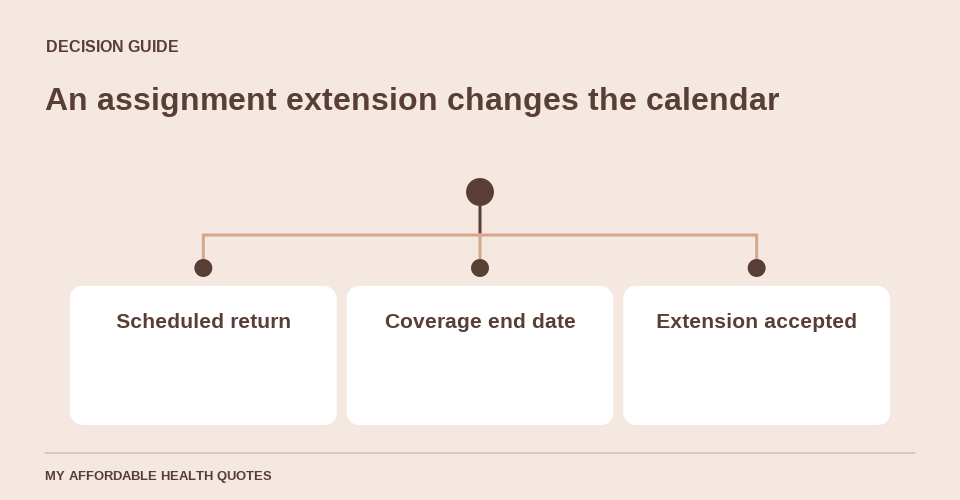
Now suppose the client asks for another twelve days on site. The original itinerary no longer describes the insured trip. Before promising the extra days, check the eligibility rules for increasing the trip length after departure. Ask whether a replacement certificate can begin while you are outside the United States and whether an illness that developed during the first period affects the second. An offer to purchase another policy online does not establish that a traveler already abroad is eligible for it.
Document the business decision separately from the insurance answer. It may be possible to negotiate remote handover, ask the client to fund a different arrangement, or return home as planned. Only one of those alternatives extends the trip. A reimbursement clause cannot change an insurer’s contract or determine when a local hospital expects payment. If the client says its corporate policy will handle an extension, request the certificate or written eligibility confirmation that covers contractors in your situation, your dates and your destination.
Back at home, retain the claims instructions and the correspondence identifying the plan. If a Maryland-issued insurer denies a covered-service claim, read the reason and the available review process. Maryland’s Insurance Administration publishes guidance about health claims and medical-necessity disputes. Its jurisdiction and the appropriate appeal route depend on the arrangement. A foreign travel assistance vendor, an employer benefit and a Maryland individual plan do not all follow the same complaint procedure. A denial letter is the starting document for determining where to take the question.
Before requesting domestic health insurance quotes for a year that includes international work, condense the issue to one sentence: where you will be, how long you will be there and which costs require a written answer. Keep travel medical and evacuation quotations beside the domestic policy comparison, with the unresolved questions clearly marked. That gives the agent a concrete assignment and gives you something more valuable than a reassuring adjective: a plan for getting appropriate care and paying for it while you are away.
Sources and further reading
- U.S. Department of State — Travel insurance
- U.S. Department of State — Medicine and health abroad
- Maryland Insurance Administration — Understanding health claims