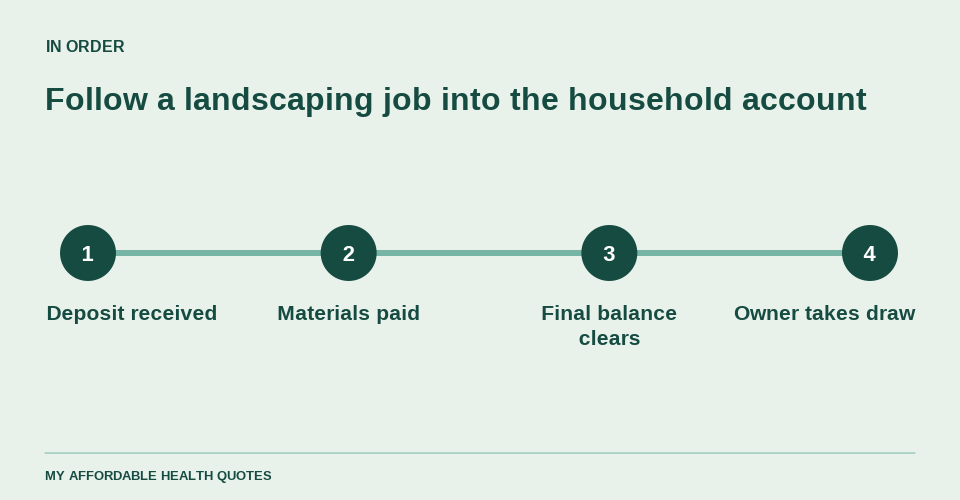
A landscaping company can finish its most profitable season and still leave its owner short of cash in January. The last commercial customer pays after inspection. The equipment dealer wants its money before then. The mortgage comes from the household account and so does the premium for the owner’s individual health plan. If a planned appointment also lands that month, the policy with the best annual price may require more money before the first client check arrives. That timing question belongs in a quote comparison even for someone with strong annual earnings.
Imagine Emilia, a solo landscape designer and installer. She has no employees and buys individual coverage for herself. Her busy season produces enough cash to support her household through winter, but the final draw varies depending on when customers settle their accounts. Emilia is comparing two health plans for a full upcoming year. She wants to keep the professionals who know her and expects a scheduled service early in the year. After confirming the relevant benefits and providers, she can compare the timing of the two options with a pencil and a calendar.
Trace one customer payment far enough
Emilia begins with her last completed installation. A customer signed the contract in August, paid a deposit in September and received the final invoice in October. The customer did not pay the balance until December. Part of that balance went straight to the stone supplier. Another part covered a contracted equipment operator. Only the money Emilia actually made available to the household could pay a personal premium. Treating the whole contract as household cash in August would make winter coverage look far easier to carry than it really was.
Look at several actual jobs to identify where payment timing tends to vary. On one route, residential customers may pay on the day an installation is complete. On another, a property manager might release money only after a monthly review. A spreadsheet that lists the date invoices went out will miss that distinction. Use actual settlement dates where available, and label anticipated receipts as estimates. Split reliable household cash from business money already committed to material orders, equipment service or other obligations. The purpose is to find money that could really be used for personal coverage when the bill comes due.
Give each health plan its own calendar
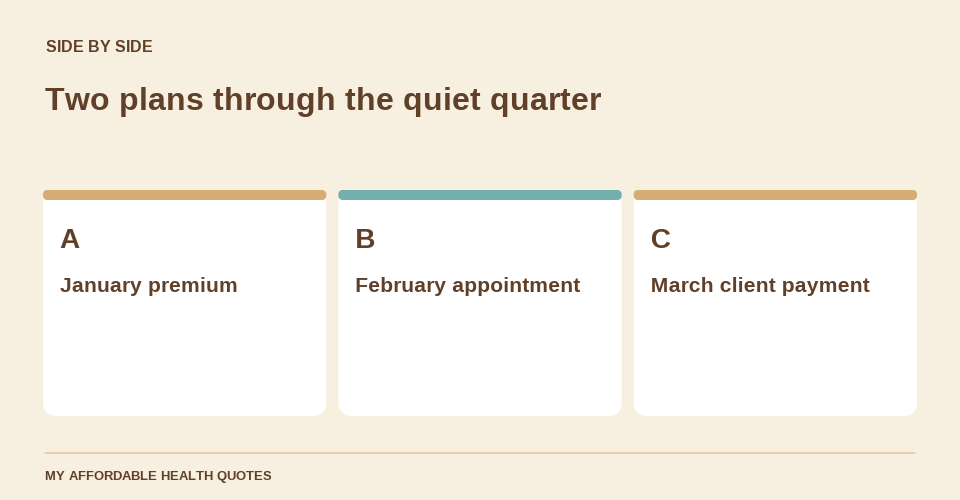
For each quote, start with the first premium, its deadline and the date the insurer expects coverage to take effect. HealthCare.gov explains that the first premium for Marketplace coverage is paid directly to the insurance company. Confirm the payment method, insurer instructions and recurring due date. A selection confirmation is useful, but it does not show that the insurer received a payment. At renewal, check the amount that will actually be debited from the household account. A deposit schedule that comfortably supported the old monthly charge might be too tight after a rate change.
Now add expected health expenses for the people actually enrolling. Ask how a planned office service will be billed, how much the provider expects the member to pay, and when payment is usually requested. A deductible is a benefit calculation, not a bill automatically due on the first day of the policy year. Some services may have a different cost-sharing rule or may be covered before the deductible. Others could generate separate invoices. Give each expected payment an approximate date and mark the amount as provisional wherever the office is giving an estimate.
Work through a winter quarter with real arithmetic
Suppose the first policy costs four hundred dollars a month and the second costs five hundred dollars. Assume the same planned February service would cost Emilia eight hundred dollars under the first policy or three hundred dollars under the second. These are invented figures for an illustration, and they assume both providers and services have already been checked. Also assume no other insurance or medical payments during the three months. Under the first quote the quarter costs two thousand dollars in premiums and medical expense. Under the second it costs eighteen hundred dollars.
The annual answer can move the other way. With twelve months of coverage and no additional member expenses, the first policy would cost fifty-six hundred dollars for the year, consisting of forty-eight hundred in premiums and eight hundred for the February service. The second would cost sixty-three hundred dollars, consisting of six thousand in premiums and three hundred for the service. That makes the first policy seven hundred dollars less expensive over the full year under these assumptions. It also asks the household for two hundred dollars more in the quiet quarter. Both observations can be true.
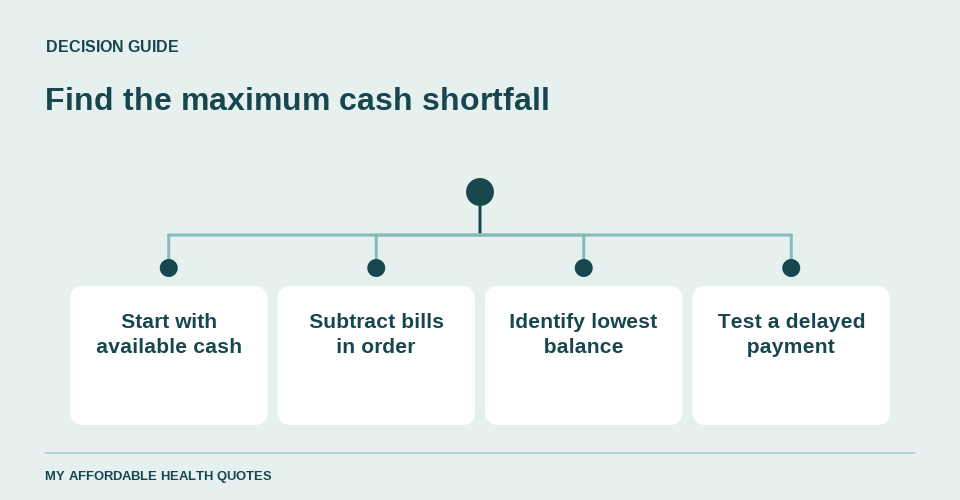
Make the timing even more concrete. Suppose Emilia starts January with seventeen hundred dollars available specifically for the insurance comparison after ordinary household obligations. She expects to transfer another thousand dollars from a completed job in March, but the insurer collects the March premium before the client pays. With the first plan she has thirteen hundred after January’s premium, nine hundred after February’s premium and one hundred after February’s medical bill. March’s four-hundred-dollar premium would leave a three-hundred-dollar shortfall before the transfer. With the second plan, seventeen hundred becomes twelve hundred, then seven hundred, then four hundred, and finally a one-hundred-dollar shortfall before the transfer.
Test the payment dates that make a difference
Those shortfalls describe the assumed cash account and the order of events. They are neither a prediction of missed payments nor a reason to choose a particular policy. If the commercial customer pays before the March premium, the temporary shortfall disappears in this example. If the medical office collects the patient share later than expected, the lowest point may move to a different week. Use a conservative estimate of when cash will clear and ask the billing office about actual payment terms. Someone depending on an unconfirmed extension should keep the original due date in the comparison until the office agrees to another arrangement.
Emilia checks the cost of building a winter cushion while she is still busy. In this illustration, reserving another three hundred dollars before January would cover the larger modeled shortfall, given the other assumptions. That amount says nothing about emergencies, other household needs or an unpaid customer invoice. She tests what happens if the March transfer slips until April and includes the next scheduled premium in that version. A household that already maintains an accessible reserve can compare the cost of drawing it down with its other commitments. A household without that reserve needs to see exactly when a quote becomes difficult to sustain.
Add a second scenario for an expensive month
Use the plan’s stated out-of-pocket limit as a separate high-use scenario for covered, eligible in-network services. Check the actual limit, which expenses count toward it and whether the limit is individual or family. HealthCare.gov explains that premiums and certain other expenses, including noncovered services, fall outside that limit. Do not add the entire deductible on top of a maximum that already includes qualifying deductible spending. Likewise, do not treat the limit as a guarantee that every conceivable health expense is capped. Ask about the policy’s own network and benefit rules.
When modeling high use, the date of the expense may change the business decision. Emilia’s crew arrangements are minimal in winter, but she has less cash. Summer has stronger receipts, but leaving an installation site may require hiring help or moving a customer deadline. Estimate those business consequences separately from the medical charge. A one-day interruption might cost no revenue if work can be rescheduled. A paid equipment rental that cannot be extended may create a real additional expense. Actual obligations make a better comparison than assigning every missed hour the highest hourly rate Emilia has ever billed.
Keep the income estimate and the cash calendar separate
The Marketplace asks self-employed applicants to estimate net self-employment income for the coverage year as part of the household income calculation. HealthCare.gov recommends updating the application when the expected annual figure changes. Emilia’s winter cash calendar answers a different question. One late customer might move a household transfer by three weeks without changing her expectation of the year’s total net income. A lost recurring contract could change both. Keep the annual estimate and supporting business records separately so a timing change in the checkbook is not inadvertently treated as an entirely new annual forecast.
Before choosing, Emilia reviews the two calendar lines with the actual policy documents beside them. Are the same doctors and services available? Did the quoted premiums assume savings for which she has an eligibility result? Is the early estimate for the same covered service under both products? When is the first payment due? The original question about irregular cash now has a concrete answer. One policy has the lower illustrated annual total, while the other creates a smaller winter funding gap. With her own receipts, obligations and provider estimates substituted, Emilia can decide which tradeoff the household is willing and able to finance.
One final check is to compare the assumed household transfer with the bank transaction after the season ends. If the materials supplier raises its deposit or the client keeps a portion pending a final inspection, Emilia can correct the timing model without changing the policy's published benefits. If the difference comes from a larger medical bill, she can compare the statement with the insurer's explanation and adjust the expected patient share. Knowing which assumption failed is more useful for next season than simply labeling the entire winter over budget.
Sources and further reading
- HealthCare.gov: Total health care costs
- HealthCare.gov: Reporting self-employment income
- HealthCare.gov: Premium
- HealthCare.gov: Out-of-pocket maximum