A new health plan can be active while payroll deductions are wrong. It can also be the other way around: an employee sees a deduction and assumes coverage exists even though enrollment has not been accepted. During the first month of a group-plan launch, verify both systems separately and then reconcile them.
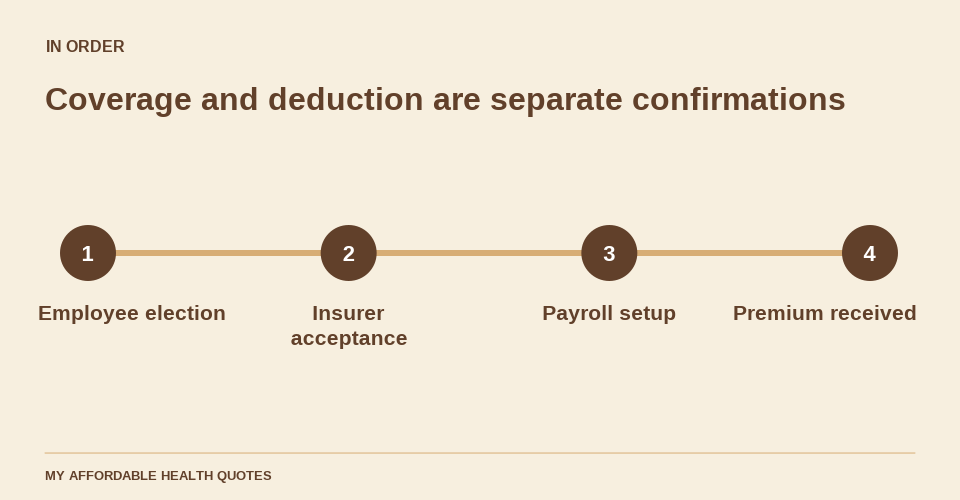
The owner's review should answer four questions. Did the employee make the recorded election? Did the insurer accept it for the intended date? Did payroll deduct the approved amount for the correct period? Did the insurer receive the required premium? This article provides a practical first-month audit with hypothetical arithmetic, not a rule for every employer's deduction schedule.
Freeze the approved election file
Before the first relevant payroll is processed, identify the final election record used for setup. It should show the employee identifier, selected plan, coverage tier, effective date and approved employee contribution. Keep the file controlled so later changes do not silently overwrite the version payroll used.
Mark declined and incomplete elections clearly. A blank field is ambiguous: it could mean the employee waived coverage, did not respond or has a pending application. The administrator should resolve the status rather than allowing payroll to infer an election.
Keep sensitive enrollment information restricted to the people who need it. Payroll may need a coverage tier and deduction amount without needing a dependent's full personal record. Use the minimum appropriate data for each handoff.
Translate monthly cost into the actual pay calendar
Insurer premiums are often discussed monthly, while payroll may run weekly, every two weeks or twice a month. These schedules are not interchangeable. Ask payroll to document the approved conversion method, the number of deductions and how any special payroll dates are handled.
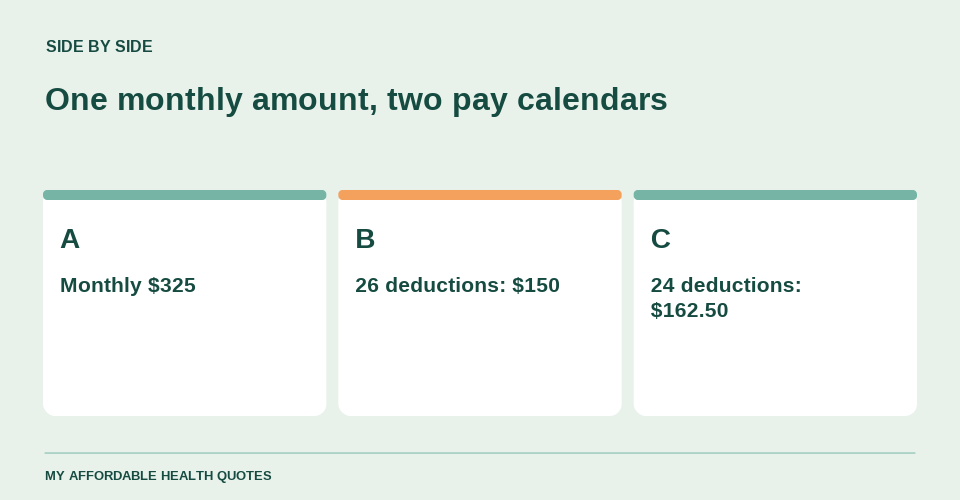
In a hypothetical full-year example, an employee contribution of $325 per month totals $3,900 for twelve months. If the approved arrangement spreads that amount evenly over twenty-six deductions, the arithmetic is $150 per deduction. If it uses twenty-four deductions, the arithmetic is $162.50. Dividing a monthly amount by two without checking the calendar can produce the wrong annual total.
These figures are examples, not instructions to adopt a particular method. The actual schedule must follow the employer's approved arrangement, payroll rules and applicable requirements. Have payroll and the benefits administrator agree on the method before using it.
Check the number of deductions, not only one paycheck
A deduction can look reasonable on a single pay stub while producing the wrong annual total. Multiply the amount by the planned number of deductions and compare it with the approved contribution for the same coverage period. Investigate rounding or extra-pay-period treatment with payroll.
For a midyear launch, use the actual period being funded. Do not apply a full-year calculation mechanically if deductions start after coverage begins or if the employer has approved another timing method. Identify any catch-up amount separately so the employee understands it.
Keep the insurer's billing month visible. A paycheck dated in one month may fund another coverage period under the employer's process. The audit should show that relationship explicitly rather than assuming all dates match.
Confirm accepted enrollment before trusting the deduction
Obtain the insurer's accepted enrollment record or equivalent confirmation. Compare it with the employee election file. A submitted spreadsheet, upload receipt or email from payroll is not proof that the insurer enrolled the person.
Review rejected records, missing documents and dependent questions promptly. Assign each issue to the administrator or insurer contact responsible for resolving it. If coverage is not confirmed, tell the employee the actual status and the next action rather than treating the payroll deduction as reassurance.
Once accepted, give employees the appropriate instructions for accessing identification information. Ask them to report discrepancies in names or covered family members through the secure process. Do not require them to post personal details in a shared company chat.
A first-paycheck example with two different errors
Suppose a small company launches a plan for twelve employees. Casey elects employee-only coverage with an approved monthly contribution of $180. Riley elects a family tier with a different approved amount. Payroll accidentally copies Casey's deduction to Riley's record.
At the same time, another employee's enrollment is rejected because required information is missing, but payroll begins withholding anyway. The first problem is a deduction setup error; the second includes an unresolved coverage issue. They should not be grouped together as a minor payroll rounding problem.
The owner asks the administrator to confirm the accepted roster and payroll to compare each election with its deduction. Corrections are documented and communicated individually. The company does not collect an arbitrary extra amount on the next check until the proper correction has been reviewed.
This invented example illustrates why sampling only one employee may miss a systematic copy error or a rejected enrollment. For a small launch, reviewing every election is often practical and more informative than checking only the total invoice.
Read the employee documents alongside the setup
The Department of Labor explains the role of plan information such as the Summary Plan Description and Summary of Benefits and Coverage. The company's operational setup should agree with the approved documents and communications, rather than a salesperson's earlier illustration.
Check whether the stated employee contribution and eligibility dates match what workers received. If an announcement used an estimate, make sure employees received the final terms before their election. A correct payroll calculation based on an uncommunicated amount can still create confusion.
Ask the administrator to handle any required notices or document changes. An owner should not attempt to fix a formal plan communication by sending a casual message that contradicts the governing terms.
Reconcile the carrier invoice by coverage tier
Compare the invoice with the accepted roster for the same coverage month. Check employee-only and dependent tiers, additions and terminations. A total that is close to the budget does not prove that every person is billed correctly.
Separate employer cost from employee contributions. The insurer may receive one combined payment while payroll collects only the employee share. Keep a ledger showing both components so the company can explain how the invoice was funded.
For SHOP coverage, HealthCare.gov directs employers to pay the insurer and contact the agent, broker or insurer for changes. Follow the actual payment instructions for your arrangement and retain confirmation. Do not assume a deduction in payroll automatically causes money to reach the insurer.
Handle partial months through the approved process
A new hire, late acceptance or eligible family change can create a partial-period question. Ask the insurer how the premium is billed and ask payroll how the approved employee contribution should be collected. Do not prorate by calendar days merely because that feels fair.
Write down the coverage effective date, invoice treatment and deduction instruction. If the insurer processes an adjustment later, keep the issue open until the change appears. Avoid collecting the same amount twice because one person corrected payroll while another separately entered a catch-up deduction.
Explain the adjustment to the employee before it appears where appropriate. The message should identify the period and amount without exposing other employees' contributions. Give a contact for questions and retain the calculation.
Check the second and third cycles for delayed effects
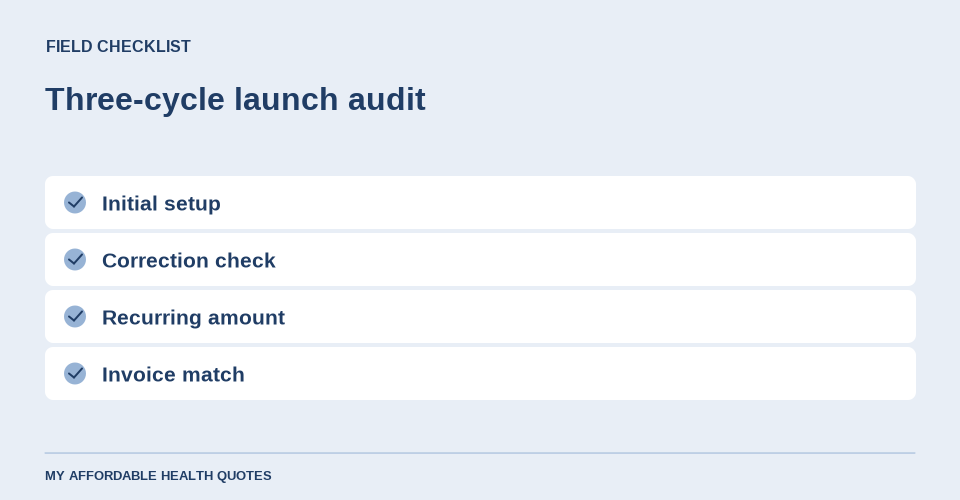
The first payroll audit establishes the setup, but later cycles can reveal missed corrections or a recurring deduction that was meant to occur once. Compare the next checks against the approved ongoing amount and any documented temporary adjustment.
Look for a catch-up deduction that did not stop, a family election still using the old tier or a waived employee whose deduction remains active. Match these findings to the insurer's current roster so a payroll fix does not conceal an unresolved enrollment issue.
Use one issue log with a clear status. Each item should show the original discrepancy, approved correction, responsible person and evidence of completion. Closing the item requires the actual corrected record, not just a message that someone plans to fix it.
Give employees a short self-check
Ask employees to verify the plan they selected, covered household members, effective date and the deduction shown on their pay stub. Provide a private way to report a mismatch. Keep the instruction short enough that people can complete it without reading a lengthy administrative manual.
Explain that the deduction is not a claim charge and does not show how much they will owe for medical care. The premium contribution and the plan's deductible or copays are different costs. Clear terminology can prevent an employee from assuming that a larger payroll deduction means a medical bill has been paid.
Do not ask employees to certify that everything is correct if they cannot access the insurer record yet. Treat a missing confirmation as an issue to resolve, not a reason to pressure them into signing off.
Turn the launch audit into routine control
After the first cycles align, document the ongoing change process. State who receives elections, who submits enrollment, who confirms acceptance and who instructs payroll. Review the insurer bill against those records each month using the company's approved workflow.
Keep the calculation for each payroll schedule and update it when the calendar or contribution changes. A new payroll provider should receive the approved method rather than reverse-engineering it from a pay stub.
Request a health-plan review if the launch exposes a mismatch between the business's intended benefit and the available arrangement. For an otherwise suitable plan, the immediate fix may be administrative: accepted enrollment, accurate deductions and timely premium payment. Those three confirmations turn a promising benefits launch into coverage employees can actually use.