An Alabama business owner whose spouse receives a new employer health-plan offer should review that offer even if the owner prefers to keep an individual policy. The offer can affect more than the monthly premium. It may influence Marketplace financial assistance, tax treatment and the household's enrollment choices. Declining the offer does not necessarily make those effects disappear.
The most useful approach is to gather the employer's actual terms, evaluate the people in the household separately and compare the resulting options using the same time period. This is not a question that can be answered from the employee-only premium or from a statement that the spouse has “good benefits.” You need the cost and eligibility information that applies to the owner and any children.
Request the offer details before comparing plans
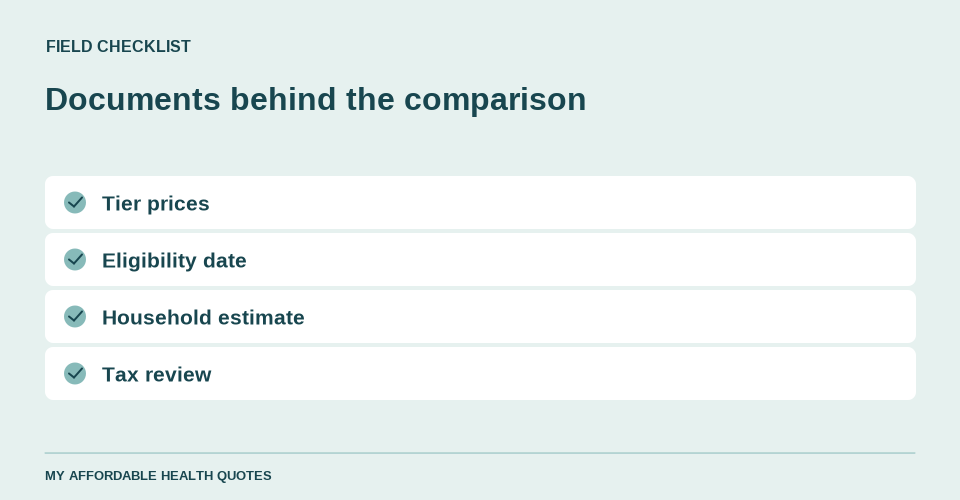
Ask the spouse's benefits office for the available plan documents, eligibility date, enrollment deadline and employee contributions for each relevant coverage tier. Obtain the amount for employee-only coverage and the amount that would cover the household members being considered. Note whether more than one plan is offered and which one is the lowest-cost option meeting the applicable standards.
Ask whether spouses are eligible under the employer's rules and whether any surcharge or restriction applies. Do not assume that every employer offers the same dependent terms. If a rule depends on whether the spouse has access to another employer plan, explain the business owner's actual situation accurately and request clarification.
HealthCare.gov offers an employer-coverage comparison process and an Employer Coverage Tool. Those resources can help organize the information needed for a Marketplace application. Use the employer's confirmed answers rather than estimating a premium from a coworker's paycheck.
Distinguish the employee's result from the family's result
Marketplace affordability is not evaluated solely by asking whether the working spouse can afford employee-only coverage. HealthCare.gov explains that the employee and offered household members can have different affordability results. The applicable percentage changes by year, so use the current official standard rather than a number copied from an old article.
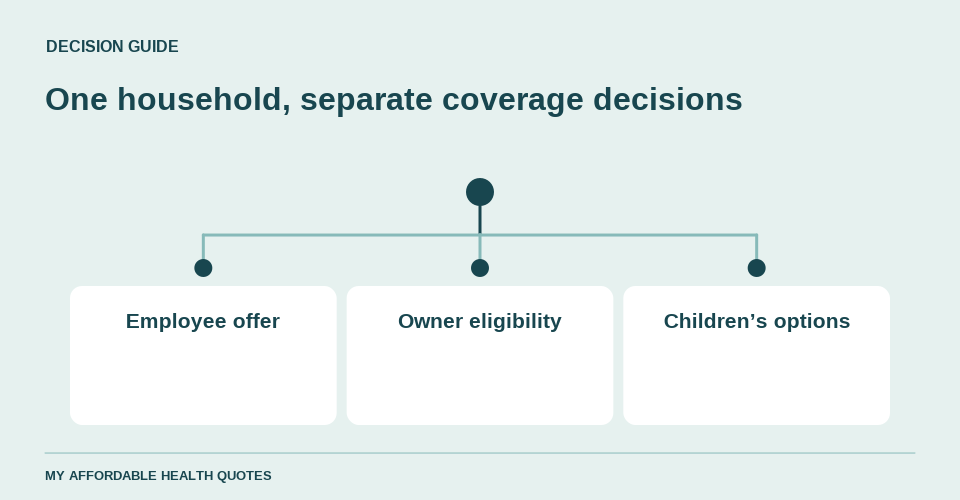
This means one household may reasonably need more than one coverage decision. The employee could remain on the employer plan while other family members evaluate individual coverage, if eligible. The application determines assistance using the relevant information; the household should not assume that everyone receives the same outcome.
Also distinguish an offer from enrollment. An affordable offer meeting the applicable standards can affect Marketplace assistance even when a person declines it. Enter the offer accurately and review the eligibility notice before relying on an estimated subsidized price.
Keep the household information complete
If only the business owner needs an individual plan, that does not mean the Marketplace application should omit the spouse. HealthCare.gov's household guidance explains who generally belongs on the application and distinguishes household membership from the people requesting coverage.
Prepare the household income estimate with the relevant tax rules in mind. The spouse's wages and the owner's business income may both matter. A business checking-account balance is not a substitute for the estimate required by the application.
If income is uncertain, document the basis for the estimate and schedule a review when updated figures become available. Ask a tax professional how to handle unusual items rather than deciding that a payment does not count simply because it came from the business instead of payroll.
Use Alabama's official route for Marketplace information
The Alabama Department of Insurance directs consumers to HealthCare.gov for Marketplace shopping and applications. Its Marketplace information page explains the role of that channel and income-based assistance. Use the official route or authorized assistance when evaluating the employer offer's effect.
For questions about an insurer or product marketed in Alabama, the department's consumer resources can help identify the company and appropriate assistance. Keep the insurer's legal name and policy information available. A network logo or agency name alone may not identify the company responsible for the policy.
A plan sold outside the Marketplace may still be worth comparing, but it does not receive Marketplace premium tax credits. Confirm the product type and benefits before comparing its price. A limited-benefit product should not be treated as equivalent to comprehensive major medical coverage just because the monthly payment is smaller.
A household example without a predetermined winner
Consider a hypothetical Birmingham household. Devon runs a repair business, and his spouse begins a new salaried job. The employer contributes substantially toward employee-only coverage but much less toward adding family members. Devon initially assumes that the family must either all join the employer plan or all keep their individual policies.
The couple requests the full tier pricing and eligibility details. They complete the Marketplace review using the correct household information and the employer offer. Then they compare the available arrangements, including the possibility of different household members using different plans where permitted.
They also check Devon's regular clinic and a child's specialist against the exact candidate networks. A premium comparison that ignores those providers would be incomplete. The family writes down the annual premium total, expected care costs and any separate deductibles for each realistic arrangement.
The example intentionally supplies no invented subsidy amount or universal recommendation. Its lesson is that the employer offer must be evaluated accurately before the family can compare costs. Different contribution structures, incomes and provider needs could produce a different decision for another Alabama household.
Compare the added family cost correctly
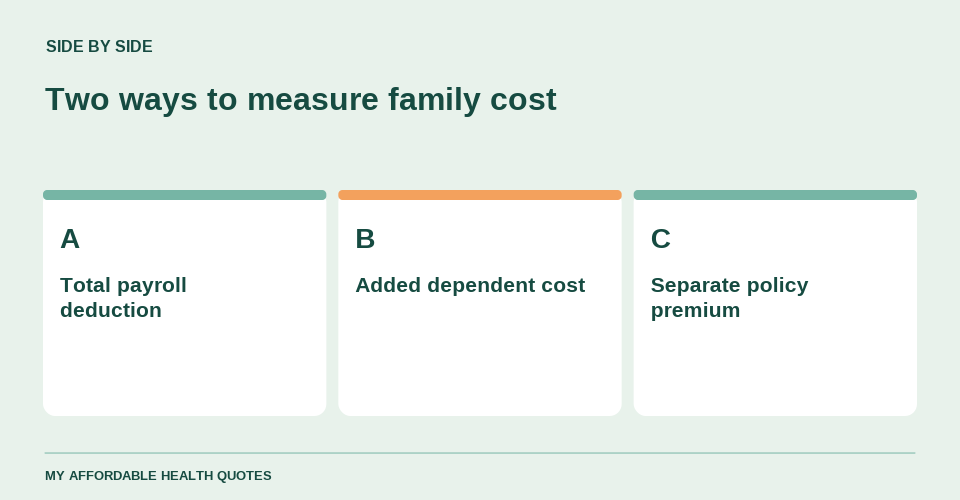
When evaluating whether to add the owner to the spouse's plan, distinguish the total employer-plan premium deduction from the incremental amount caused by adding that person. Both figures can be useful, but they answer different questions. One describes the household's entire payroll cost; the other describes the change from the employee-only election.
Use the same number of months for each option. If the new employer coverage begins in the middle of a year, a twelve-month comparison may not describe the immediate decision. Prepare a remaining-year view and, if helpful, a separate full-year projection.
Review deductibles and out-of-pocket limits for the actual enrollment tier. Ask how individual and family amounts interact. If the household uses separate policies, identify which expenses accumulate under each one rather than mentally treating all medical spending as if it reaches one shared limit.
Do not assume a business deduction survives the offer
The IRS instructions for the self-employed health-insurance deduction describe limits for months when a person is eligible for subsidized coverage through an employer, including a spouse's employer. Eligibility can matter even if the person does not choose that coverage.
Give the accountant the offer date, eligibility date and plan information. Ask how the rule applies to the owner's circumstances and which months need different treatment. Do not make a coverage choice based on a presumed deduction that has not been checked.
Keep the tax question separate from the coverage question. A policy might meet the family's medical needs while having a different after-tax cost than expected. The correct comparison uses the accountant's advice rather than treating all business-paid premiums as automatically deductible.
Coordinate enrollment dates before ending anything
The employer's election window and the individual market's enrollment rules are not necessarily identical. Ask when the spouse and dependents can join the employer plan and what events permit later changes. Separately confirm whether the owner can enroll in or change individual coverage at the desired time.
Do not cancel the current policy merely because the new employer has made an offer. Obtain the accepted election and effective date. If Marketplace coverage or assistance needs updating, complete the official process and retain the notice.
Where the dates do not align, identify the gap before making a cancellation request. Ask the administrator and licensed enrollment professional which options are available. Avoid assuming that a voluntary cancellation creates a new enrollment right.
Resolve disagreements with documents
If a quote assumes that no employer offer exists while the benefits office says the owner is eligible, pause the price comparison and correct the facts. Ask the employer for a written explanation of the offer and submit the accurate information through the appropriate enrollment process. A convenient quote based on an incomplete application is not a reliable budget.
If the household receives conflicting answers about a spouse surcharge, request the governing eligibility language and ask the administrator to apply it to the actual business arrangement. Avoid asking a coworker to interpret the rule. Their household may have different employer coverage available.
Keep a dated record of the clarification. The objective is not to collect paperwork for its own sake; it is to make sure the final decision can be traced to the offer that actually exists. That record also helps the family respond accurately if the employer changes its rules at renewal.
Check the first month after the decision
Review the spouse's first relevant paycheck and the insurer's enrollment confirmation. Verify the correct people and coverage tier. If the owner retains an individual plan, confirm that its premium and any assistance reflect the updated application.
Save the documents used in the decision, including the employer offer and the Marketplace result. The accountant may need the dates later, and the household may need them if a billing question arises. A short decision note can explain why the family selected the arrangement without storing unnecessary health details.
Set a review for the next employer renewal or a meaningful income change. The right choice can change when the employer contribution, network or household circumstances change. Reviewing those facts is more useful than automatically repeating last year's election.
Request help comparing individual coverage options after obtaining the spouse's employer details. A licensed agent can help evaluate available policies, while the employer administrator and tax professional resolve their respective questions. The strongest decision is one that accounts for the actual offer, the whole household and the dates when each choice can take effect.
Sources and further reading
- HealthCare.gov: Employer and Marketplace comparison
- HealthCare.gov: Affordable coverage
- HealthCare.gov: Household membership
- Alabama DOI: Marketplace information
- IRS: Form 7206 instructions