The first health-insurance invoice after buying a business is a reconciliation project, not merely another bill to pay. It may contain employees who transferred, people who left, dependent changes, earlier credits and charges for a coverage period that does not match the closing month. Before changing deductions or disputing the total, identify what each line represents.
This guide is for the buyer or successor management team after a transaction. It focuses on the first billing cycles and the records needed to resolve differences. The purchase agreement, plan documents and professional advice determine legal responsibility; an invoice comparison cannot replace those decisions. The goal is to make the approved arrangement operate accurately.
Start with the coverage decision made at closing
Find the final written instructions about which plan continues, which employer sponsors it and when transferred employees become eligible. Do not rely on an early diligence presentation if the transaction changed. Confirm that the insurer or administrator received the final facts.
Identify whether the invoice belongs to the seller's continuing arrangement, the buyer's existing plan or a new policy. Similar company names can make this surprisingly easy to confuse. Record the legal entity, group identifier and coverage month before reviewing the employee-level charges.
Ask the transaction team to identify unresolved obligations. A purchase agreement may allocate costs between parties while the insurer still expects payment from the named policyholder. Separate the contractual reimbursement question from the immediate insurance administration question, and route each to the person authorized to resolve it.
Create four records that can be compared
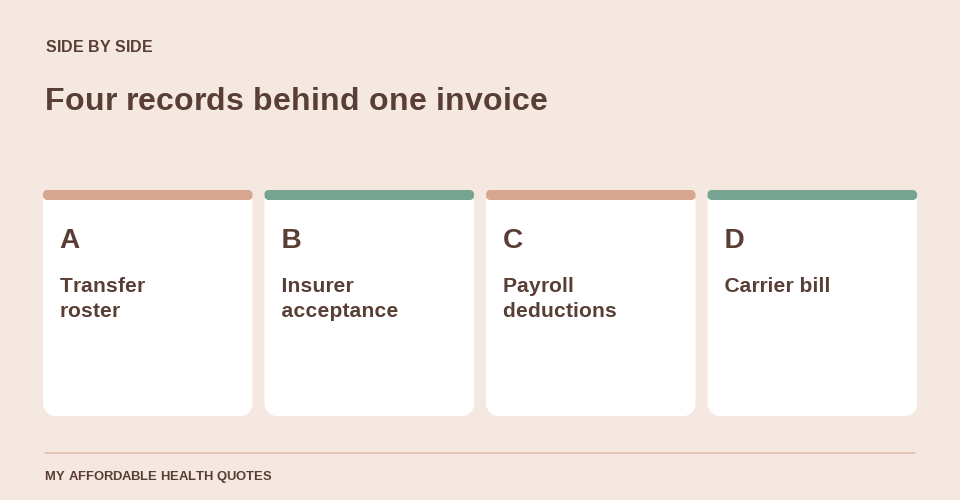
You need the final approved transfer roster, accepted insurer enrollment, payroll deductions and the carrier invoice. Each record answers a different question. The roster shows the intended population, insurer confirmation shows accepted coverage, payroll shows money withheld and the invoice shows what the insurer billed.
Use a consistent employee identifier to match records. Avoid relying on names alone where there are spelling differences or similar names. Keep the matching file in a restricted location and share only the fields needed for reconciliation.
Record the date of every source file. A roster exported before the last enrollment correction may disagree with a later invoice for a legitimate reason. Knowing the sequence helps distinguish a timing difference from an actual error.
Sort differences before taking action
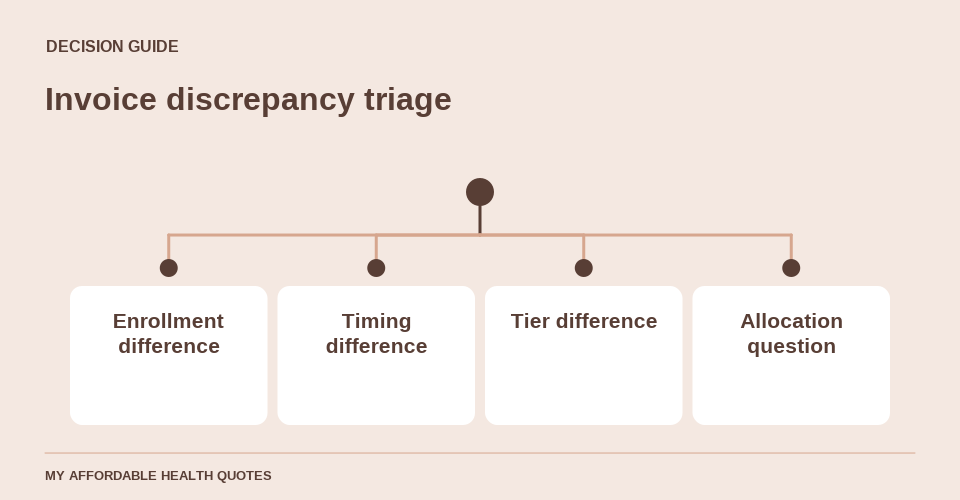
Classify each discrepancy as an enrollment issue, a timing issue, a pricing or tier issue, a payroll issue or an unresolved transaction responsibility. This avoids sending every problem to the broker or assuming payroll can fix an insurer record.
An employee missing from the invoice may have a pending enrollment, a rejected record or a billing lag. A former employee still listed may have an unprocessed termination or valid continuation coverage. Do not remove someone simply because their name is absent from current payroll.
A larger premium may reflect a dependent tier rather than a rate increase. A negative amount may be a prior-period adjustment rather than a refund available for the buyer's general use. Ask for the supporting detail before deciding how the accounting entry should be made.
Rebuild the coverage-month ledger
Create a ledger organized by coverage month, not by the date the invoice was paid. Show the original charge, subsequent adjustment, payment and remaining question. This is particularly helpful when closing occurred midmonth or when the insurer processes changes on a later bill.
Keep seller-period and buyer-period items visible without deciding responsibility yourself. Reference the transaction adviser's allocation instructions where available. If responsibility is unresolved, mark it for that adviser rather than moving the amount into whichever account has cash.
Have the accountant determine how the ledger connects to the company's books. The benefits team should provide accurate coverage facts, while accounting applies the approved financial treatment. A clean division of work reduces the risk that an accounting shortcut changes an employee's coverage record.
A hypothetical acquisition invoice
A buyer acquires a small distribution operation and receives a medical invoice listing twenty-three people. Its current payroll includes twenty employees. The buyer's first instinct is to dispute three charges because those people are not working in the acquired operation.
The administrator identifies one person whose termination was entered after the invoice cutoff, one person receiving continuation coverage and one person whose transfer was delayed. Each difference requires a different response. Removing all three from the insurer roster would have been an uninformed action.
The buyer also finds two employees whose family elections are correct with the insurer but whose deductions were entered as employee-only in the new payroll system. That discrepancy belongs in payroll correction, not an insurer rate dispute. The records are reconciled before any adjustment is communicated to employees.
This invented example shows why a headcount comparison is only the beginning. The objective is to explain every difference, not force all files to display the same number without understanding what they represent.
Do not lose continuation participants in the handoff
Obtain the administrator's list of people whose continuation coverage or election process remains active. Confirm who handles notices, payments and questions after the acquisition. These people may not appear in the buyer's employee onboarding system.
The Department of Labor notes that acquisitions can involve successor responsibilities for continuation coverage. The IRS has also addressed acquisition-related COBRA issues. Have qualified advisers resolve the applicable rules rather than assuming the buyer's usual small-employer practice applies unchanged.
Keep evidence of the administrative handoff. If a third party performs the work, identify the service scope and confirmation process. A contract with an administrator is useful only if the correct population and effective dates actually reach it.
Check participant money carefully
Employee deductions collected before closing may relate to coverage after closing, depending on the payroll schedule and arrangement. Similarly, a later refund may relate to premiums partly funded by employees. Flag these items for the accountant and benefits adviser.
Do not treat every insurance credit as unrestricted acquisition income. The appropriate handling may depend on the source of the money and plan rules. The Department of Labor's plan-responsibility guidance provides background on administering participant contributions and plan assets.
Explain any approved payroll correction to the affected employee. State the coverage period, original deduction, corrected amount and when the adjustment will appear. Avoid asking the employee to infer the reason from an unexplained extra withholding.
Preserve access to the seller's records
Arrange a controlled way to obtain prior enrollment and billing records after closing. The seller may need to answer a question about a change submitted before the transaction. Do not assume that the buyer's new portal contains the full history.
Identify a named seller contact and a response process for unresolved items. Keep requests specific: the employee identifier, coverage month and document needed. Broad requests for all employee files create unnecessary work and privacy exposure.
Export required records before vendor accounts are closed, following the retention and access instructions established by the advisers. Store them in the buyer's authorized system when appropriate, with a clear distinction between historical evidence and current operational records.
Set a repeatable review for the next invoices
The first reconciled bill may still be followed by delayed adjustments. Continue the comparison for the next several cycles until the transaction-related items are resolved. Use the same issue log so a credit is not investigated repeatedly by different people.
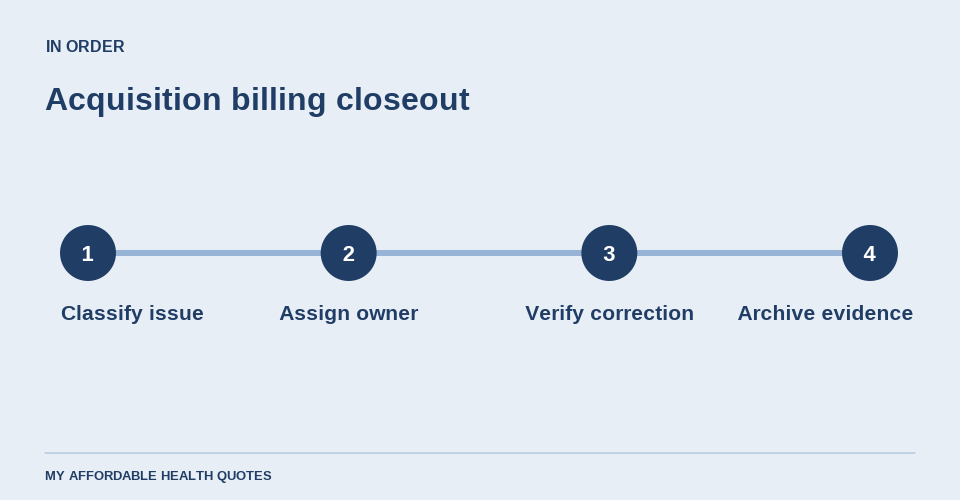
For every open item, record the responsible party, requested action and next follow-up date. When the insurer confirms a correction, verify that it appears in the appropriate enrollment or billing record. An email promise alone should not close an item that still affects payment or coverage.
Once the acquisition issues are cleared, transfer remaining work into the normal monthly reconciliation process. Do not keep an indefinite special spreadsheet that conflicts with the company's official benefits records.
Use the review to find process weaknesses
If multiple employees have the wrong tier, examine the data transfer rather than correcting only the visible cases. If termination dates are repeatedly late, review the handoff from managers to the administrator. The acquisition may reveal a process problem that existed before the transaction.
Document the corrected workflow in practical terms. State who approves enrollment changes, who submits them, who checks acceptance and who informs payroll. Give each step an owner rather than assigning the whole process vaguely to human resources.
Ask whether the benefit arrangement still fits the combined workforce after the administrative records are accurate. A plan comparison should use a reliable census and known employee needs. Shopping while the roster is still wrong can simply carry the acquisition errors into a new proposal.
Before replacing the acquired company's administrator, ask how unresolved adjustments will be handled after the service ends. Obtain the relevant records and a contact for historical questions. Changing vendors can be sensible, but doing it without a handoff may leave the buyer unable to explain a credit or prove that a termination request was submitted. Preserve the evidence first, then implement the approved change.
Finish with a signed-off reconciliation
Have the authorized benefits and accounting contacts review the final ledger. Identify any unresolved legal allocation separately and state who continues to handle it. The reconciliation should show which coverage and payroll issues are complete, rather than implying that every aspect of the transaction has been settled.
Retain the accepted roster, invoice history, correction confirmations and employee communications in the appropriate records. A future audit or employee question should not require reconstructing the acquisition from personal email accounts.
Request a coverage comparison if the combined business needs a different arrangement after the handoff. First make the inherited records accurate. A buyer who can explain the first invoices has a stronger foundation for budgeting, employee communication and any later insurance decision.
Sources and further reading
- DOL: Acquisitions and continuation coverage
- IRS: Acquisition-related COBRA guidance
- DOL: Health-plan responsibilities