Two people can own equal shares of a business and have very different health-coverage needs. One may insure a family, another may use a spouse's employer plan, and their preferred providers may not participate in the same network. Before a new partner joins, agree on how the business will evaluate and fund benefits without confusing equal ownership with identical personal insurance costs.
The discussion should produce a documented policy and an approved tax and insurance arrangement. It should not become an informal negotiation in which partners trade medical details for a larger benefit. This guide focuses on the governance questions that arise when independent owners begin sharing a business, rather than the enrollment mechanics of an employee receiving a small equity award.
Define the benefit the partners are discussing
Start by identifying whether the business intends to sponsor group coverage, contribute toward an approved arrangement or leave each owner responsible for personal insurance. The word benefit can hide very different commitments. A promise to pay a premium is not the same as a promise to make a specific policy available.
List any existing employee benefits separately. The partners cannot evaluate their own preferences in isolation if the company already has workers covered under a plan. Ask the benefits adviser which plan rules, eligibility provisions and other requirements affect the proposed change.
Do not assume that adding another owner creates eligibility for small-group insurance. HealthCare.gov's SHOP guidance distinguishes qualifying employees from owners and certain family members. The actual insurer and arrangement must be reviewed before the partners build an agreement around group coverage.
Establish the entity and tax treatment first
The legal form and tax classification of the business affect how owner benefits are handled. An LLC may have different tax treatment depending on its classification, and the term partner is sometimes used casually for someone who is not a partner for tax purposes. Ask the accountant to identify the applicable structure.
The IRS partnership publication discusses health premiums paid on behalf of partners and their treatment. Use that guidance with an accountant rather than copying the payroll process used for ordinary employees. The partners need a written payment and reporting method that fits their actual entity.
Keep the insurance eligibility answer separate from the tax answer. A tax adviser may explain how a payment is reported without deciding whether a particular insurer permits enrollment. Obtain both answers and make sure the partnership agreement does not promise something the approved arrangement cannot deliver.
Choose a principle before comparing personal costs
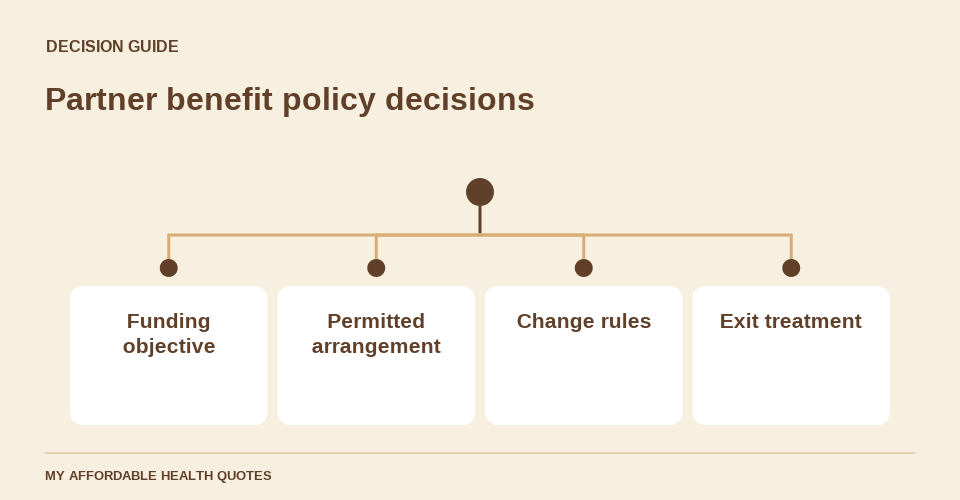
Ask what the partners want the business contribution to accomplish. Is the objective a predictable company budget, a consistent compensation policy or access to a particular group benefit? Naming the objective makes it easier to evaluate alternatives without turning every personal premium difference into a fairness dispute.
Consider how the principle would apply to a future partner. A rule negotiated only around today's two households may become difficult when a third owner joins with different needs. Test the proposed approach against several fictional situations before adopting it.
Have the accountant and benefits adviser review the chosen principle before implementation. An approach that sounds fair in conversation may create tax, plan-design or administration questions. The final policy should reflect the permitted arrangement, not merely the owners' preferred wording.
Keep household privacy intact
Partners can discuss the cost category and coverage tier they need without sharing diagnoses, treatment plans or a child's medical history. Provider and prescription comparisons can occur privately with the insurer or licensed adviser. The business agreement should not require one owner to prove medical need to another owner.
Use aggregate budget figures where possible. For example, the partners can review the company's total proposed contribution and administrative cost while each household receives its own plan details through a confidential channel.
Decide who can access premium invoices and reimbursement records. A partner's ownership interest does not mean every employee or co-owner should receive every health-related document. Follow the approved privacy and recordkeeping process for the arrangement.
A hypothetical equal-ownership disagreement
Two professionals form a fifty-fifty design business. One has individual coverage; the other covers a spouse and two children. They initially agree that the company will “pay both partners' health insurance equally,” but they have not defined whether equally means the same dollar contribution, the same percentage or full payment of each actual premium.
When invoices arrive, the ambiguity becomes a compensation dispute. The partners also learn that the accountant needs a specific reporting method and that their ownership-only business cannot simply assume it qualifies for the group arrangement they discussed.
A better agreement would have defined the contribution principle, eligible expenses, approval process and review date after professional review. Each partner could then compare personal options knowing the actual company commitment. The example does not recommend one funding formula; it shows why an undefined promise is not a workable benefits policy.
Specify how changes will be handled
A partner may marry, add a child, obtain coverage through a spouse or move to another state. State which changes require notice and which can alter the business contribution under the approved arrangement. Avoid deciding every case through an improvised meeting after the expense occurs.
Include a process for premium changes at renewal. The company may need to revisit its budget, but the agreement should say who makes the decision and how much notice partners receive. A surprise reduction can be difficult for a household that planned around the prior commitment.
Also define what happens when a partner takes leave, reduces work or exits the business. These changes may affect both eligibility and payment. The partnership agreement should refer to the applicable plan and professional review rather than guaranteeing continued coverage regardless of circumstances.
Coordinate owner decisions with employee benefits
If the business has employees, ask whether the proposed owner arrangement affects the existing plan, reimbursement structure or administration. Do not add an informal owner-only payment process without checking the consequences for the overall arrangement.
Keep employee communications accurate. A change in partner compensation does not necessarily mean employee benefits change, but managers should not speculate. If an approved plan change affects staff, provide the required documents and explanation through the administrator.
Use the same secure operational standards for owners and employees. Elections should be documented, payments reconciled and eligibility questions resolved by the appropriate professional. Ownership should not become a reason to bypass the process that protects everyone else from errors.
Create a budget with visible assumptions
Separate the proposed owner contribution, employee contribution, administrative fees and expected timing of payments. Label estimates as estimates until the arrangement is approved. A verbal quote should not become a fixed annual obligation in the partnership agreement without review.
Model a few ordinary changes, such as a new partner, a dependent election or a premium increase. The purpose is to identify whether the policy remains manageable, not to predict medical claims. A business with a clear contribution rule can plan more effectively than one that negotiates every invoice.
Ask the accountant how to record the approved payments and what documents support them. Have each partner follow the same submission process where applicable. Missing documentation should be corrected through that process rather than handled with an unexplained distribution.
Separate insurance choice from compensation negotiation
A partner might prefer a more expensive policy for reasons the business does not need to judge. The agreement should explain the company's commitment while allowing the household to evaluate available options within the permitted arrangement. That keeps a private coverage choice from becoming a debate over whose health needs are more deserving.
Conversely, a partner with inexpensive coverage should not assume the difference can automatically be taken as a tax-free cash payment. Any alternative compensation needs separate review and documentation. The accountant should explain the treatment before money changes hands.
If the partners cannot agree, return to the stated objective and the professional constraints. Compare proposals using the same assumptions and ask which policy could be applied consistently to a future owner. That is more productive than comparing one person's diagnosis or family size with another's.
Write a concise benefits provision
The final agreement should identify the approved arrangement, contribution principle, eligible participants, responsible administrator and review process. It should also explain how changes and departures are handled. Have counsel draft or review the provision so it fits the broader ownership agreement.
Reference insurer and plan documents where appropriate instead of attempting to restate every coverage term. A partnership agreement cannot force an insurer to cover a service or waive an eligibility requirement. Avoid language that creates a broader guarantee than the business intends or can fulfill.
Give each partner the final version and the operational instructions. The bookkeeper should receive the approved payment process, not a series of informal messages from different owners. One consistent instruction set reduces the risk of unequal or incorrectly reported treatment.
Review the first quarter together
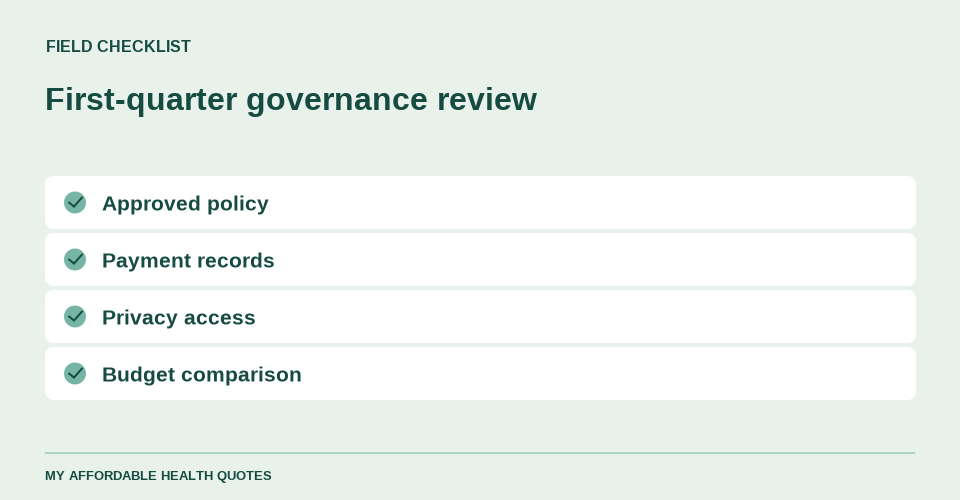
After implementation, compare actual company spending with the budget and confirm that the payment records follow the approved method. Resolve missing documentation or inconsistent entries early. Keep personal claims information out of the business review.
Ask whether the process is practical. If it requires a partner to approve another partner's private medical receipts unnecessarily, the administration may need redesign within the permitted rules. If invoices repeatedly arrive late, clarify responsibility and deadlines.
Record any approved changes and the next review date. The goal is a durable policy that survives normal household changes and new ownership, not a one-time compromise that no one can explain six months later.
Request help comparing available health coverage once the partners know the business structure and proposed contribution approach. A clear ownership agreement and a verified insurance arrangement solve different problems; together they let each household choose with accurate expectations and let the business budget consistently.