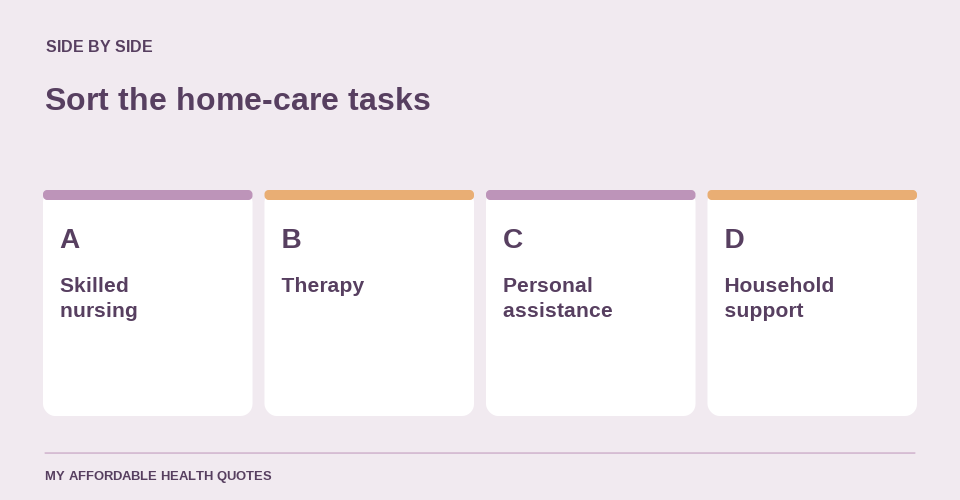
A home health benefit does not automatically pay for someone to stay with you throughout the day. Skilled nursing or therapy, help with bathing and meals, equipment, and household support can be treated differently under a private health policy. For a Kentucky family arranging care after illness or surgery, the first step is to describe the actual tasks and hours needed rather than asking only whether home care is covered.
This distinction is practical, not a judgment about which needs matter. Assistance with daily activities can be essential to a household even when a medical policy does not cover it. A useful plan identifies both the services insurance may pay and the remaining support that must be arranged through another resource or financial plan.
Translate the discharge plan into tasks
Ask the treating team to list the expected services at home, who should provide them, and how often. Separate wound care, medication-related skilled tasks, rehabilitation, equipment setup, personal assistance, and household work. Do not assume that one agency's phrase “home care package” corresponds to one insurance benefit.
For each task, identify whether the clinician has ordered it and what documentation is available. Ask whether the service requires a licensed professional or can be performed by a trained caregiver. The clinical team should make that determination. Your insurance worksheet should reflect the care recommendation rather than reclassifying tasks to fit a payment category.
Also identify the expected duration and review date. A short period of skilled visits after a hospital stay is a different planning problem from ongoing daily assistance. If the need is uncertain, mark that uncertainty and ask when it will be reassessed. An open-ended family expectation can conflict with a time-limited authorization if nobody discusses the difference.
Read the policy's home health definition
Locate home health, skilled nursing, therapy, custodial care, personal care, and exclusions in the contract. Read the definitions and any referenced conditions. A glossary offers a general explanation, but the actual policy controls the benefit, subject to applicable law. Obtain the current document for the product and coverage year.
HealthCare.gov's coverage glossary distinguishes home health services from ordinary nonmedical household tasks. Insurer clinical guidance also separates skilled from custodial services. These references help frame the questions; they do not determine that a particular Kentucky policy covers a particular number of hours or visits.
Ask whether the policy requires a home-health agency, physician order, plan of care, prior authorization, or specific eligibility conditions. Do not import Medicare's home-health rules into an individual private policy simply because an agency serves both kinds of patients. Request the requirements for your member contract explicitly.
Count visits and hours accurately
Ask how the plan measures the benefit. A visit allowance is not necessarily an hourly allowance, and a brief skilled visit does not establish payment for the rest of the day. Request an example using the proposed schedule so the difference is clear before the agency begins services.
If several disciplines visit on the same day, ask how they are counted. Nursing, physical therapy, occupational therapy, and speech services may be administered under different or shared rules. Also ask whether services delivered through home health count against another therapy benefit. Do not rely on an assumption that each category has a separate unused allowance.
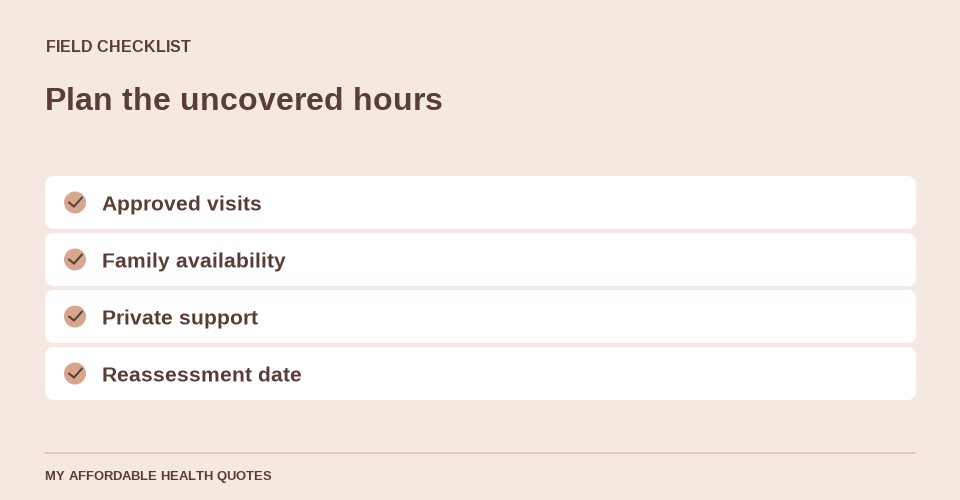
Keep a weekly schedule showing the clinician's recommendation, insurer-approved visits, and family-arranged support. Those are three distinct columns. The gap between them is the practical issue to solve, not a reason to describe the insurer's approval as more extensive than it is.
Verify the agency and service availability
Check the agency's participation under the exact policy and whether it can provide the required disciplines in your location. An agency listed in a directory may not currently have staff available for the proposed start date. Ask for an actual availability confirmation rather than treating a directory listing as a scheduled visit.
If the insurer suggests an agency that cannot accept the case, document the response and request further assistance. Give the insurer the clinical start date and service needs without overstating urgency. If a delay presents a health concern, have the treating team communicate that concern through the appropriate process.
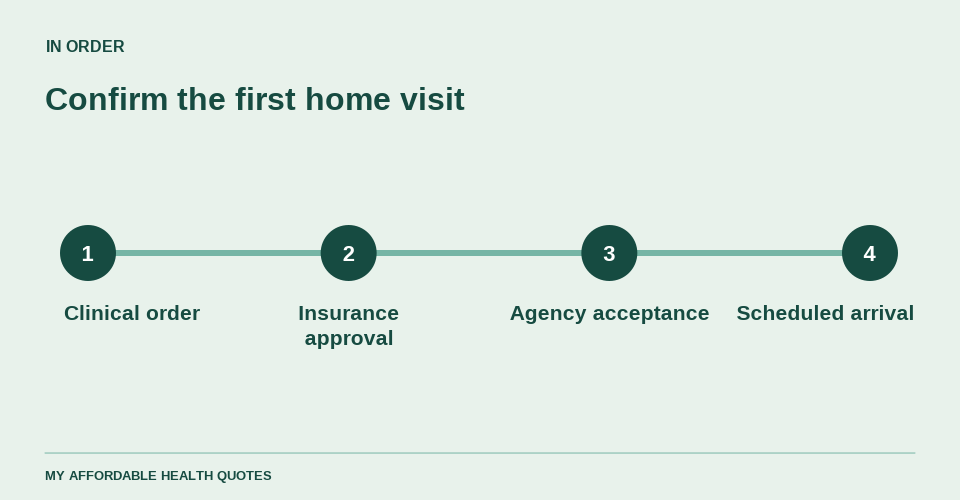
Ask who coordinates the first visit and how the agency receives the orders. A discharge referral, an insurance approval, and an accepted agency appointment are different steps. Assign a person to confirm each one so the patient does not arrive home expecting a visit that nobody actually scheduled.
Separate supplies and equipment
Ask whether dressings, infusion supplies, mobility equipment, or other items are included in the agency's payment or billed separately. Identify the supplier and authorization requirements for any separate item. A home health approval should not be treated as blanket approval for every product delivered to the home.
For rented equipment, obtain the rental and return terms. For recurring supplies, ask about covered quantities and ordering procedures. If the agency changes, confirm who remains responsible for supplies and equipment. Otherwise a family may receive duplicate deliveries or discover that an essential item was assumed to be another organization's responsibility.
Keep a list of what is already at home and what still needs delivery. This helps the care team coordinate safely and makes the financial estimate more accurate. Do not substitute a cheaper item without asking the clinician whether it is suitable for the intended care.
Budget the complete home-support plan
A hypothetical patient, Rosa, is approved for several skilled visits after a procedure. Her family initially expects that approval to include daily meal preparation and supervision. A task-based review shows that the nursing visits and household support are different arrangements. The family can then plan honestly for the hours not included in the medical authorization.
Ask each service organization for a written estimate describing tasks, frequency, patient share, and excluded charges. If you purchase additional support privately, keep that agreement separate from insurance billing. A privately arranged caregiver's rate should not be presented as the insurer's covered copay or deductible.
Consider how costs change if the clinical plan extends or becomes less intensive. Ask when the agency will reassess and how it will notify you before providing services outside the approved arrangement. Avoid signing an open-ended financial responsibility statement without understanding which services it could encompass.
Know what continued authorization requires
Ask the agency which progress notes or updated orders the insurer needs and when another review is due. Record the current approval's dates and services. A clinical recommendation for continued care and an insurer authorization are related but separate records, and both may need attention.
If the insurer reduces or ends approval, obtain the written reason. Does it say the service is no longer skilled, the records are incomplete, a limit has been reached, or another setting is appropriate? The response should address that actual rationale rather than submitting a general statement that the family still needs help.
The treating team can explain clinical needs and any risk from interruption. Ask about expedited review if the situation warrants it. Do not stop clinically necessary care or assume payment will continue solely because an appeal is pending; clarify both the medical plan and the financial arrangement with the relevant professionals.
Use Kentucky's review guidance appropriately
Kentucky's Department of Insurance describes different paths for medical determinations, coverage limitations, and other plan-rule disputes. Its current utilization-management guidance provides process requirements for regulated entities. Follow the notice for your plan and ask the Department which route applies rather than assuming a single external-review process handles every disagreement.
A dispute over whether a task is skilled may involve clinical evidence. A dispute over an explicit exclusion may require contract interpretation. A missing claim or incorrect service date may need billing correction. Classifying the problem helps the agency and insurer provide the right documentation and preserves your time for the actual issue.
Keep copies of the order, plan of care, authorization, service log, explanation of benefits, and denial notices. Share only the information needed through secure channels. A clear record makes it easier to show what was ordered, what was delivered, and what the insurer decided.
Plan the handoff when services end
Ask the care team how the patient and caregivers will be prepared for tasks that continue after skilled visits stop. Clarify who provides training, whom to contact with questions, and when medical reassessment is needed. Insurance termination dates should not be the only signal a family receives about the next stage of care.
Confirm equipment returns, remaining supplies, final claims, and any private-service cancellation requirements. An agency's clinical discharge may not automatically end a separate equipment rental or household-help agreement. Review each arrangement so avoidable recurring charges do not continue after the care plan changes.
If needs remain that the health policy does not cover, ask the clinical social worker or appropriate local resource about other support options. Eligibility and availability vary; do not assume a referral guarantees payment. The important step is to recognize the uncovered need early enough to investigate a workable alternative.
Bring the task list to a policy comparison
For a prospective Kentucky private plan, ask about the services you actually expect: skilled visits, therapy at home, equipment, and personal assistance. Request the contract language and conditions for each. A broad promise of home health coverage is less useful than a documented answer to a specific care schedule.
My Affordable Health Quotes can help organize those benefit questions when comparing available individual policies. Keep the clinical recommendations with the treating team and ask the insurer to confirm the contractual terms. The resulting plan should show both the insurance-supported care and the household support that still needs its own arrangement.
Sources and further reading
- HealthCare.gov coverage glossary
- Anthem skilled and custodial care guideline
- Kentucky denial appeal guide
- Kentucky 2026 utilization-management review guide