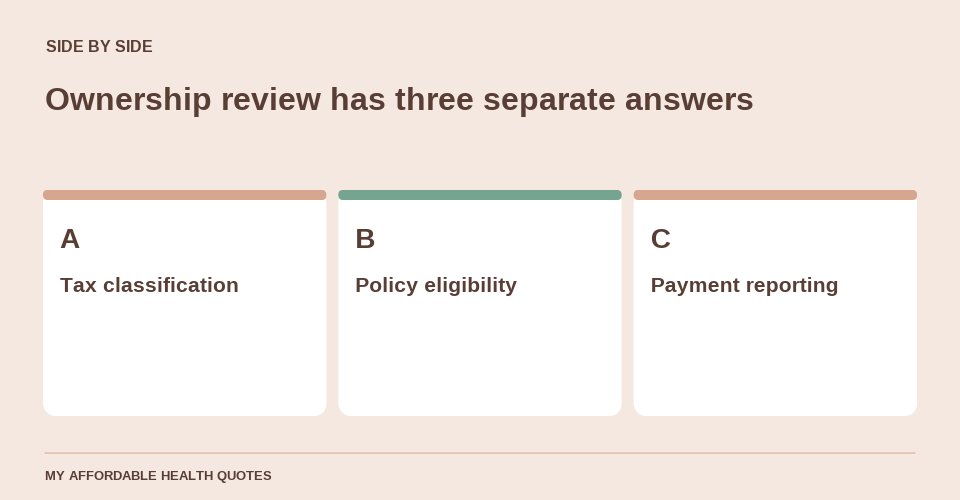
Buying into the Georgia company where you work can change how health benefits are administered even when your job, desk and insurer stay the same. The right first step is a coordinated review of ownership, tax classification, payroll treatment and plan eligibility. Do not assume that receiving an ownership interest automatically ends coverage, and do not assume that an existing employee benefit can continue unchanged.
The practical goal is to identify what changes on the ownership effective date, who must approve those changes and which records need updating. A licensed benefits professional, the company's accountant and the person handling the ownership transaction may each answer different parts. Keeping those answers together helps prevent a coverage decision from being made solely inside payroll software.
Identify the transaction you are actually making
“Becoming a partner” can describe several different arrangements. You might receive shares in a corporation, become a member of an LLC taxed as a partnership, acquire an option that has not yet been exercised, or merely receive a new job title. These are not interchangeable facts. Ask the transaction adviser to state the legal and tax classification in plain language.
Record the date ownership becomes effective and whether your employment relationship changes at the same time. Note whether a spouse or other family member has an ownership interest that the accountant must consider. Give the benefits adviser the relevant facts securely instead of trying to interpret ownership rules yourself.
Also identify the current benefit arrangement. Is it a group insurance policy, a reimbursement arrangement or individual coverage that the employee pays personally? Keep the insurance contract separate from the way premiums are recorded in the company's books. A change in tax treatment does not, by itself, tell you whether a particular insurer will continue enrollment.
Make a before-and-after benefits record
Before the transaction, save the current election, covered dependents, premium amount, employer contribution and payroll deduction. Download the benefit summary and identify any separate reimbursement account. If there is a health savings account or flexible spending arrangement, list it separately rather than referring to everything as “the health plan.”
Create a second column for the proposed post-transaction treatment. Leave uncertain items marked for review. The useful output is not a completed spreadsheet with guessed answers; it is a list of specific decisions the accountant, administrator and insurer must resolve.
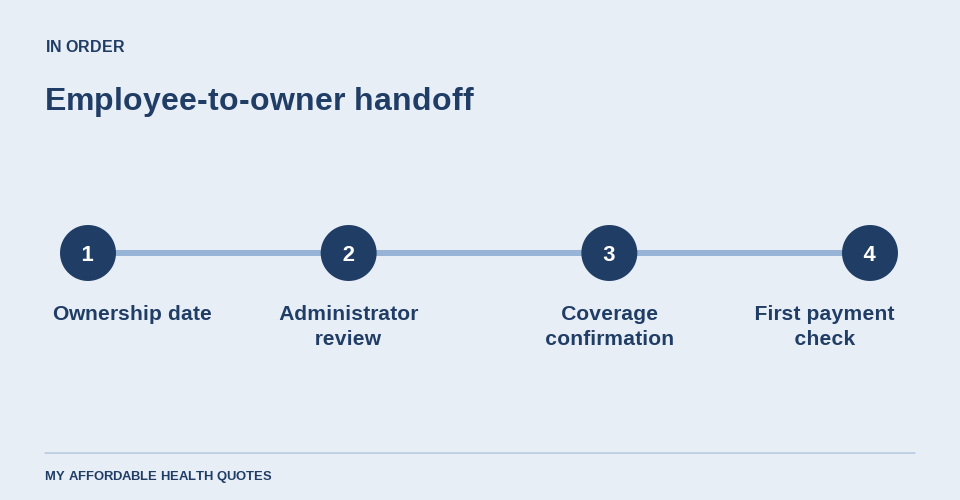
Include the person who can authorize changes and the date each answer is needed. For example, payroll may need instructions before a processing cutoff, while the insurer may require an ownership document before confirming eligibility. Working backward from those deadlines is more reliable than discovering the issues during year-end tax preparation.
Understand why entity classification matters
The IRS states that partners performing services for a partnership are self-employed rather than employees for federal tax purposes. An LLC can be treated as a partnership, so the letters LLC alone do not settle the question. Ask your accountant what classification applies to the actual entity.
The IRS also has specific guidance for certain S corporation shareholders. Its S corporation medical-insurance page explains special treatment and restrictions that can affect benefits and reimbursements. Do not copy an ordinary employee's payroll setup to a new owner without checking those rules.
These are reasons to obtain tailored tax instructions, not a reason to cancel an insurance policy. Ask the accountant for a written description of how premiums should be paid and reported, then ask the insurer or administrator whether enrollment is permitted under the contract. Each answer addresses a different issue.
A Georgia employee-to-owner example
In this hypothetical case, Priya works for an Atlanta design studio and receives an interest in an LLC taxed as a partnership. Before the transaction, the studio treats her as an employee and deducts part of the group premium from each paycheck. She assumes the benefit will simply continue because her daily duties are unchanged.
The accountant identifies the classification issue before closing. The benefits adviser asks the insurer to confirm whether and how Priya can remain covered under the group's terms. The administrator reviews any separate reimbursement benefit. Rather than immediately canceling coverage, the team establishes a dated plan for payment, reporting and any necessary enrollment changes.
Priya's family coverage is reviewed at the same time. The ownership transaction concerns her, but a mistaken termination could affect a spouse or child as well. The team therefore requests confirmation for every covered person and preserves the current policy until the replacement or continuation arrangement is documented.
The example does not prescribe a universal treatment for LLC owners. Its lesson is that the legal transaction, insurance contract and payment process must be reviewed together. A job title change alone would not provide enough information to reach the same conclusions.
Review individual coverage through the correct Georgia channel
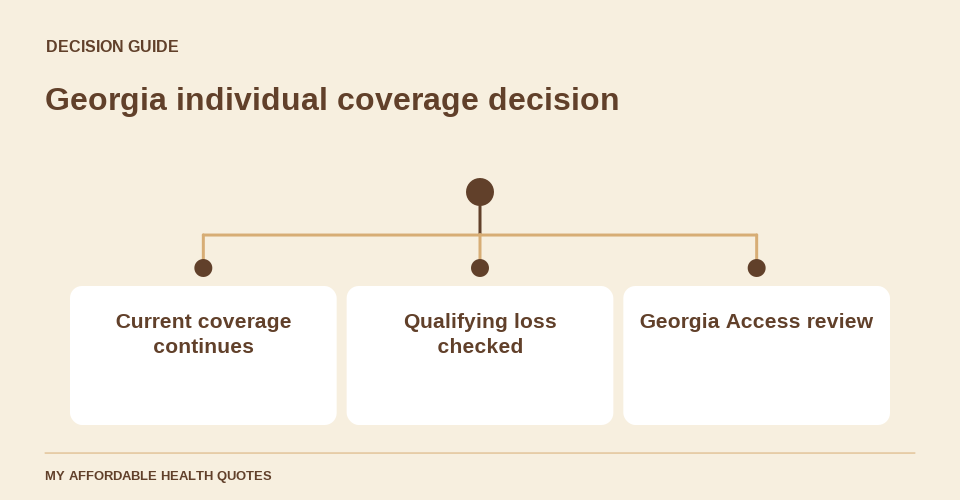
If individual insurance becomes relevant, Georgia residents should use the state's official Marketplace, Georgia Access, for Marketplace enrollment information. The Georgia Access small-business resource identifies individual coverage as an option for self-employed Georgians and explains that financial assistance depends on circumstances.
Do not assume that becoming an owner creates an enrollment opportunity by itself. Identify whether there is a qualifying coverage loss or another eligible event, and confirm the required documentation and effective date. A transaction date and an insurance eligibility date may differ.
If you already have Georgia Access coverage, report relevant changes to income, employment or other coverage offers. The state's change-reporting guidance directs consumers to update their information promptly. Use the official process and retain the resulting notice rather than asking the company bookkeeper to make an informal estimate of your assistance.
Separate income forecasting from business cash
An ownership interest can create a more complicated income picture. Salary, business profit, distributions and transaction proceeds may not be the same thing for tax or Marketplace purposes. Ask the tax adviser which amounts belong in the relevant household estimate. Do not substitute the cash drawn from the business for a properly prepared income calculation.
Prepare a forecast with an explanation of uncertainty. Identify amounts already known, amounts expected under signed agreements and amounts that depend on future business performance. Schedule a review when the accountant has updated figures. This is especially useful when the transaction occurs late in a year and ownership income is difficult to estimate from prior paychecks.
Keep the forecast private. The group insurance administrator generally does not need a detailed personal tax projection to perform routine enrollment work. Share each document with the professional who needs it and avoid creating one broad email thread containing payroll, tax and health details.
Protect ongoing care during any transition
If a different policy is necessary, compare the exact providers and prescriptions before enrollment. A company ownership event does not make a new network equivalent to the old one. Review scheduled treatment, authorization requirements and the proposed start date with the insurer.
Ask whether changing plans will affect deductible accounting or prior approvals. Obtain a direct answer rather than assuming that a familiar carrier will carry every detail forward. A new policy with the same logo can still have different benefits and administrative rules.
For a household member receiving treatment, give the benefits professional a practical description of the timing problem without disclosing more medical information than needed. The clinician and insurer can address clinical details through appropriate channels. The company's transaction team should not become the repository for a family member's medical records.
Give the agreement a benefits attachment
Ask the transaction adviser whether the final agreement should include a plain-language attachment identifying which benefit questions have been resolved. The attachment can record responsibilities without pretending to replace the insurer contract or tax advice. It might identify who pays a premium during the transition, which administrator communicates with the insurer and how an unresolved question will be escalated.
Keep the attachment factual. A statement that coverage is guaranteed indefinitely would exceed what the parties can establish from an ordinary transaction review. A dated reference to the insurer's written confirmation is more useful. Make sure the new owner receives the final version rather than relying on an earlier negotiation draft.
Inspect the first payment cycle
After the ownership change, compare the insurer's enrollment record, premium invoice and the company's accounting entry. Verify that any discontinued employee deduction actually stops and that the approved replacement payment method begins. Check covered dependents as well as the new owner.
If an administrator reports an inconsistency, document the issue and request a correction through the approved process. Do not make an informal cash adjustment simply to make a paycheck appear right. The correction may need to address both coverage records and reporting.
Ask the accountant to confirm that the first cycle follows the written instructions. Catching an error after one payment is easier than rebuilding a year of premium records. Save the confirmation with the ownership-related benefits file so a future payroll provider can understand the arrangement.
Questions to resolve before signing
Before the transaction closes, you should know the entity's tax classification, the effective ownership date, the insurer's enrollment answer, the permitted payment method and the person responsible for reporting. You should also know whether any household member needs replacement coverage and when that coverage can actually begin.
If one of those answers remains pending, make the dependency visible to the transaction team. A benefits issue does not necessarily stop a business deal, but ignoring it can turn an orderly review into a rushed coverage problem. Document the interim arrangement and the deadline for a final answer.
Request help comparing available coverage if the ownership change requires an individual-plan review. Bring the confirmed coverage end date and the questions your accountant has resolved. That allows the insurance discussion to focus on actual options rather than assumptions about what the word owner means.
Sources and further reading
- IRS: Partners and employee status
- IRS: S corporation medical insurance
- Georgia Access: Small-business options
- Georgia Access: Report changes