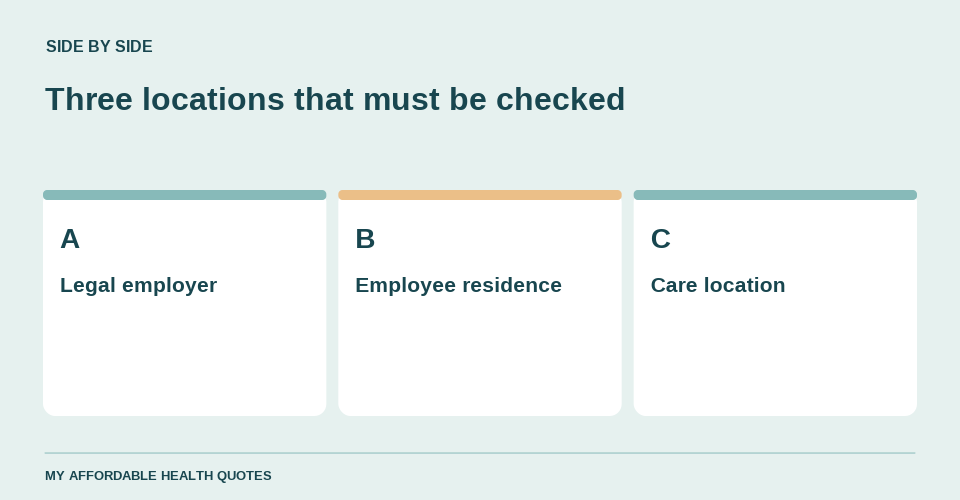
Opening a second Florida location should trigger a health benefits review before the first employee moves desks. The central question is not whether your existing insurer operates in Florida. It is whether the exact policy, participating providers, employee eligibility records and billing arrangements still work for the workforce you are about to have. A business address, an employee residence and a place where someone receives care can be three different locations.
This guide is for an owner expanding within Florida, such as adding an Orlando office to a Fort Lauderdale company. It concentrates on the information needed to assess an existing arrangement. It does not assume that a second location requires a replacement plan, a new group or a separate policy. Those answers depend on the contract, employer structure and insurer's assessment.
Describe the expansion before requesting prices
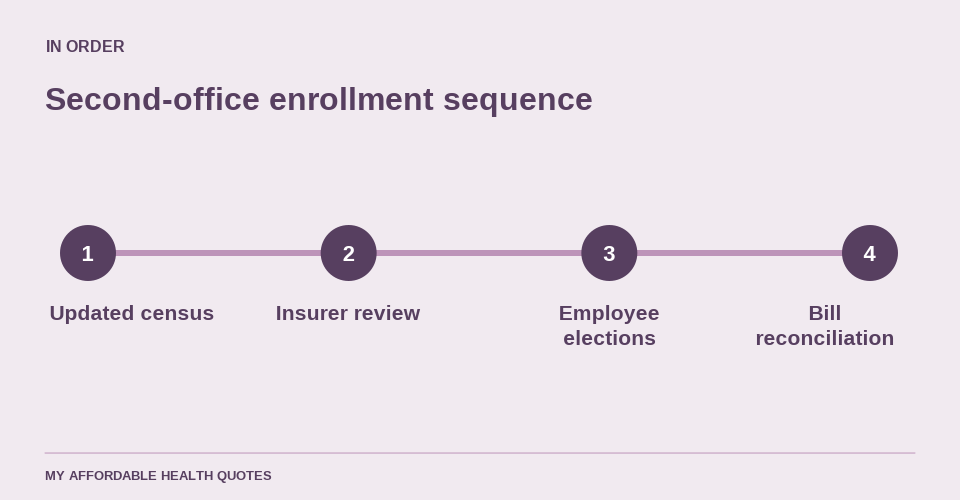
Start with a one-page description of what is changing. State whether the new location belongs to the existing legal entity, whether payroll will remain consolidated, which employees are relocating and which positions are new. Include the intended opening date and the first payroll date for new hires. If ownership or the employing entity also changes, flag that separately; an address-only request would conceal important information.
Give the benefits professional the company's actual legal names and identifiers through a secure channel. Do not substitute the brand printed on the storefront. Two locations may share a brand while employing people through different entities, and the person reviewing eligibility needs the employing relationship. Ask which documents are required to establish that relationship before collecting anything sensitive from employees.
Explain whether the new site is permanent, temporary or a shared workspace. A room rented for occasional client meetings is not necessarily the same operational change as a staffed location. Let the insurer decide how its policy treats the facts rather than trying to choose a description that preserves a preferred premium.
Build a location-aware employee census
A useful expansion census distinguishes current staff, transferring staff and incoming hires. For each person, record only the administrative fields requested by the insurer or authorized administrator: relevant work location, residence information, employment status, start date and proposed coverage election. Keep medical information out of the general project spreadsheet. The owner needs to understand access problems without receiving everyone's health history.
Set an effective date beside every proposed change. Someone may transfer to the new office in February but keep the same residence until June. Another employee might live near the new location while working remotely for the original office. Dates prevent these situations from being flattened into one inaccurate address change.
Assign responsibility for keeping the census current. If recruiting adds three employees after the original quote, the quoted group and the enrolled group may no longer match. Require the hiring manager to notify the benefits administrator when a start date changes, an offer is declined or a role is moved. A spreadsheet that is accurate only on quote day is insufficient for enrollment.
Test local access with service scenarios
Ask employees to verify their own essential providers through the exact plan directory and insurer. Offer a standard instruction sheet that explains how to identify the plan, coverage year and network. The company can collect nonmedical feedback such as “no participating primary care office located within my preferred travel area” without requesting a diagnosis or medication list.
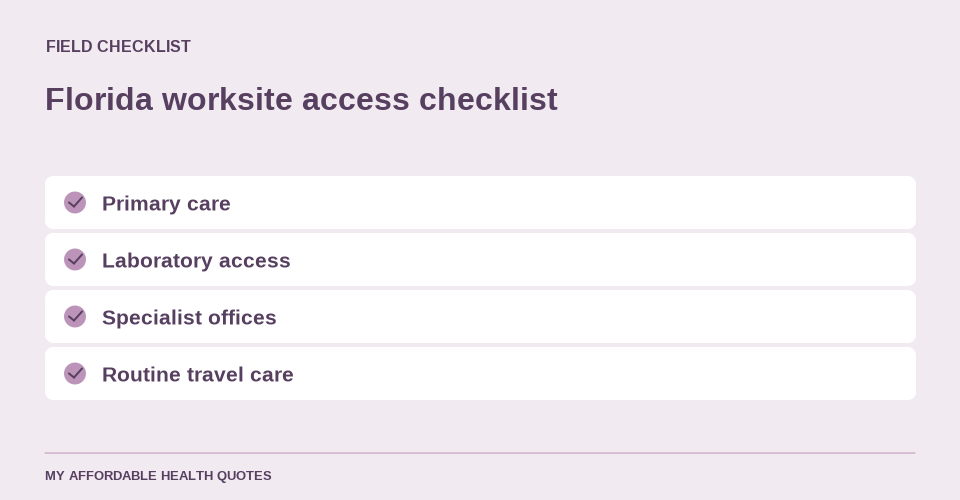
Look beyond the nearest hospital. A new location may need practical access to primary care, urgent care, laboratories, imaging and specialists. Ask the insurer where routine care is available and whether there are service-area restrictions affecting the new workforce. Do not assume a familiar carrier name means the same network reaches every Florida county.
For an employee who divides time between both offices, describe that work pattern specifically. Ask how routine visits near each office would be handled. Emergency benefits are not a substitute for a routine-care answer. A plan may respond differently to a scheduled appointment and an unexpected emergency, so those should be separate questions.
A two-office planning example
Consider a hypothetical bookkeeping company with eight employees in Fort Lauderdale that plans to hire four people for an Orlando office. The owner initially requests a quote for twelve employees at the original address. That request omits the question the expansion actually creates: whether the four new employees can conveniently obtain routine care near their homes and workplace.
The office manager revises the request to show both worksites and the intended hiring dates. The broker asks the insurer to confirm the applicable service area and provides the exact directory for employee checks. One incoming employee identifies a preferred clinic that does not participate. The company records an unresolved access concern without collecting the employee's private treatment history.
Management then compares three concrete possibilities: retaining the arrangement if the access review is acceptable, reviewing another available group option, or evaluating an appropriately designed alternative with professional assistance. The example establishes a decision process, not a promise that all three options are available or suitable. The insurer's documented response and employee needs determine the actual shortlist.
Use Florida resources for the right question
The Florida Department of Financial Services provides consumer information on individual and small-group health coverage. Its Affordable Care Act overview distinguishes small-group purchasing from individual coverage and discusses participation requirements. Use that resource as background, then ask the insurer to apply its requirements to your expanded business.
The state guidance also warns that a business consisting only of owners and family members should not assume that it qualifies for a small-group policy. That matters when an owner calls a second family-operated storefront an expansion of employee coverage even though no eligible nonfamily workforce exists. The legal structure and actual enrollment matter more than the number of signs on buildings.
Florida's available products can change by plan year. Avoid copying a carrier list from a prior quote into the expansion budget. Request current availability for the exact locations and intended effective date. If a question concerns a regulated insurer or product, the state's consumer resources can help identify the appropriate place to seek clarification.
Reconcile the contribution budget with the hiring plan
Build a monthly projection that separates existing enrollment from additions. Show the earliest and latest expected hire dates, the proposed employer contribution and any administrator charges. Use actual written proposals when available; label preliminary figures as estimates. A twelve-person quote does not mean all twelve premiums begin on opening day.
Ask payroll how deductions will be implemented for employees paid on different schedules. If the second office uses a different payroll calendar, equal monthly benefit costs may translate into different per-paycheck deductions. Have payroll demonstrate the calculation and explain how partial months or delayed enrollments will be handled under the applicable arrangement.
Run a modest stress test. What happens if the opening slips a month, two additional hires join, or an employee changes a dependent election through an eligible event? The aim is not to forecast every possible claim. It is to understand whether ordinary staffing changes can be administered and funded without improvised deductions or late premium payments.
Keep communication specific to the employee
Tell existing staff whether their coverage is expected to remain the same or is under review. Tell incoming employees what has been confirmed and what remains pending. Avoid saying “benefits start immediately” unless the actual eligibility and effective-date rules support that statement. Recruiting language should match the final documents.
Provide a contact for confidential coverage questions and a separate contact for payroll errors. This reduces the chance that an employee shares medical details with a location manager who cannot resolve them. State when enrollment materials will be issued and how confirmation will be delivered.
If a plan change is selected, explain the actual differences rather than describing it as an automatic upgrade. Include where employees can check providers, how to obtain benefit documents and whom to contact about treatment already scheduled. Applicable notices and deadlines should be reviewed by the benefits administrator; an informal announcement does not replace them.
Close the project with a confirmation packet
Before treating the expansion as complete, obtain written confirmation of the covered employer arrangement, accepted locations, enrolled population and effective dates. Reconcile that confirmation with the first insurer bill and the first relevant payroll deductions. Investigate missing employees, unexpected dependent tiers and unexplained credits promptly.
Retain the approved census version, the insurer's answers and the final employee communication. Store them in the company's controlled benefits records rather than in a personal inbox. A future office manager should be able to reconstruct what was approved without relying on the owner's memory.
Set a follow-up after the first full month of operation. Ask whether employees can obtain identification information, whether payroll deductions match elections and whether any location-related access questions remain unresolved. That follow-up is more useful than assuming the absence of complaints means the transition worked.
Give the project a named backup owner as well. If the expansion manager is traveling on the date enrollment closes, another authorized person should know which employees are still pending and which insurer contact can resolve a problem. The backup should have appropriate access, not a shared password forwarded at the last minute.
For a Florida expansion, the most productive quote request begins with a clear description of the two worksites and the people affected. Ask for licensed assistance comparing available coverage after preparing that description. The goal is a documented arrangement that works where employees actually live and receive care, with a budget and enrollment process the business can maintain.