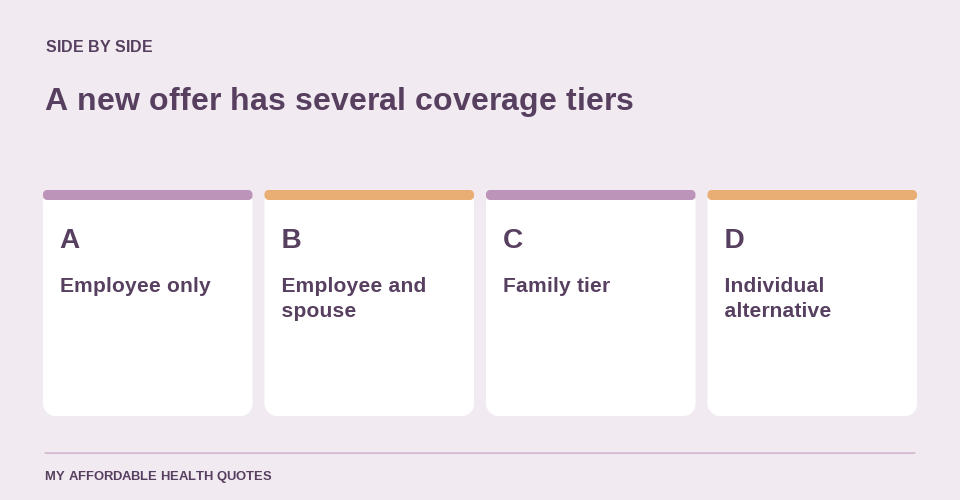
When one spouse accepts a new job, a family already buying private health insurance should review the employer offer before moving everyone onto it or ignoring it entirely. The offer may change financial-assistance eligibility even for someone who prefers the existing policy. It may also offer a better network for one family member and a less suitable arrangement for another. The household needs a person-by-person comparison built from actual benefit information, not an assumption that employment automatically settles the insurance decision.
For Colorado families, this work can involve both the new employer and Connect for Health Colorado. The employer explains its eligibility dates, required premiums, and benefit standards. The exchange evaluates the Marketplace application and any financial help. Neither organization automatically knows every fact held by the other. A concise information packet helps the household give consistent answers and avoid a rushed cancellation that leaves someone without coverage.
Request the cost of every relevant enrollment tier
Ask human resources for the employee contribution to the lowest-cost option meeting the relevant benefit standard, as well as the cost of any plan the family actually prefers. Obtain the rates for employee-only coverage and the applicable family tier. These figures answer different questions. The amount deducted for an employee alone should not be used as though it is the cost to insure a spouse and children. The family needs the actual numbers before comparing alternatives.
Also ask whether contributions are quoted per paycheck or per month. A payroll figure can look smaller simply because it is collected more often. Convert costs consistently for budgeting while preserving the original employer document for eligibility review. Record whether the rates apply immediately or change at an upcoming renewal. An offer accepted late in the year may be followed quickly by a new benefit year, so the initial rate may not describe the full period the household is planning.
Affordability is an eligibility term, not a feeling
A household may reasonably find a premium difficult to manage, but Marketplace affordability rules use a defined test. HealthCare.gov explains that the employee's test and the family members' test use different premium information. The applicable percentage changes by coverage year. Supply accurate employer details and let the exchange determine the result rather than using an old percentage remembered from a previous application.
The IRS questions and answers provide further explanation of employer offers and the premium tax credit. A preference for a Marketplace policy does not by itself make an employer offer unaffordable. Likewise, an affordable employee-only offer does not automatically settle every dependent's result. This is why collecting the complete offer is essential even when the household believes its income is too high for assistance.
A hypothetical split-family decision
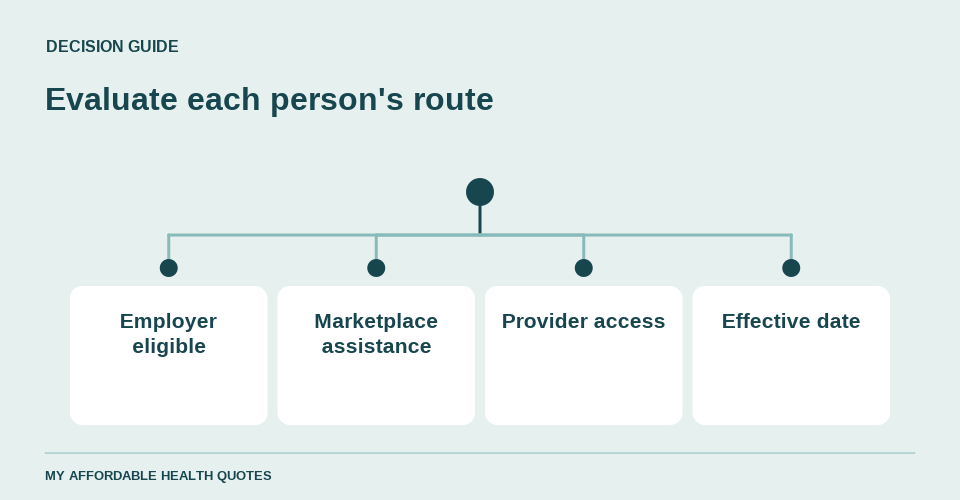
Imagine a Colorado couple with two children. One spouse begins a job offering several coverage tiers. The other spouse runs a consulting business, and the family currently has an individual policy. The new employer's employee-only contribution is attractive, but adding the entire family costs more. One child has a specialist relationship that the family wants to preserve. The useful next step is not to choose based solely on the employee's payroll deduction; it is to evaluate the full family arrangement.
The family obtains the employer's costs and benefit documents, updates its household earnings forecast, and asks the exchange how the offer affects each person's financial eligibility. It also checks the specialist against the exact employer and individual networks. The resulting arrangement might place everyone together or use different policies. This example does not predict which outcome is best. It demonstrates that household membership, coverage enrollment, and financial eligibility are related but separate questions.
Keep the tax household intact while changing coverage
Moving a spouse onto employer coverage does not necessarily remove that spouse from the household information used by the Marketplace. The application may still need the person's income and other relevant details even though that person no longer seeks Marketplace insurance. Do not delete a household member simply to make the screen resemble the people remaining on the policy. Follow the application's instructions for who belongs in the household and who needs coverage.
Update the annual earnings forecast to reflect the new job without losing income earned earlier in the year. Include a reasonable estimate of the consulting business and other relevant sources. If the new job starts midyear, a full annual salary figure may not equal the wages expected in that coverage year. Ask payroll for the expected pay schedule and use an adviser-supported calculation where needed. The next year's estimate may require a different full-year assumption.
Colorado changes should reach the exchange
Connect for Health Colorado's frequently asked questions discuss reporting household and income changes and the effect of other coverage offers. Use the exchange account or approved assistance channel to report the actual change. Telling a doctor or insurer that a spouse has a new job does not update the eligibility application. Retain the resulting notice and review what it says about the people still enrolled and any financial help.
If the employer provides incomplete information, ask what additional documentation the exchange needs rather than entering a convenient estimate as a final fact. Keep the name and date of the employer response. A short note explaining that a rate is pending can help you track the unresolved item, but it does not replace a required answer. The household should know which parts of the application are confirmed and which still need follow-up.
Compare care access before comparing convenience
One insurance card for the whole family can be administratively simple, but simplicity should not hide a significant network problem. List the providers used by each person, including specialists, behavioral-health clinicians, hospitals, and pharmacies. Verify participation in the particular product and network. If a child has recurring therapy, ask about both network access and the relevant benefit rules. An employer's well-known carrier name is not enough to establish that the existing care arrangement will continue unchanged.
For each policy, examine referral requirements, prescription restrictions, and the handling of planned services. Ask whether existing authorizations would need to be reviewed again after a switch. Keep clinical decisions with the treating professionals; the insurance task is to understand administrative and benefit requirements. If care is time-sensitive, resolve the new plan's procedures before the old policy ends rather than discovering them at the next appointment.
Compare combined household costs
If family members use different policies, add all premiums and consider each policy's cost-sharing structure. Two separate deductibles can behave differently from a family deductible. The household also needs to understand which expenses count toward which out-of-pocket limit. Do not combine the limits into a single promise that one insurer will recognize spending under the other policy. Ask for an explanation using the actual arrangement being considered.
A useful budgeting exercise examines an ordinary care year and a year with substantial covered care. The point is not to predict illness but to see whether the household could manage the exposure. Include any payroll contribution and the full premium of individual coverage, then show assistance separately if applicable. This makes the comparison easier to revisit if income or eligibility changes rather than leaving the family with only a net monthly number.
Coordinate dates person by person
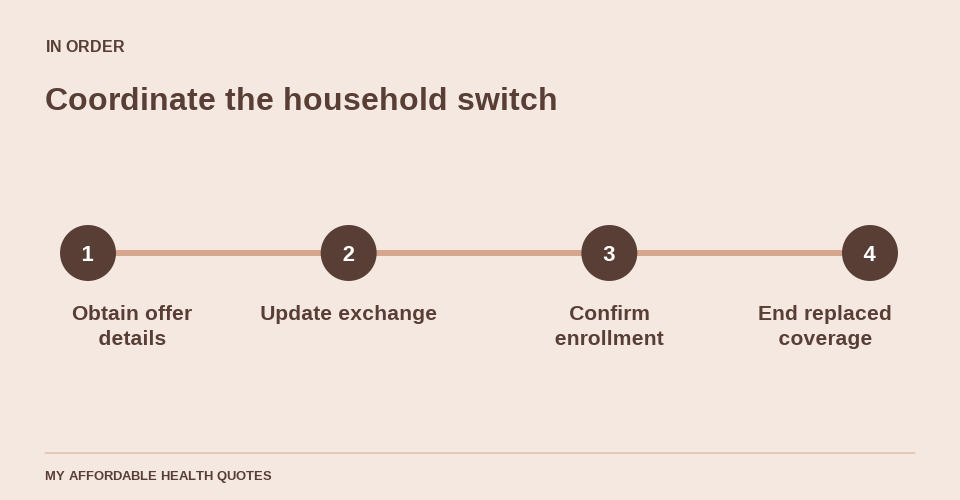
Confirm when the employee and dependents can begin the new plan. The date an offer is signed, the first workday, and the insurance effective date may differ. Keep existing coverage until the replacement is confirmed, and ask how to end coverage only for the people moving. Canceling an entire family policy when only one person is changing can create an avoidable problem. Review the cancellation confirmation carefully.
If the employer's enrollment period is short, request the necessary documents early. Place the employer election deadline, exchange update, first payment, and effective dates on one calendar. A household member should own the final check that every person has the intended coverage. This is especially useful when spouses divide administrative tasks and each assumes the other has completed the last step.
Review the first bills and notices
After the change, compare the first payroll deduction with the employer election and the individual-policy bill with the exchange notice. Check that the people removed from one policy were actually enrolled in the other. Give new cards to providers and pharmacies, and keep the former policy information for older claims. A clean enrollment decision can still produce billing confusion if records are not updated at the places where care is received.
If an unexpected difference appears, contact the organization responsible for that part of the process. Payroll resolves a deduction discrepancy; the insurer confirms active coverage; the exchange addresses the assistance determination. Keep a brief log of the question and response. Avoid solving a billing problem by stopping payments without understanding the coverage consequence. The goal is to correct the record while keeping the household's intended insurance in force.
Make renewal a fresh comparison
A new job's benefits can change at renewal, and the consulting spouse's income may become more predictable after the transition. Review both rather than automatically repeating the first arrangement. Preserve the original decision notes so you remember why a family member used a particular policy. A specialist relationship or a temporary waiting period may have driven the choice, and the relevant facts may now be different.
For help evaluating individual options alongside an employer offer, contact My Affordable Health Quotes with the actual family premium information and current household estimate. The useful outcome is an arrangement chosen deliberately for each person, supported by accurate employer facts, suitable care access, and coordinated dates. A new job should trigger a review, not an automatic assumption that every family member must move to the same plan.
Sources and further reading
- HealthCare.gov: Affordable Coverage
- IRS: Premium Tax Credit Questions
- Connect for Health Colorado: Frequently Asked Questions