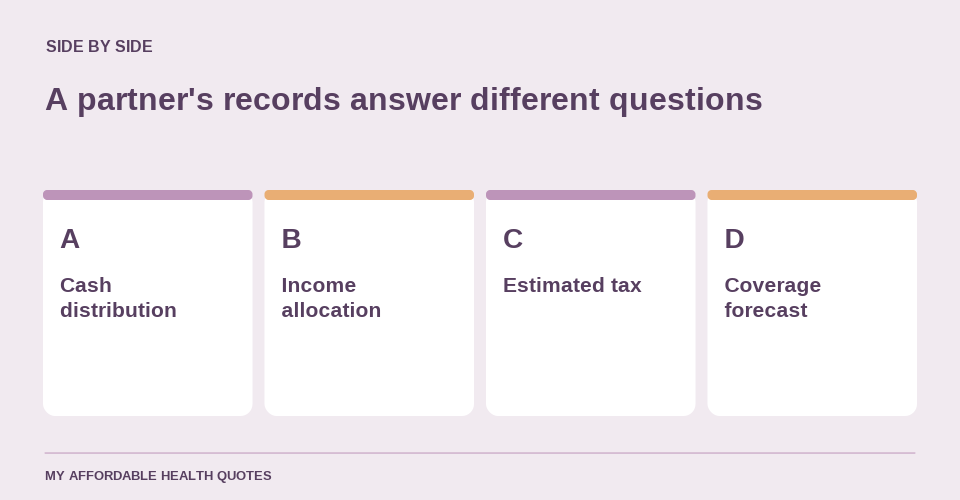
A hypothetical Colorado partner receives regular cash distributions from a business but does not receive the final Schedule K-1 until well after the year ends. The partner's family buys individual health insurance. During enrollment, someone suggests using the distributions as the income estimate because they are the only figures readily available. That shortcut is tempting, but it can confuse cash received with the amount that belongs in the household's tax and coverage calculations.
The better workflow begins before the K-1 is final. Obtain a reasonable business estimate, have the tax adviser translate it into the household forecast, and update the insurance record as material facts change. This is not a request to predict the final return perfectly. It is a way to maintain a supportable estimate while the business closes its books. Colorado's exchange process and the partnership's reporting schedule can be coordinated without pretending they operate on the same timetable.
The first meeting: identify the entity and the owner
Start by identifying the entity's tax classification and the person's role. A partnership K-1 is not interchangeable with an S corporation K-1, a trust K-1, or a wage statement. The forms may look related while representing different rules. Give the tax adviser the exact entity name and the expected form. If the household owns interests in several entities, list each separately instead of describing them all as business income.
Ask who can provide the current estimate: the partnership's accountant, financial officer, or another authorized person. Record the date of that estimate and the period it covers. A year-to-date management report may not include year-end adjustments or a transaction expected later. The household should understand what the number represents before using it in a full-year forecast. An impressive-looking spreadsheet is not necessarily a final tax calculation.
The second meeting: separate cash from allocation
IRS Publication 541 distinguishes partnership distributions from a partner's distributive share of income. That distinction explains why the deposit total cannot automatically serve as the insurance income estimate. A business may retain cash while allocating income, or distribute cash that has a different relationship to the current year's result. Ask the tax adviser to identify the relevant amounts and any separate treatment needed.
Keep cash distributions in the household budget, where they help explain how premiums will be paid. Keep the adviser-reviewed income allocation in the coverage forecast. These two records can differ without either being wrong. The problem arises when one is silently substituted for the other. Labeling them clearly helps the partner, spouse, and enrollment assister avoid discussing different numbers as though they were competing versions of the same fact.
A case file with three versions
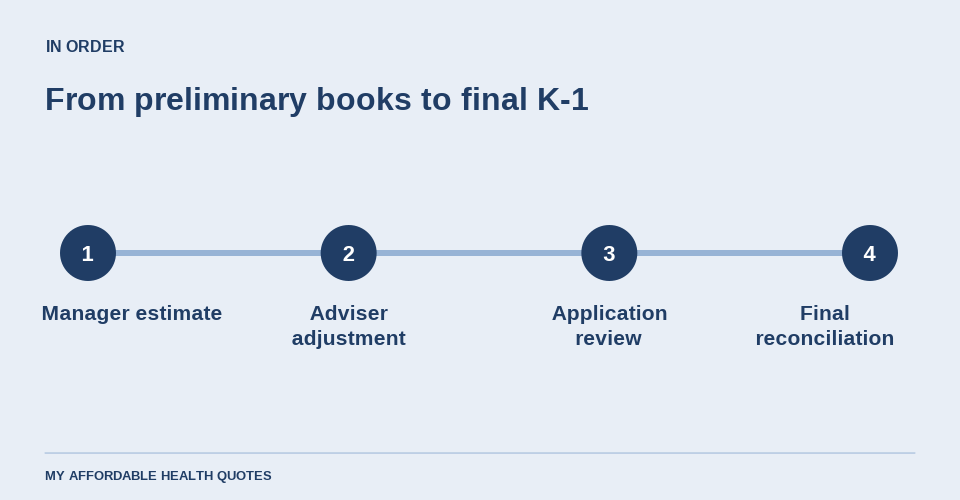
In the hypothetical example, the partnership first provides a midyear estimate based on ordinary operations. Later, it sells an asset and revises the forecast. Finally, the completed K-1 reflects additional adjustments. The household keeps all three versions, each with a date and explanation. The insurance application is reviewed when the revised forecast becomes reasonably clear, not only when the final tax form arrives.
This approach is more useful than overwriting the original number and losing the reason for the change. If an eligibility reviewer or tax preparer later asks why the application changed, the household can show the business event that prompted the revision. The record also helps distinguish a genuine new fact from a duplicate entry or arithmetic mistake. The goal is a coherent history, not a claim that the first estimate was guaranteed to remain exact.
Losses should be reviewed before they reduce the forecast
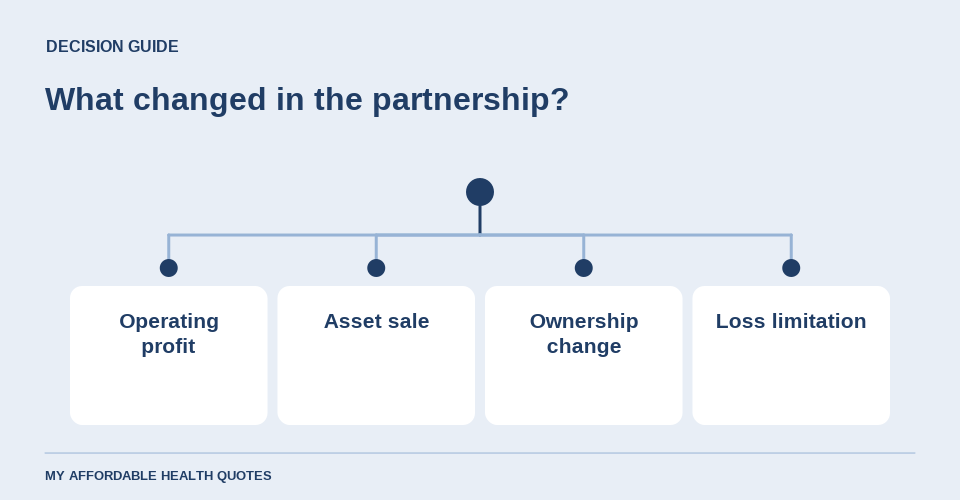
A K-1 may show losses or deductions that require further analysis at the owner level. The IRS instructions for partners discuss limitations and reporting responsibilities. Do not assume every negative number can immediately offset wages or other household income. The tax adviser should evaluate the applicable facts and explain what amount belongs in the current forecast. This is particularly important for owners with multiple investments or changing ownership interests.
Mark unresolved items rather than quietly treating them as fully usable. Ask whether the projection includes the item, excludes it, or uses an assumption that needs later confirmation. The answer should be specific enough that the household knows what would trigger an update. An insurance agent can work with the resulting estimate without being asked to determine partnership basis or apply loss limitations.
Guaranteed payments and other items need separate lines
Some partners receive payments for services or other amounts that differ from ordinary cash distributions. The partnership records and tax adviser should explain their treatment. List them separately until the adviser confirms how they enter the household calculation. Do not add a payment twice if it is already included in a broader estimate. A source-by-source reconciliation is safer than a single total assembled from several documents whose contents overlap.
Also include relevant income outside the partnership. A spouse's wages, investment gains, or another business can materially change the household total. The partner's K-1 is one component, not the whole application. If only one household member needs coverage, do not assume only that person's earnings matter. Establish the appropriate household information and then apply the current income rules with professional help where needed.
Colorado verification can happen before final tax forms
Connect for Health Colorado explains accepted documentation and its verification process on the Submit Documents page. If the exchange requests proof while the K-1 remains pending, ask what current evidence and explanation it will accept. Do not ignore the deadline because the partnership has not finished its return. A timely response should address the specific request and explain why the forecast differs from an older document when relevant.
Keep the submitted evidence, explanatory note, and confirmation together. If the household receives a follow-up request, respond to the new question rather than repeatedly sending the same incomplete packet. The accountant may need to provide a concise projection or clarify the period covered. Share only what is needed through the appropriate secure channel; the exchange does not automatically need the partnership's entire internal financial archive.
The coverage comparison still starts with care
While the income work is underway, the household can compare networks, medicines, and benefits. A partnership's profitability does not determine whether a specific plan includes a child's specialist or an adult's preferred facility. Check the exact policy and coverage year. If a Colorado household receives care in different parts of the state, list those locations and verify them individually rather than relying on the carrier's name.
Record the full premium and any assistance separately. This allows the household to understand the insurance commitment even if the final income result changes. Compare ordinary expected care and the potential covered in-network cost exposure. Avoid assuming that a large distribution makes any deductible manageable; some of that cash may be reserved for estimated taxes or business obligations. The available healthcare reserve deserves its own calculation.
An ownership change is a new review event
Buying or selling an interest, changing the allocation arrangement, or leaving a partnership can affect both income and available coverage. Notify the tax adviser and insurance professional of the actual event. A prior estimate may no longer describe the year, and a former business benefit may end on a date that is different from the transaction date. Obtain written confirmation of any coverage termination rather than inferring it from the ownership paperwork.
If replacement coverage is needed, review enrollment eligibility and effective dates promptly. An ownership transaction is not a universal enrollment event by itself. The relevant loss of qualifying coverage or other circumstance must be evaluated. Keep the business transaction documents for the advisers who need them and the coverage-end notice for the enrollment process. Each document has a distinct purpose.
When the final K-1 arrives
Compare the final form with the latest estimate, not only with the first version. Ask the tax preparer to explain any material difference and whether it affects a current application or only the completed year's tax reconciliation. Do not try to solve that distinction by entering a prior-year amount into the current-year application without review. The year and the nature of the correction both matter.
If an amended K-1 later arrives, preserve it alongside the original and seek appropriate advice. A corrected form can require more than changing a spreadsheet total. Keep a record of which professional reviewed it and what follow-up was recommended. The household's role is to supply complete information and carry out the necessary updates, not to improvise tax treatment from a changed box number.
Turn the process into a recurring business routine
Ask the partnership when preliminary owner estimates are normally available and put that date on the household's insurance calendar. Schedule an additional review after major business events rather than waiting for the annual cycle. This makes coverage forecasting part of ordinary owner administration. It is easier to maintain a short dated estimate several times a year than to reconstruct the entire history during a documentation deadline.
For a private-plan comparison in Colorado, request help from My Affordable Health Quotes with the current adviser-reviewed household forecast and care priorities. The final K-1 may come later, but the insurance decision can still be made using reasonable information, clear assumptions, and a reliable update process. The essential discipline is to keep cash distributions, taxable allocations, and healthcare spending in their proper places.
Keep a named contact for the next projection rather than relying on an old email thread. If the partnership changes accountants, transfer the request and explain why the household needs a timely estimate. Continuity in that small administrative relationship can prevent a reporting gap even when the business itself is undergoing a busy transition.
Sources and further reading
- IRS: Partnerships
- IRS: Partner Instructions for Schedule K-1
- Connect for Health Colorado: Submit Documents